Clinical Trial
. 2021 Oct 1;157(10):1165-1173.
doi: 10.1001/jamadermatol.2021.2830.

Efficacy and Safety of Abrocitinib in Combination With Topical Therapy in Adolescents With Moderate-to-Severe Atopic Dermatitis: The JADE TEEN Randomized Clinical Trial

Affiliations
Clinical Trial

Efficacy and Safety of Abrocitinib in Combination With Topical Therapy in Adolescents With Moderate-to-Severe Atopic Dermatitis: The JADE TEEN Randomized Clinical Trial

Lawrence F Eichenfield et al. JAMA Dermatol. .

Erratum in

  • Errors in Table 1, Figure 3, and Results.
    [No authors listed] [No authors listed] JAMA Dermatol. 2021 Oct 1;157(10):1246. doi: 10.1001/jamadermatol.2021.4398. JAMA Dermatol. 2021. PMID: 34668957 Free PMC article. No abstract available.

Abstract

Importance: Dupilumab subcutaneous injection is approved for treating moderate-to-severe atopic dermatitis (AD) in adolescents, but there has been too little research on an efficacious systemic oral treatment with a favorable benefit-risk profile for adolescents with moderate-to-severe AD.

Objective: To investigate the efficacy and safety of oral abrocitinib plus topical therapy in adolescents with moderate-to-severe AD.

Design, setting, and participants: The phase 3, randomized, double-blind, placebo-controlled study JADE TEEN was conducted in countries of the Asia-Pacific region, Europe, and North America in patients aged 12 to 17 years with moderate-to-severe AD and an inadequate response to 4 consecutive weeks or longer of topical medication or a need for systemic therapy for AD. The study was conducted between February 18, 2019, and April 8, 2020. The data were analyzed after study completion.

Interventions: Patients were randomly assigned 1:1:1 to receive once-daily oral abrocitinib, 200 mg or 100 mg, or placebo for 12 weeks in combination with topical therapy.

Main outcomes and measures: Coprimary end points were achievement of an Investigator's Global Assessment (IGA) response of clear (0) or almost clear (1) with improvement of 2 or more grades from baseline (IGA 0/1) and 75% or greater improvement from baseline in Eczema Area and Severity Index (EASI-75) response at week 12. Key secondary end points included 4-point or greater improvement in Peak Pruritus Numerical Rating Scale (PP-NRS4) at week 12. Adverse events (AEs) were monitored.

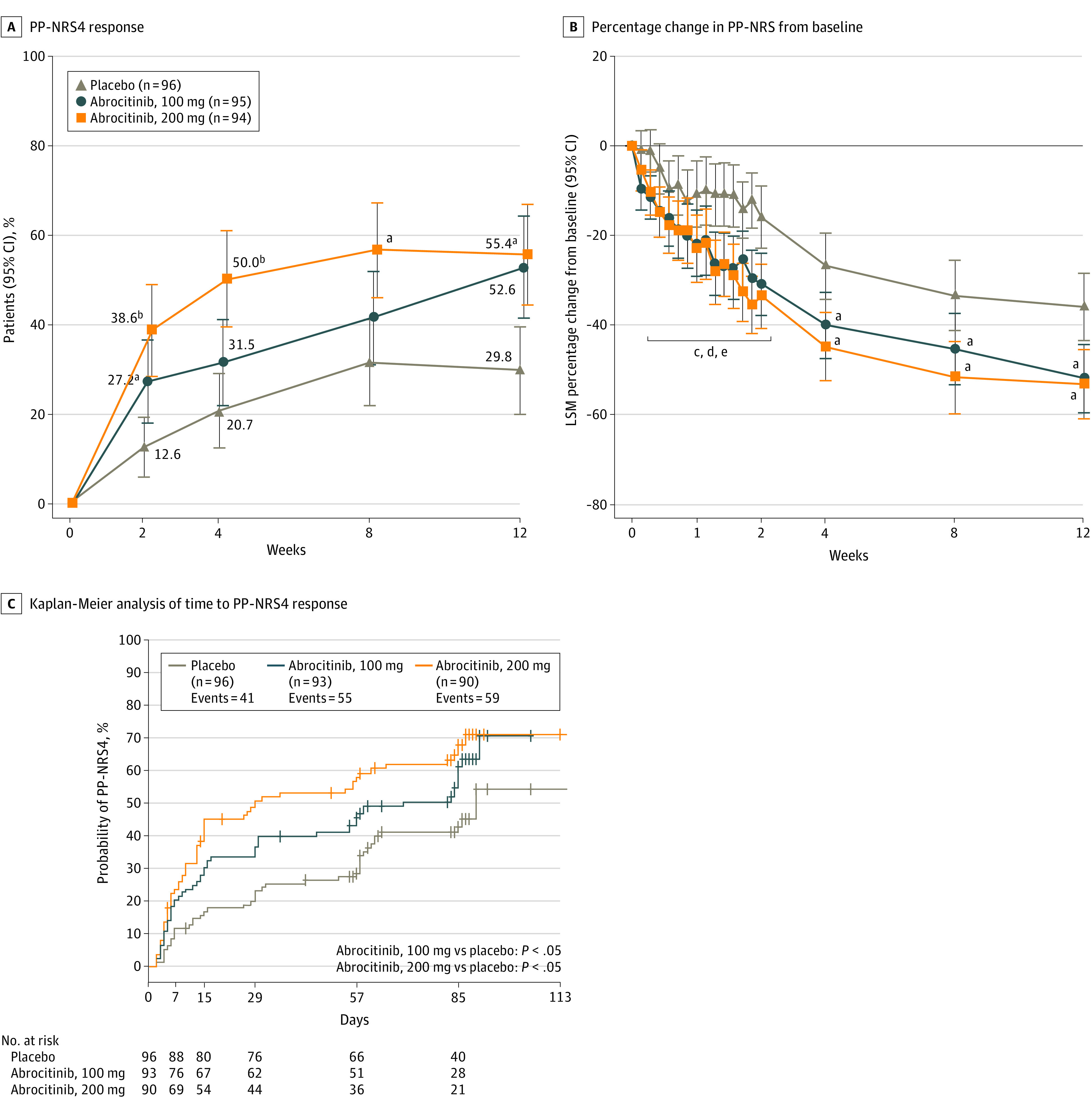
Results: This study included 285 adolescents with moderate-to-severe AD (145 boys [50.9%] and 140 girls [49.1%]), of whom 160 (56.1%) were White and 94 (33.0%) were Asian; the median age was 15 years (interquartile range 13-17 years). Substantially more patients treated with abrocitinib (200 mg or 100 mg) vs placebo achieved an IGA response of 0/1 (46.2%; 41.6% vs 24.5%; P < .05 for both), EASI-75 (72.0%; 68.5% vs 41.5%; P < .05 for both), and PP-NRS4 (55.4%; 52.6% vs 29.8%; P < .01 for 200 mg vs placebo) at week 12. Adverse events were reported for 59 (62.8%), 54 (56.8%), and 50 (52.1%) patients in the 200 mg, 100 mg, and placebo groups, respectively; nausea was more common with abrocitinib, 200 mg (17 [18.1%]) and 100 mg (7 [7.4%]). Herpes-related AEs were infrequent; 1 (1.1%), 0, and 2 (2.1%) patients had serious AEs.

Conclusions and relevance: This randomized clinical trial found that oral abrocitinib combined with topical therapy was significantly more effective than placebo with topical therapy in adolescents with moderate-to-severe AD, with an acceptable safety profile.

Trial registration: ClinicalTrials.gov identifier: NCT03796676.


Conflict of interest statement

Conflict of Interest Disclosures: Dr Eichenfield reported nonfinancial support from AbbVie, Ortho Dermatologics, Regeneron, Forte Equity, Sanofi Genzyme, Pfizer/Anacor, and Verrica Equity and personal fees from Almirall, Arcutis, Asana, Dermavant, Dermira, Forte, Galderma, Ichnos, Incyte, LEO Pharma, Novartis, Otsuka, Pfizer/Anacor, Sanofi Genzyme, Verrica, and Lilly outside the submitted work. Dr Flohr reported grants from the EU BIOMAP consortium, Sanofi, National Institute of Health Research, and British Skin Foundation during the conduct of the study. Dr Sidbury reported nonfinancial support from Regeneron outside the submitted work. Dr Siegfried reported grants from Pfizer and personal fees from Pfizer, Regeneron, Sanofi, and LEO Pharma outside the submitted work. Dr Szalai reported personal fees from Sanofi outside the submitted work. Dr Barbarot reported personal fees from Sanofi Genzyme, LEO Pharma, Lilly, AbbVie, Janssen, Pfizer, UCB Pharma, and Almirall and nonfinancial support from Galderma and Novartis during the conduct of the study. Dr Feeney reported being an employee of Pfizer. Dr Zhang reported being an employee and shareholder of Pfizer during the conduct of the study. Dr DiBonaventura reported personal fees from Pfizer during the conduct of the study. Dr Rojo reported being an employee and shareholder of Pfizer. Dr Valdez reported personal fees and stock options from Pfizer during the conduct of the study and holding a patent for abrocitinib. Dr Chan reported being an employee of Pfizer. No other disclosures were reported.

Figures

Figure 1.
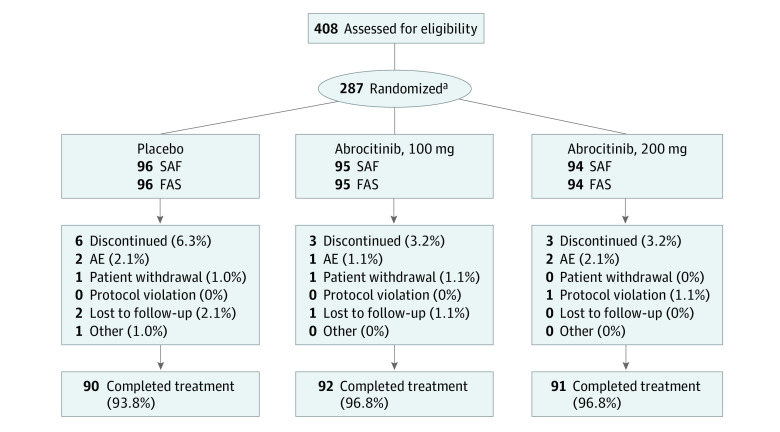
Figure 1.. Patient Disposition in JADE TEEN
AE indicates adverse event; FAS, full analysis set; SAF, safety analysis set. aTwo patients randomly assigned to receive abrocitinib, 200 mg, were not treated and were not included in the analysis sets.
Figure 2.
Figure 2.. Proportion of Patients Who Achieved Investigator’s Global Assessment (IGA) Response and Eczema Area and Severity Index (EASI-75) Response
Error bars represent 95% CIs. Conclusion of statistical significance was controlled for multiplicity at week 12. P values for other comparisons were not controlled for multiplicity. aP < .05 vs placebo. bP < .0001 vs placebo.
Figure 3.
Figure 3.. Peak Pruritus Numerical Rating Scale (PP-NRS) Outcomes
A, Proportion of patients who achieved at least 4-point improvement from baseline in PP-NRS (PP-NRS4). B, Least-squares mean (LSM) percentage change from baseline in PP-NRS scores. C, Kaplan-Meier analysis of time to achieve at least 4-point improvement from baseline in PP-NRS. Error bars in panels A and B represent 95% CIs. Conclusion of statistical significance was controlled for multiplicity at weeks 2, 4, and 12. P values for other comparisons were not controlled for multiplicity. P values shown in panel C are from log-rank tests for median time to response. aP < .05 vs placebo. bP < .001 vs placebo. cP < .05 for abrocitinib, 100 mg, vs placebo at days 3, 4, 6, and 8 to 15. dP < .05 for abrocitinib, 200 mg, vs placebo at days 3, 4, 6, 8 to 12, and 15. eP < .001 for abrocitinib, 200 mg, vs placebo at days 13 and 14.

References

    1. Williams H, Robertson C, Stewart A, et al. . Worldwide variations in the prevalence of symptoms of atopic eczema in the International Study of Asthma and Allergies in Childhood. J Allergy Clin Immunol. 1999;103(1 Pt 1):125-138. doi:10.1016/S0091-6749(99)70536-1 - DOI - PubMed
    1. Weidinger S, Beck LA, Bieber T, Kabashima K, Irvine AD. Atopic dermatitis. Nat Rev Dis Primers. 2018;4(1):1. doi:10.1038/s41572-018-0001-z - DOI - PubMed
    1. Suárez-Fariñas M, Tintle SJ, Shemer A, et al. . Nonlesional atopic dermatitis skin is characterized by broad terminal differentiation defects and variable immune abnormalities. J Allergy Clin Immunol. 2011;127(4):954-64.e1, 4. doi:10.1016/j.jaci.2010.12.1124 - DOI - PMC - PubMed
    1. Boguniewicz M, Fonacier L, Guttman-Yassky E, Ong PY, Silverberg J, Farrar JR. Atopic dermatitis yardstick: practical recommendations for an evolving therapeutic landscape. Ann Allergy Asthma Immunol. 2018;120(1):10-22.e2. doi:10.1016/j.anai.2017.10.039 - DOI - PubMed
    1. Newton L, DeLozier AM, Griffiths PC, et al. . Exploring content and psychometric validity of newly developed assessment tools for itch and skin pain in atopic dermatitis. J Patient Rep Outcomes. 2019;3(1):42. doi:10.1186/s41687-019-0128-z - DOI - PMC - PubMed

Publication types

Associated data