


Lower conversion rate with robotic assisted rectal resections compared with conventional laparoscopy; a national cohort study
- PMID: 34406469
- PMCID: PMC9001201
- DOI: 10.1007/s00464-021-08681-x
Lower conversion rate with robotic assisted rectal resections compared with conventional laparoscopy; a national cohort study
Abstract
Background: Conversion from laparoscopic to open access colorectal surgery is associated with a poorer postoperative outcome. The aim of this study was to assess conversion rates and outcomes after standard laparoscopic rectal resection (LR) and robotic laparoscopic rectal resection (RR).
Methods: A national 5-year cohort study utilizing prospectively recorded data on patients who underwent elective major laparoscopic resection for rectal cancer. Data were retrieved from the Norwegian Registry for Gastrointestinal Surgery and from the Norwegian Colorectal Cancer Registry. Primary end point was conversion rate. Secondary end points were postoperative complications within 30 days and histopathological results. Chi-square test, two-sided T test, and Mann-Whitney U test were used for univariable analyses. Both univariable and multivariable logistic regression analyses were used to analyze the relations between different predictors and outcomes, and propensity score matching was performed to address potential treatment assignment bias.
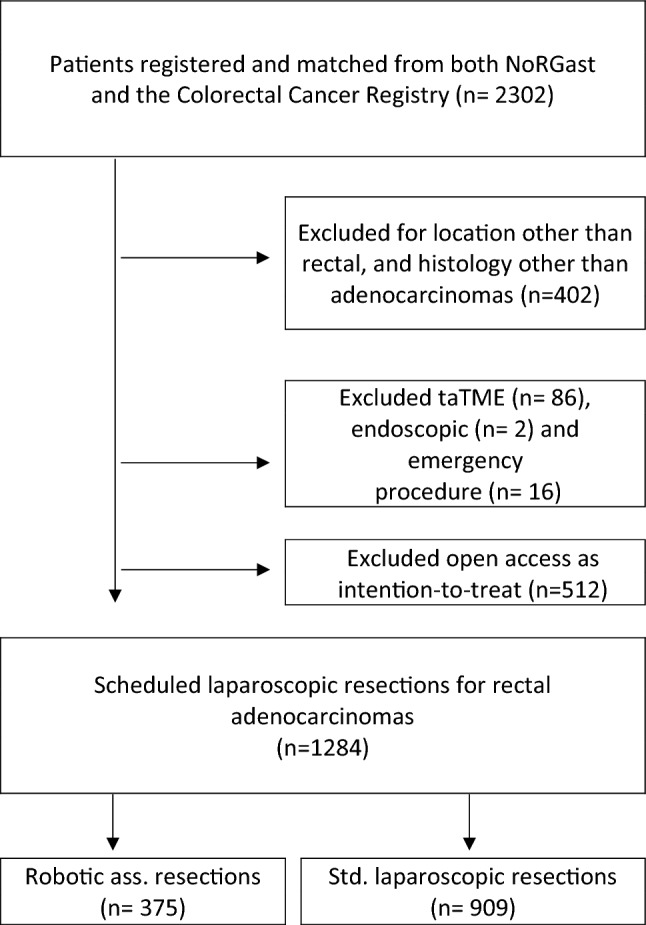
Results: A total of 1284 patients were included, of whom 375 underwent RR and 909 LR. Conversion rate was 8 out of 375 (2.1%) for RR compared with 87 out of 909 (9.6%) for LR (p < 0.001). RR was associated with reduced risk for conversion compared with LR (aOR 0.22, 95% CI 0.10-0.46). There were no other outcome differences between RR and LR. Factors associated with increased risk for conversion were male gender, severe cardiac disease and BMI > 30. Conversion was associated with higher rates of major complications (20 out of 95 (21.2%) vs 135 out of 1189 (11.4%) p = 0.005), reoperations (13 out of 95 (13.7%) vs 93 out of 1189 (7.1%) p = 0.020), and longer hospital stay (median 8 days vs 6 days, p = 0.001).
Conclusion: Conversion rate was lower with robotic assisted rectal resections compared with conventional laparoscopy. Conversions were associated with higher rates of postoperative complications.
Keywords: Complications; Conversion; Laparoscopy; Rectal resection; Robotic.
© 2021. The Author(s).
Conflict of interest statement
Drs Elisabeth Myrseth, Linn Såve Nymo, Petter Fosse Gjessing, Hartwig Kørner, Jan Terje Kvaløy and Stig Norderval have no conflicts of interest or financial ties to disclosure.
References
-
- National Bowel Cancer Audit. Annual report 2020. https://www.nboca.org.uk/content/uploads/2020/12/NBOCA-2020-Annual-Repor...
-
- Nymo LS, Norderval S, Eriksen MT, Wasmuth HH, Kørner H, Bjørnbeth BA, et al. Short-term outcomes after elective colon cancer surgery: an observational study from the Norwegian registry for gastrointestinal and HPB surgery, NoRGast. Surg Endosc. 2019;33:2821–2833. doi: 10.1007/s00464-018-6575-4. - DOI - PubMed
-
- Ehrlich A, Kellokumpu S, Wagner B, Kautiainen H, Kellokumpu I. Comparison of laparoscopic and open colonic resection within fast-track and traditional perioperative care pathways: clinical outcomes and in-hospital costs. Scand J Surg. 2015;10(104):211–218. doi: 10.1177/1457496914557016. - DOI - PubMed
Publication types
MeSH terms
LinkOut - more resources
Full Text Sources
