Case Reports
. 2021 Nov;36(11):3789-3793.
doi: 10.1007/s00467-021-05212-7. Epub 2021 Aug 18.

Kidney involvement and histological findings in two pediatric COVID-19 patients

Affiliations
Case Reports

Kidney involvement and histological findings in two pediatric COVID-19 patients

Jessica Serafinelli et al. Pediatr Nephrol. 2021 Nov.

Abstract

Background: Histological findings of kidney involvement have been rarely reported in pediatric patients with SARS-CoV-2 infection. Here, we describe clinical, laboratory, and histological findings of two pediatric cases with almost exclusive kidney involvement by SARS-CoV-2.

Results: A 10-year-old girl with IgA vasculitis nephritis underwent kidney biopsy, showing diffuse and segmental mesangial-proliferative glomerulonephritis, and steroid therapy was initiated. After the worsening of the clinical picture, including an atypical skin rash, she was diagnosed with SARS-CoV-2. The re-evaluation of initial biopsy showed cytoplasmatic blebs and virus-like particles in tubular cells at electron microscopy. Despite SARS-CoV-2 clearance and the intensification of immunosuppression, no improvement was observed. A second kidney biopsy showed a crescentic glomerulonephritis with sclerosis, while virus-like particles were no longer evident. The second patient was a 12-year-old girl with a 3-week history of weakness and weight loss. Rhinitis was reported the month before. No medications were being taken. Blood and urine analysis revealed elevated serum creatinine, hypouricemia, low molecular weight proteinuria, and glycosuria. A high SARS-CoV-2-IgG titre was detected. Kidney biopsy showed acute tubular-interstitial nephritis. Steroid therapy was started with a complete resolution of kidney involvement.

Conclusion: We can speculate that in both cases SARS-CoV-2 played a major role as inflammatory trigger of the kidney damage. Therefore, we suggest investigating the potential kidney damage by SARS-CoV-2 in children. Moreover, SARS-CoV-2 can be included among infectious agents responsible for pediatric acute tubular interstitial nephritis.

Keywords: Children; Glomerulonephritis; Kidney biopsy; SARS-CoV-2; Tubular damage.


Conflict of interest statement

The authors declare no competing interests.

Figures
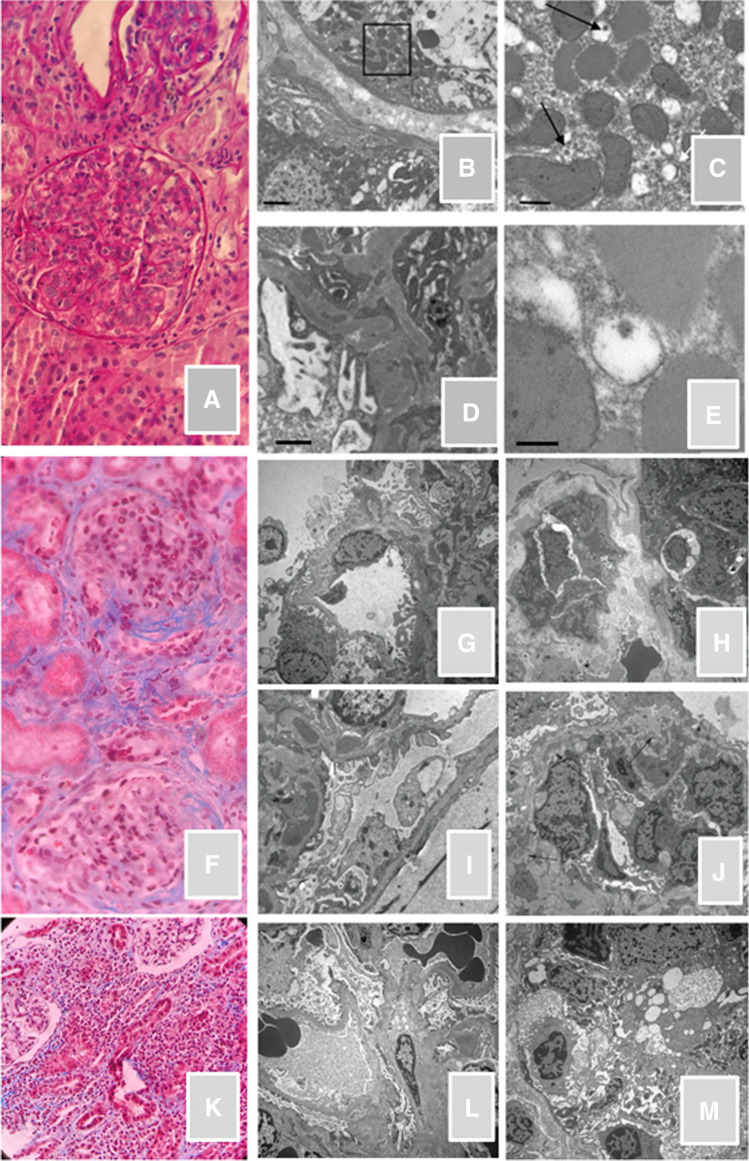
Fig. 1
Fig. 1
A, B, C, D, E Histological finding of first biopsy in patient 1. A (light microscopy): diffuse and segmental mesangial proliferation with endocapillary proliferation without crescents or sclerosis (periodic acid Schiff stain). Electron microscopy: a tubular cell (B) contains rare intra-vacuolar virus-like particles (detail C, arrows) of about 80–90 nm in diameter, with rare preserved spikes (E), structure, and location suggestive of coronavirus infection. The cell also contains isolated vesicles delimited by a double membrane, similar to the viral replicative organelle DMV involved in viral-RNA replication, described in RNA-positive virus included SARS-CoV2. OM (original magnification): B × 4400, C × 20,000, D × 85,000. Bar: B 2micron, C 500 nm, D 200 nm. C Glomerular fine granular electron dense deposits, with mesangial and sub-endothelial localization. F, G, H, I, J Histological finding of second kidney biopsy in patient 1. Light microscopy: evidence of global mesangial proliferation with fibrocellular crescent in 30% of glomeruli (of the 33 glomeruli, fibrocellular crescents were present in 9, and fibrotic crescents in 6, of which 2 have complete floccular sclerosis), diffuse segmental glomerular sclerosis, and initial membranoproliferative pattern in association with interstitial fibrosis, suggestive of a worsening of kidney activity and an appearance of signs of chronic nephropathy. Trichrome stain (F). Electron microscopy: increase in the sclerotic component of matrix (G), widespread presence of finely granular electron dense deposits (H, I, J); presence of segmental GBM deposits mainly intramembrane, sometimes sub-endothelial and occasionally sub-epithelial (I). Lamellation and reticulation of the lamina densa (I). Features of reabsorption of immune deposits (H, I). Focal images of deposits associated with mesangial interpositions (membranoproliferative pattern) (G, J). Podocytes: alterations secondary to lesions of the basement membrane. Segmental monocytes and rare granulocytes sometimes with occlusion of the capillary lumen, sometimes associated with intraluminal fibrin aggregates (I, J). Widespread loss of fenestrations of the endothelial cells (I). No virus-like particles were evident. K, L, M Histological features of kidney biopsy in patient 2. Light microscopy: marked neutrophilic, and lympho-plasmacellular invasion of the interstitium with multi-focal tubular acute damage suggestive of tubulitis. Trichrome stain (K). Electron microscopy: mild secondary sclerotic-ischemic changes of the mesangial matrix associated with mild thickening of GBM and podocytes effacement (L, M). No images suggestive of immune deposits or virus-like particles were observed

References

    1. Hoang A, Chorath K, Moreira A, Evans M, Burmeister-Morton F, Burmeister F, Naqvi R, Petershack M, Moreira A. COVID-19 in 7780 pediatric patients: a systematic review. E Clinical Medicine. 2020;24:100433. doi: 10.1016/j.eclinm.2020.100433. - DOI - PMC - PubMed
    1. Nicastro E, Verdoni L, Bettini LR, Zuin G, Balduzzi A, Montini G, Biondi A, D’Antiga L. COVID-19 in immunosuppressed children. Front Pediatr. 2021;9:629240. doi: 10.3389/fped.2021.629240. - DOI - PMC - PubMed
    1. Melgosa M, Madrid A, Alvárez O, Lumbreras J, Nieto F, Parada E, Perez-Beltrán V, Association SPN. SARS-CoV-2 infection in Spanish children with chronic kidney pathologies. Pediatr Nephrol. 2020;35:1521–1524. doi: 10.1007/s00467-020-04597-1. - DOI - PMC - PubMed
    1. Mastrangelo A, Morello W, Vidal E, Guzzo I, Petruzzelli LA, et al. Impact of COVID-19 pandemic in children with CKD or immunosuppression. Clin J Am Soc Nephrol. 2020;16:449–451. doi: 10.2215/CJN.13120820. - DOI - PMC - PubMed
    1. Morello W, Mastrangelo A, Guzzo I, Cusinato L, Petruzzelli LA, et al. Prevalence of SARS-CoV-2 IgG antibodies in children with CKD or immunosuppression. Clin J Am Soc Nephrol. 2021 doi: 10.2215/CJN.00330121. - DOI - PMC - PubMed

Publication types

MeSH terms

Supplementary concepts
