


Diagnostic Value of 16S Ribosomal RNA Gene Polymerase Chain Reaction/Sanger Sequencing in Clinical Practice
- PMID: 34407178
- PMCID: PMC8442790
- DOI: 10.1093/cid/ciab167
Diagnostic Value of 16S Ribosomal RNA Gene Polymerase Chain Reaction/Sanger Sequencing in Clinical Practice
Abstract
Background: Accurate microbiologic diagnosis is important for appropriate management of infectious diseases. Sequencing-based molecular diagnostics are increasingly used for precision diagnosis of infections. However, their clinical utility is unclear.
Methods: We conducted a retrospective analysis of specimens that underwent 16S ribosomal RNA (rRNA) gene polymerase chain reaction (PCR) followed by Sanger sequencing at our institution from April 2017 through March 2019.
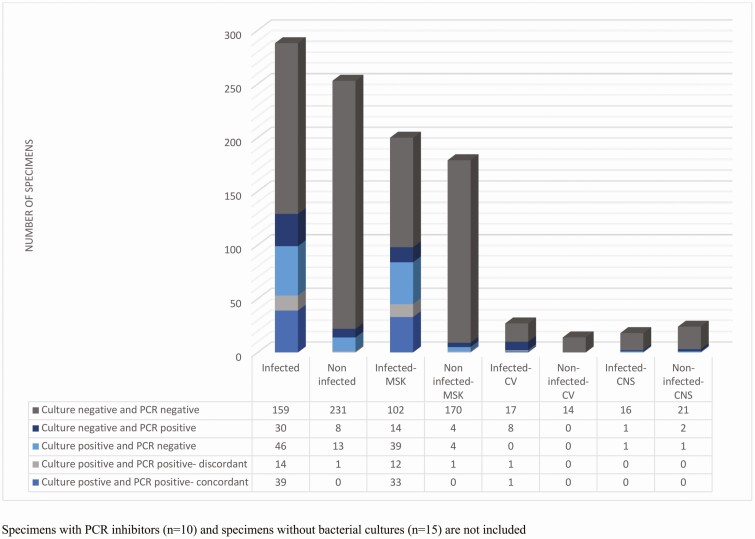
Results: A total of 566 specimens obtained from 460 patients were studied. Patients were considered clinically infected or noninfected based on final diagnosis and management. In 17% of patients, 16S rRNA PCR/sequencing was positive and in 5% of patients, this test led to an impact on clinical care. In comparison, bacterial cultures were positive in 21% of patients. Specimens with a positive Gram stain had 12 times greater odds of having a positive molecular result than those with a negative Gram stain (95% confidence interval for odds ratio, 5.2-31.4). Overall, PCR positivity was higher in cardiovascular specimens (37%) obtained from clinically infected patients, with bacterial cultures being more likely to be positive for musculoskeletal specimens (P < .001). 16S rRNA PCR/sequencing identified a probable pathogen in 10% culture-negative specimens.
Conclusion: 16S rRNA PCR/sequencing can play a role in the diagnostic evaluation of patients with culture-negative infections, especially those with cardiovascular infections.
Keywords: 16S rRNA gene PCR; Sanger sequencing; bacterial infections; broad range bacterial PCR; molecular diagnostics.
© The Author(s) 2021. Published by Oxford University Press for the Infectious Diseases Society of America. All rights reserved. For permissions, e-mail: journals.permissions@oup.com.
Figures
References
-
- Harbarth S, Nobre V, Pittet D. Does antibiotic selection impact patient outcome? Clin Infect Dis 2007; 44:87–93. - PubMed
-
- Fournier PE, Thuny F, Richet H, et al. Comprehensive diagnostic strategy for blood culture-negative endocarditis: a prospective study of 819 new cases. Clin Infect Dis 2010; 51:131–40. - PubMed
Publication types
MeSH terms
Substances
Grants and funding
LinkOut - more resources
Full Text Sources
Medical
Miscellaneous
