. 2021 Aug 18;7(34):eabg9045.
doi: 10.1126/sciadv.abg9045. Print 2021 Aug.

A neural substrate of compulsive alcohol use

Affiliations

A neural substrate of compulsive alcohol use

Esi Domi et al. Sci Adv. .

Abstract

Alcohol intake remains controlled in a majority of users but becomes "compulsive," i.e., continues despite adverse consequences, in a minority who develop alcohol addiction. Here, using a footshock-punished alcohol self-administration procedure, we screened a large population of outbred rats to identify those showing compulsivity operationalized as punishment-resistant self-administration. Using unsupervised clustering, we found that this behavior emerged as a stable trait in a subpopulation of rats and was associated with activity of a brain network that included central nucleus of the amygdala (CeA). Activity of PKCδ+ inhibitory neurons in the lateral subdivision of CeA (CeL) accounted for ~75% of variance in punishment-resistant alcohol taking. Activity-dependent tagging, followed by chemogenetic inhibition of neurons activated during punishment-resistant self-administration, suppressed alcohol taking, as did a virally mediated shRNA knockdown of PKCδ in CeA. These findings identify a previously unknown mechanism for a core element of alcohol addiction and point to a novel candidate therapeutic target.


Figures

Fig. 1
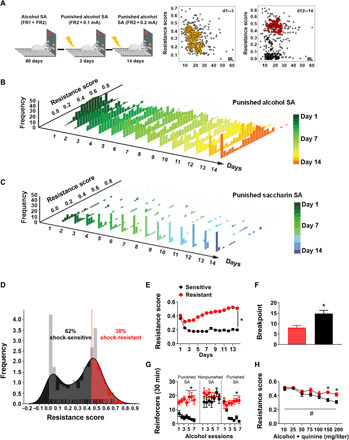
Fig. 1. Punishment-resistant alcohol self-administration emerges in a minority of outbred rats.
(A and B) Schematic representation of the footshock punishment procedure and resistance score distribution of punished alcohol self-administration in the total cohort of outbred rats screened (n = 301) over 14 days (color-coded). Insets show individual distribution for days 1 to 3 and 12 to 14 of punished alcohol self-administration. (C) Resistance score distribution of punished saccharin self-administration across 14 days (color-coded). (D) Bimodal distribution of the population of punished alcohol self-administration; 38% (n = 114) of rats were punishment resistant, while 62% (187) were punishment sensitive. (E) Mean resistance score (±SEM) during a 30-min punished self-administration session of 20% EtOH (FR2). *P < 0.001. (F) Mean break points (±SEM) reached during a progressive ratio session of 20% alcohol in punishment-resistant (n = 10) and punishment-sensitive (n = 9) rats. *P < 0.01. (G) Mean reinforcers (±SEM) earned during a 30-min self-administration session of punished 20% EtOH (FR2) and unpunished alcohol self-administration in punishment-resistant (n = 7) and punishment-sensitive (n = 9) rats. Punishment-resistant rats obtained a significantly higher number of punished alcohol reinforcers during the last 3 days of baseline punished self-administration (left, *P < 0.01) and when footshock punishment was reintroduced. *P < 0.001. (H) Aversion-resistant alcohol drinking in punishment-resistant (n = 7) and punishment-sensitive rats (n = 9), shown by resistance to quinine adulteration of the alcohol solution (resistance score ± SEM for quinine-adulterated alcohol drinking, #P < 0.001, *P < 0.05). SA, self-administration; FR, fixed ratio; d, day; BL, baseline.
Fig. 2
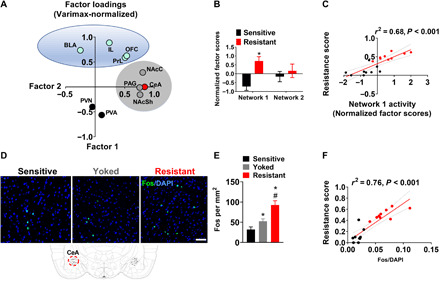
Fig. 2. A brain network associated with punishment resistance.
(A) Factor analysis using principal component extraction followed by varimax normalized rotation of Fos immunoreactivity data identified two networks that showed highly correlated within-network activity. Network 1 consisted of CeA, PAG, NAcC, and NAcSh; network 2 consisted of OFC, PrL, IL, and BLA. (B and C) Activity of network 1, but not network 2, was increased in punishment-resistant rats (*P < 0.001) and correlated with punishment-resistant self-administration. (D) Representative images of Fos immunohistochemistry in CeA in shock-resistant and shock-sensitive rats. Scale bar, 50 μm. (E) Mean number of Fos-immunoreactive neurons/mm2 (±SEM) in shock-resistant (n = 9), shock-sensitive (n = 9), and yoked rats (n = 8). *P < 0.001 versus the punishment-sensitive group; #P < 0.001 versus the yoked group. (F) Activity of CeA was particularly highly correlated with the resistance score. CeA, central nucleus of amygdala; PAG, periaqueductal gray; NAcC, nucleus accumbens core; NAcSh, NAc shell; OFC, orbitofrontal cortex; PrL, prelimbic cortex; IL, infralimbic cortex; BLA, basolateral amygdala.
Fig. 3
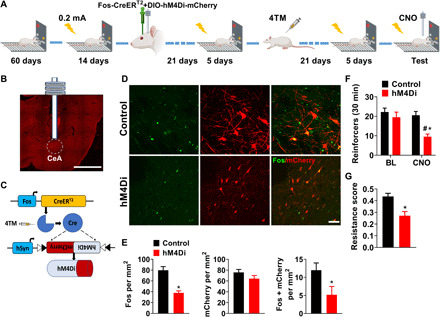
Fig. 3. Activity of CeA ensembles is necessary for punishment-resistant self-administration.
(A) Schematic overview of the experimental design. (B) Virus injection site and cannula placement (scale bar, 2 mm). (C) Schematic representation of the TRAP approach. (D and E) Representative images of CeA photomicrographs showing Fos immunoreactivity (green) and mCherry colabeling in control (n = 8) and hM4Di (n = 9). Scale bar, 50 μm. Mean number of Fos-immunoreactive neurons (±SEM), mean number of mCherry immunoreactive neurons (±SEM), and mean number of Fos+ mCherry-immunoreactive double-labeled neurons/mm2. *P < 0.001, *P < 0.05. (F) Mean number of alcohol-reinforced lever presses (±SEM) during the 30-min test in control (n = 11) and hM4Di (n = 12) punishment-resistant CNO injected rats. *P < 0.001, #P < 0.01. (G) Mean resistance score (±SEM). *P < 0.01. BL, baseline; 4TM, 4-hydroxytamoxifen; CNO, clozapine N-oxide.
Fig. 4
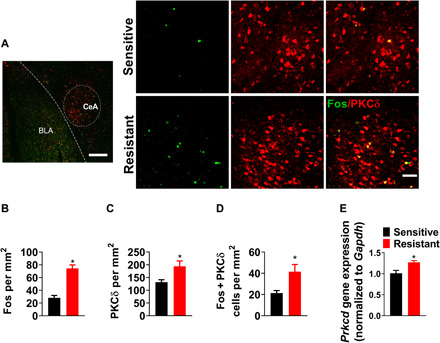
Fig. 4. Punishment resistance is driven by activity of PKCδ+ inhibitory neurons in CeA.
(A) Representative images of CeA photomicrographs showing Fos (green) and PKCδ (red) immunoreactivity colabeling [scale bars, 200 μm (left) and 50 μm (right)] in punishment-resistant (n = 10) and punishment-sensitive (n = 9) rats. (B to D) Mean number of cells (±SEM) positive for Fos, PKCδ, and double-labeled cells/mm2. *P < 0.001, *P < 0.05, *P < 0.01. (E) Mean fold change in Prkcd mRNA levels in punishment-resistant (n = 8) and punishment-sensitive (n = 6) rats, measured by qPCR. *P < 0.01.
Fig. 5
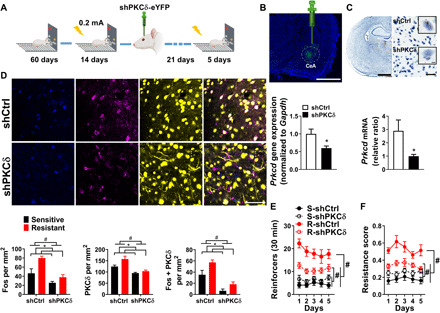
Fig. 5. A mechanistic role of CeA-PKCδ in punishment-resistant alcohol self-administration.
(A) Experimental design. (B) Virus injection site (scale bar, 2 mm) and mean fold change in Prkcd mRNA levels following a viral-mediated knockdown (n = 8 per group). *P < 0.05. (C) Expression of Prkcd in the CeA measured by RNAscope. Brown dots represent the expression of Prkcd [scale bars, 2 mm (left), 50 μm (right), and 5 μm (inset)] (n = 8 per group). *P < 0.05. (D) Representative images of CeA photomicrographs (scale bar, 50 μm) showing Fos (blue), PKCδ (magenta) immunoreactivity, and yellow fluorescent protein (YFP) colabeling. Mean number of cells positive (±SEM) for Fos, PKCδ, and double-labeled cells in punishment-resistant (n = 6 per group) and punishment-sensitive (n = 5 per group) rats/mm2. #P < 0.001, *P < 0.001, *P < 0.05, *P < 0.01. (E) Mean number of alcohol-reinforced lever presses (±SEM) during the 30-min punishment session control in punishment-resistant (n = 19) and punishment-sensitive rats (n = 19) receiving shCtrl, or shRNA knockdown of PKCδ (n = 18; n = 19). #P < 0.001. (F) Mean resistance score (±SEM). #P < 0.001.

References

    1. Carvalho A. F., Heilig M., Perez A., Probst C., Rehm J., Alcohol use disorders. Lancet 394, 781–792 (2019). - PubMed
    1. Venniro M., Banks M. L., Heilig M., Epstein D. H., Shaham Y., Improving translation of animal models of addiction and relapse by reverse translation. Nat. Rev. Neurosci. 21, 625–643 (2020). - PubMed
    1. J. C. Anthony, Epidemiology of drug dependence, in Neuropsychopharmacology: The Fifth Generation of Progress, K. L. Davis, D. Charney, J. T. Coyle, C. Nemeroff, Eds. (Lippincott Williams and Wilkins, 2002), chap. 109, pp. 1557–1573.
    1. Deroche-Gamonet V., Belin D., Piazza P. V., Evidence for addiction-like behavior in the rat. Science 305, 1014–1017 (2004). - PubMed
    1. Augier E., Barbier E., Dulman R. S., Licheri V., Augier G., Domi E., Barchiesi R., Farris S., Nätt D., Mayfield R. D., Adermark L., Heilig M., A molecular mechanism for choosing alcohol over an alternative reward. Science 360, 1321–1326 (2018). - PubMed