Review
. 2022 Jan;47(1):72-89.
doi: 10.1038/s41386-021-01132-0. Epub 2021 Aug 18.

The role of prefrontal cortex in cognitive control and executive function

Affiliations
Review

The role of prefrontal cortex in cognitive control and executive function

Naomi P Friedman et al. Neuropsychopharmacology. 2022 Jan.

Abstract

Concepts of cognitive control (CC) and executive function (EF) are defined in terms of their relationships with goal-directed behavior versus habits and controlled versus automatic processing, and related to the functions of the prefrontal cortex (PFC) and related regions and networks. A psychometric approach shows unity and diversity in CC constructs, with 3 components in the most commonly studied constructs: general or common CC and components specific to mental set shifting and working memory updating. These constructs are considered against the cellular and systems neurobiology of PFC and what is known of its functional neuroanatomical or network organization based on lesioning, neurochemical, and neuroimaging approaches across species. CC is also considered in the context of motivation, as "cool" and "hot" forms. Its Common CC component is shown to be distinct from general intelligence (g) and closely related to response inhibition. Impairments in CC are considered as possible causes of psychiatric symptoms and consequences of disorders. The relationships of CC with the general factor of psychopathology (p) and dimensional constructs such as impulsivity in large scale developmental and adult populations are considered, as well as implications for genetic studies and RDoC approaches to psychiatric classification.


Conflict of interest statement

The author declares no competing interests.

Figures
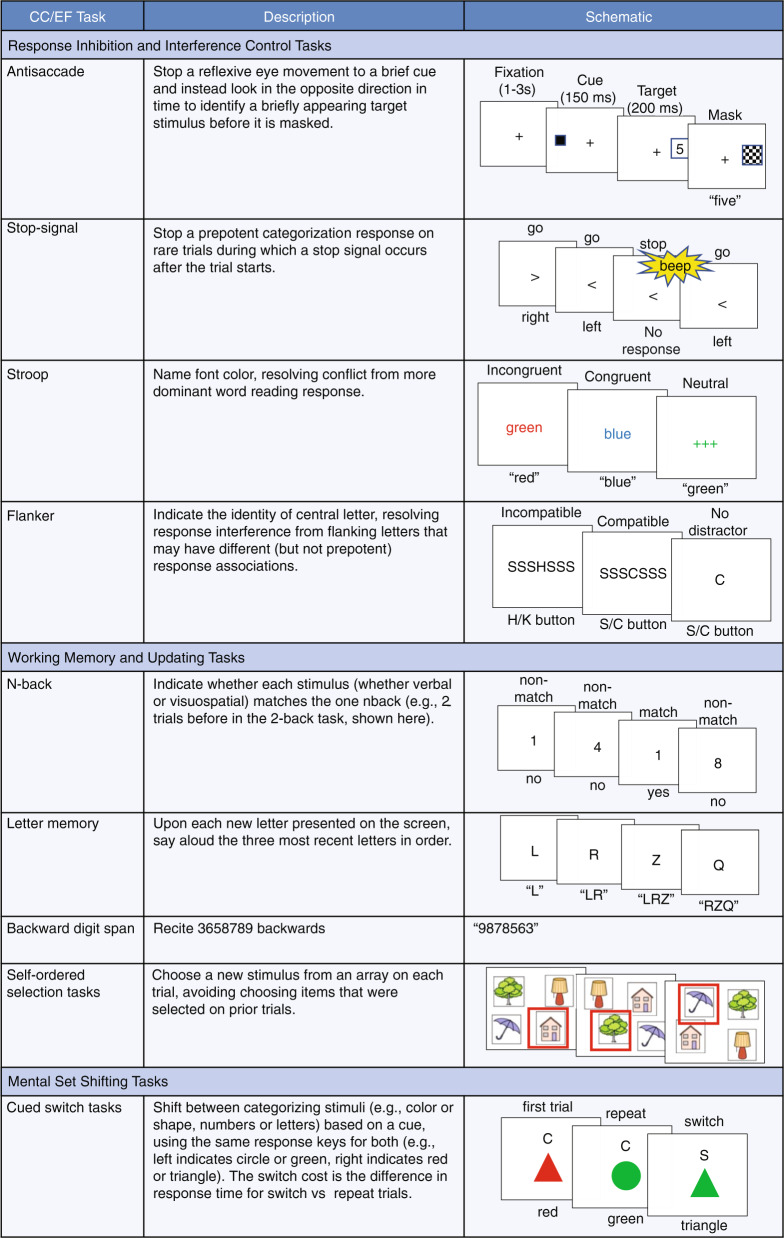
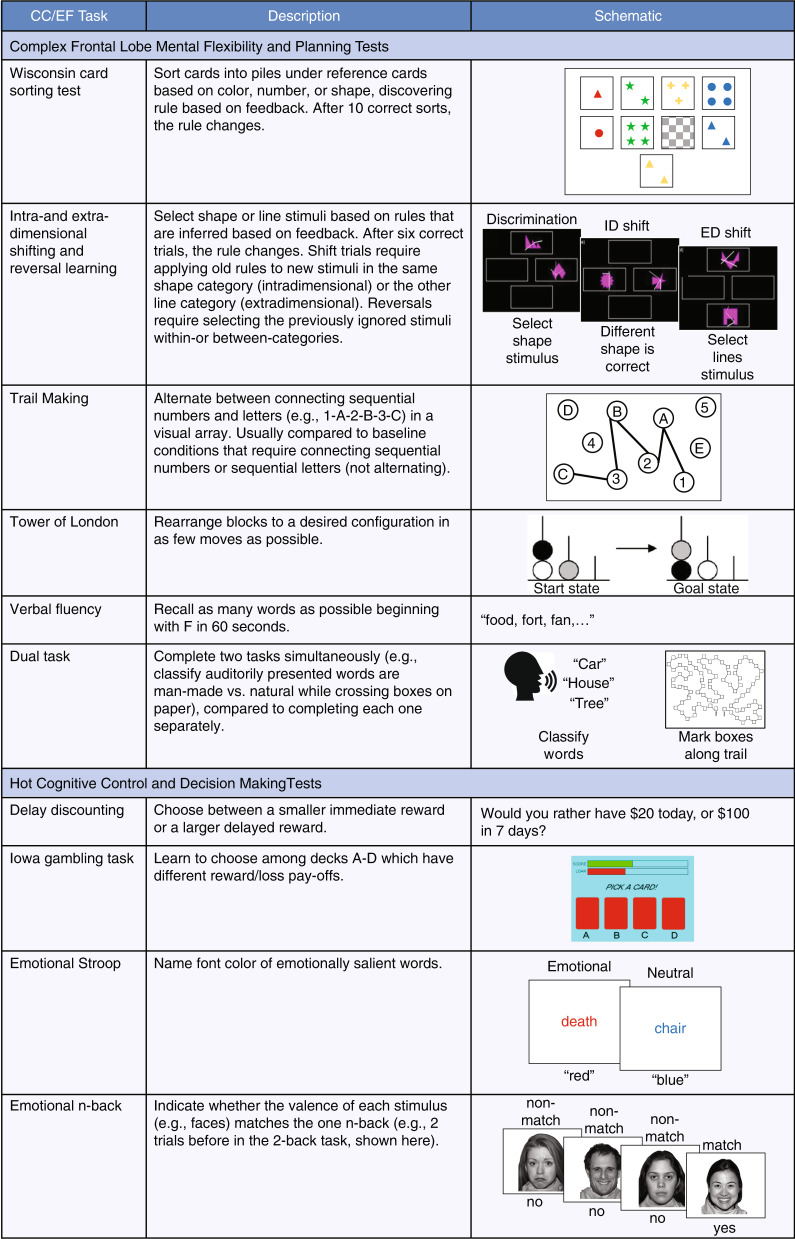
Fig. 1
Fig. 1. Commonly used cognitive control (CC)/executive function (EF) tasks.
When relevant, text above each schematic indicates different conditions, and text below indicates correct responses. The faces included in the emotional n-back illustration are taken from the NimStim set of models who have granted permission to publish their images in scientific journals [246].
Fig. 1
Fig. 1. Commonly used cognitive control (CC)/executive function (EF) tasks.
When relevant, text above each schematic indicates different conditions, and text below indicates correct responses. The faces included in the emotional n-back illustration are taken from the NimStim set of models who have granted permission to publish their images in scientific journals [246].
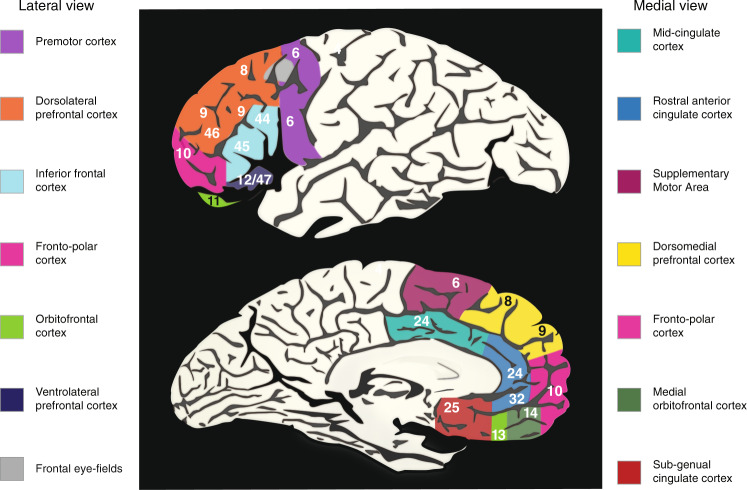
Fig. 2
Fig. 2. Major areas of the prefrontal cortex.
The top panel depicts a lateral view, and the bottom panel depicts a medial view. Numbers indicate Brodmann Areas (BA). Note that the commonly described “ventromedial prefrontal cortex” potentially subsumes several BAs: 25, 32, 14, and possibly 11 and 13.
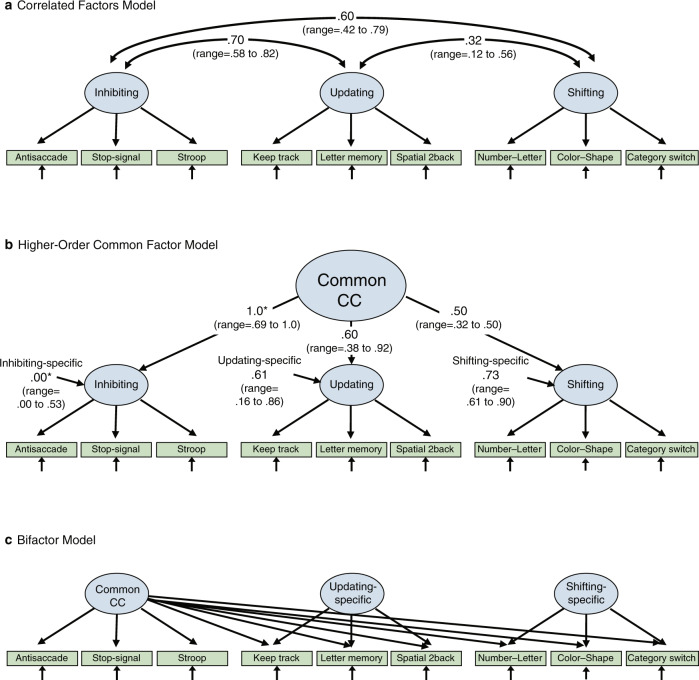
Fig. 3
Fig. 3. Latent factor models of cognitive control (CC).
Proposed CC functions are represented as latent variables (depicted with ellipses) that predict variation in performance on specific tasks (rectangles) chosen to measure those abilities. Factor loadings are depicted with single-headed arrows between the factors and nine measured tasks. The short arrows indicate residual variances, the unique variance in each task that is unrelated to the CC factors, attributable to measurement error as well as reliable task-specific variation. a In a correlated factors model, tasks are predicted by CC factors that are allowed to be correlated, and unity and diversity are represented in the correlations between factors (represented with curved double-headed arrows). The numbers shown are the average correlations and the range of correlations from six studies using a similar battery (Ns = 137–786). b A higher-order “Common” CC factor can also be used to model the correlations among the factors [39, 158]. This higher-order factor predicts the lower-order factors, and they correlate to the extent to which they are jointly predicted by the common factor. In such models, the diversity is captured by the residuals of these factors after the variance due to the common factor is removed (inhibiting-specific, updating-specific, and shifting-specific variances). The numbers shown indicate the average and range of factor loadings for the Common CC factor, and the corresponding averages and ranges for the residual variances for inhibiting, updating, and shifting factors (i.e., the variance not explained by the common factor), derived from the correlations in panel a. *indicates the standardized loadings were bound at 1, and the residual variances bound at zero. c Alternative model structures (called nested factors models or bifactor models) can be used to capture unity and diversity factors more directly. In these models, all tasks load on a common factor, but also load on orthogonal specific factors. These models thus partition each factor into variance that is common across all tasks and variance that is unique to tasks assessing particular processes. Although these alternative parameterizations typically do not result in appreciably different fits to the data, they can make it more convenient to examine relationships to other constructs of interest: Because the unity and diversity components are represented with orthogonal latent variables rather than in the correlations between factors or with residual variances, it is straightforward to discern whether a construct is related to the unity vs. diversity components.

References

    1. Snyder HR, Miyake A, Hankin BL. Advancing understanding of executive function impairments and psychopathology: bridging the gap between clinical and cognitive approaches. Front Psychol. 2015;6:328. - PMC - PubMed
    1. McTeague LM, Goodkind MS, Etkin A. Transdiagnostic impairment of cognitive control in mental illness. J Psychiatr Res. 2016;83:37–46. - PMC - PubMed
    1. Sha Z, Wager TD, Mechelli A, He Y. Common dysfunction of large-scale neurocognitive networks across psychiatric disorders. Biol Psychiatry. 2019;85:379–88. - PubMed
    1. Menon V. Large-scale brain networks and psychopathology: a unifying triple network model. Trends Cogn Sci. 2011;15:483–506. - PubMed
    1. Cohen JD. Cognitive control: core constructs and current considerations. In: Egner T, editor. The Wiley handbook of cognitive control, Chichester, West Sussex, UK: John Wiley & Sons Ltd.; 2017. p. 3–28.

Publication types