. 2021 Jul 7;3(1):vdab097.
doi: 10.1093/noajnl/vdab097. eCollection 2021 Jan-Dec.

Clinical and molecular analysis of smoothened inhibitors in Sonic Hedgehog medulloblastoma

Affiliations

Clinical and molecular analysis of smoothened inhibitors in Sonic Hedgehog medulloblastoma

Victor Pereira et al. Neurooncol Adv. .

Abstract

Background: Smoothened inhibitors (SMOi) have shown activity in Sonic Hedgehog (SHH) medulloblastoma, however this therapeutic class was not developed in children due to severe effects reported on growth. We hereby report long-term follow-up of young patients treated with SMOi for recurrent medulloblastoma.

Methods: Clinical data on response and toxicity from patients treated with vismodegib or sonidegib from 2011 to 2019 for a SHH medulloblastoma were retrospectively reviewed. Methylation analysis and whole exome sequencing were performed whenever possible.

Results: All patients with a somatic PTCH1 mutation responded to SMOi (6/8), including 2 prolonged complete responses. One patient was free of disease 8.2 years after treatment. SMOi was challenged again for 3 patients. Two of them had a response, one with SMOi alone, the other one in combination with temozolomide despite previous progression under monotherapy. SMO resistance mutations were found in patients from biopsy at relapse. Combination with temozolomide or surgery plus radiotherapy was associated with very long disease control in 2 patients. The most severe adverse events were myalgia and growth plate fusion with metaphyseal sclerosis. Normal growth velocity was recovered for 1 patient although her final height was below estimated target height.

Conclusions: Targeting SMO in mutated PTCH1 is an interesting strategy for long-term responses. Combination of SMOi with chemotherapy or surgery and local radiotherapy is an appealing strategy to prevent early resistance and diminish SMOi exposure, especially in young patients. Inhibition of SHH pathway causes growth and development impairment but partial recovery of the growth velocity is possible.

Keywords: Sonic Hedgehog; growth plate fusion; medulloblastoma; smoothened inhibitor.


Figures

Figure 1.
Figure 1.
Patients’ treatment and molecular alteration. Swimmer plot representing patients’ outcome starting at the beginning of the first SMOi treatment (a). Patients are segregated by SHH activation downstream SMO, above the dotted line, or SHH activation upstream SMO, below the dotted line. The first column described initial SHH pathway molecular alteration based on CGH, methylome analysis, and/or sequencing. Event, including responses, progressive disease, discontinuation, or death are represented on the patient line as well as other relevant treatment targeting SHH pathway or resistance. For patients who underwent a new biopsy at progression, SMO mutation are reported with their allelic fraction in the tumor biopsy. Unsupervised clustering of methylation pattern according to medulloblastoma subgroups using UMAP showed that the 4 patients were clustering with the previously published SHH medulloblastoma (b). SHH subgroups affiliations between infant (INF) or child and adolescent (CHL AD) of patients tumors were consistent with age at diagnosis. Patient #6 was 13 years old while the remaining 3 patients were of 4 years old or below at diagnosis (c). copy number profils infered from methylation array showing recurrent copy number alteration in SHH medulloblastoma. SHH, Sonic Hedgehog; SMOi, smoothened inhibitor.
Figure 2.
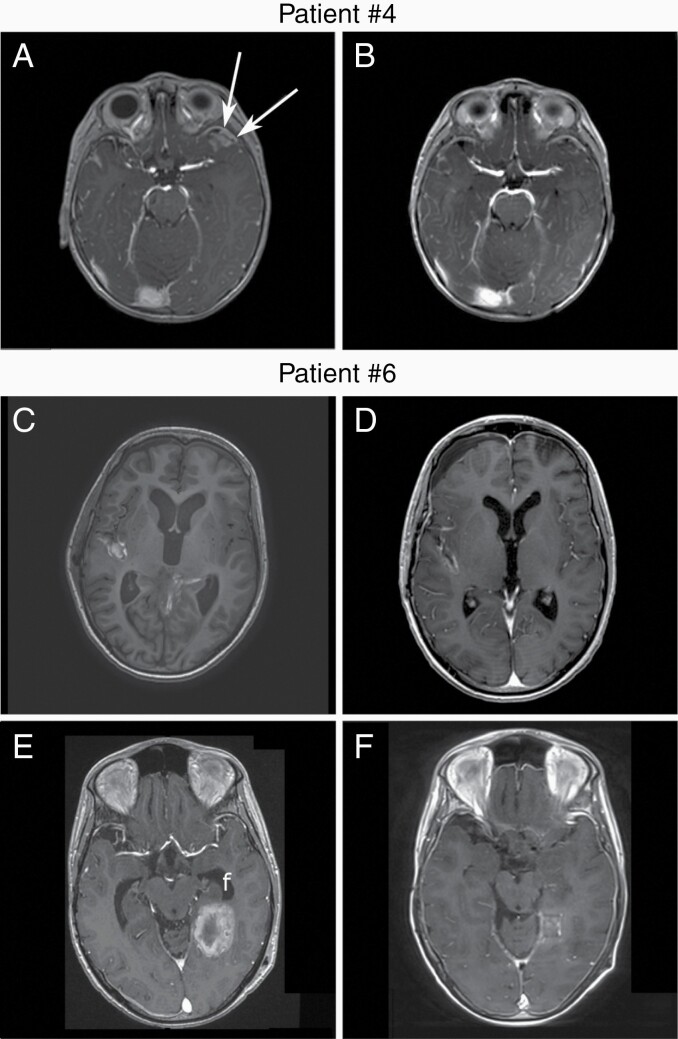
Figure 2.
SMOi response evaluation by MRI T1 with contrast enhancement. Patient #4 baseline MRI before SMOi initiation. Contrast enhancement of a relapse in the temporal lobe (a) showing a very good partial response after 8 weeks of sonidegib (b). Patient #6 baseline MRI before SMOi initiation showing a metastatic relapse in the Silvius fissure (c). Partial response was achieved after 2 months of vismodegib (d). A Dramatic relapse occurred while treated by sonidegib, with new metastasis in the temporal lobe (e). Partial response was achieved gain 4 months later with a combination of sonidegib and temozolomide (f). Importantly, the patient had previously received temozolomide. MRI, magnetic resonance imaging; SMOi, smoothened inhibitor.
Figure 3.
Figure 3.
Patient #8 growth outcome. Patient #8’s Greulich and Pyle bone age (A) and knee X-rays (B) showing central epiphyseal fusion between sonidegib treatment baseline and 1 year after (D and E). Flattening of growth chart (C) from +0.5 SD to −1 SD during sonidegib treatment. After treatment withdrawal, growth velocity improved without recovering a normal growth.
Figure 4.
Figure 4.
Patient #7 growth outcome. Patient #7’s Greulich and Pyle bone age (A) and knee X-rays (B) showing growth plate fusion between sonidegib treatment baseline and 1 year after with metaphyseal sclerosis (D and E). Flattening of growth chart (C) at sonidegib initiation with poor growth velocity at discontinuation. Her final height was 3 standard deviation below mid parent target height. To note, this patient had an ovarian dysfunction as a consequence of a high-dose chemotherapy that could impact her puberty.

References

    1. Khatua S, Song A, Citla Sridhar D, Mack SC. Childhood medulloblastoma: current therapies, emerging molecular landscape and newer therapeutic insights. Curr Neuropharmacol. 2018;16(7):1045–1058. - PMC - PubMed
    1. Northcott PA, Robinson GW, Kratz CP, et al. Medulloblastoma. Nat Rev Dis Primers. 2019;5(1):11. - PubMed
    1. Ramaswamy V, Taylor MD. Medulloblastoma: from myth to molecular. J Clin Oncol. 2017;35(21):2355–2363. - PubMed
    1. Cavalli FMG, Remke M, Rampasek L, et al. Intertumoral heterogeneity within medulloblastoma subgroups. Cancer Cell. 2017;31(6):737–754.e6. - PMC - PubMed
    1. Johnson RL, Rothman AL, Xie J, et al. Human homolog of patched, a candidate gene for the basal cell nevus syndrome. Science. 1996;272(5268):1668–1671. - PubMed

LinkOut - more resources