. 2021 Aug 18;13(1):182.
doi: 10.1007/s40820-021-00697-1.

Prevascularized Micro-/Nano-Sized Spheroid/Bead Aggregates for Vascular Tissue Engineering

Affiliations

Prevascularized Micro-/Nano-Sized Spheroid/Bead Aggregates for Vascular Tissue Engineering

Maedeh Rahimnejad et al. Nanomicro Lett. .

Abstract

Efficient strategies to promote microvascularization in vascular tissue engineering, a central priority in regenerative medicine, are still scarce; nano- and micro-sized aggregates and spheres or beads harboring primitive microvascular beds are promising methods in vascular tissue engineering. Capillaries are the smallest type and in numerous blood vessels, which are distributed densely in cardiovascular system. To mimic this microvascular network, specific cell components and proangiogenic factors are required. Herein, advanced biofabrication methods in microvascular engineering, including extrusion-based and droplet-based bioprinting, Kenzan, and biogripper approaches, are deliberated with emphasis on the newest works in prevascular nano- and micro-sized aggregates and microspheres/microbeads.

Keywords: Microspheres; Nano-/micro-sized aggregates; Vascular tissue engineering.


Figures

Fig. 1
Fig. 1
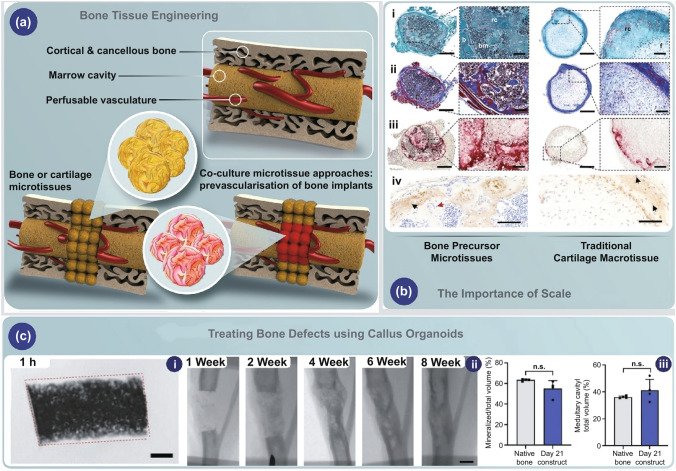
a Schematic representation of microtissues in bone tissue engineering. b The importance of scale in cartilage precursors for endochondral bone tissue engineering. c The same precursor microtissues can be used to heal a murine, critically sized long bone defect. The figure reprinted [18, 19] with permission from Elsevier and Wiley
Fig. 2
Fig. 2
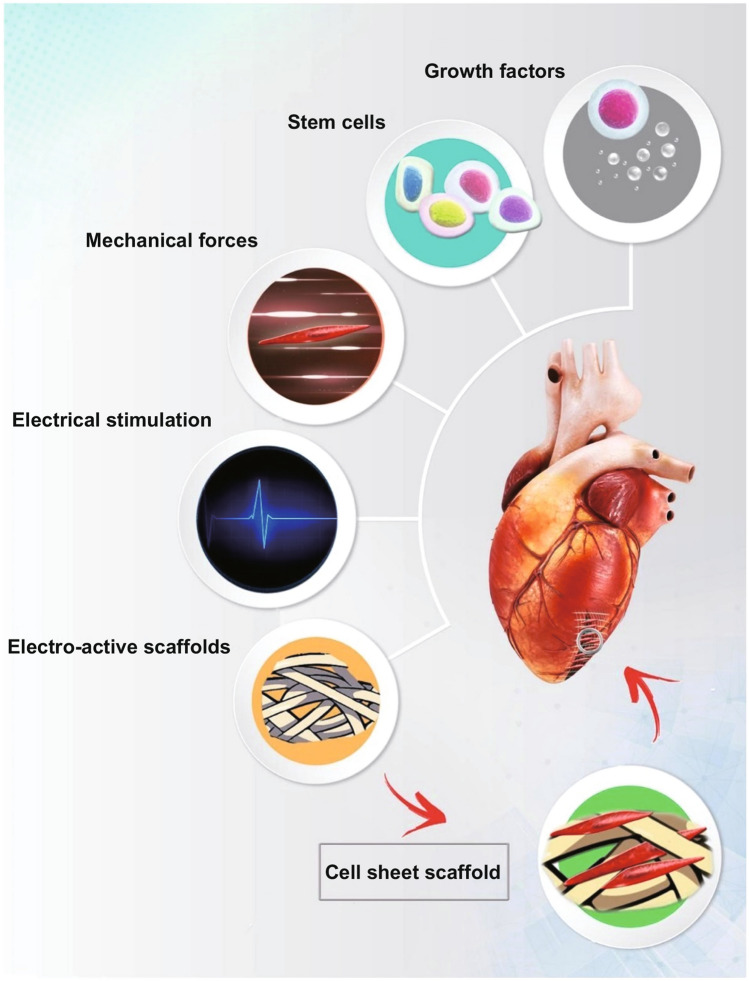
Key factors involved in the cardiac tissue engineering [57]
Fig. 3
Fig. 3
A schematic illustration regarding the delivery of GFs and effect of each key factors on this delivery system [15]
Fig. 4
Fig. 4
Photopatterning of VEGF onto the surface of collagen-glycosaminoglycan scaffolds; a the surface of the collagen-glycosaminoglycan scaffolds photopatterned with VEGFs, b cross-sectional microscopy of the photopatterned VEGF onto the surface of collagen-glycosaminoglycan scaffolds, c the VEGF bounded amount onto the surface of collagen-glycosaminoglycan scaffolds [80]
Fig. 5
Fig. 5
The photopatterned VEGF onto the surface of collagen-glycosaminoglycan scaffolds, a images of the HUVEC cells cultured on the modified photopatterned scaffolds, and b cultured on the unmodified photopatterned scaffolds [80]
Fig. 6
Fig. 6
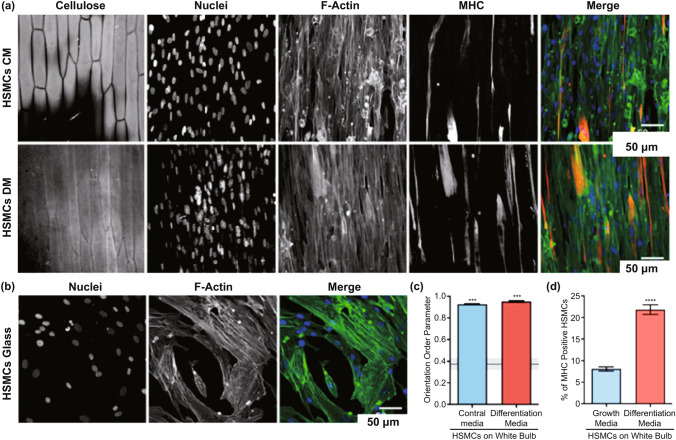
C2C12 cells differentiate into aligned myotubes when cultured on the outer surface of the green onion derived cellulose scaffolds. a When cultured on the outer green onion white bulb or green leaf cellulose scaffolds. b Example confocal fluorescence image showing C2C12 cells align randomly when cultured on a fibronectin-coated (50 μg mL−1) glass coverslip. c Quantitative analysis of the fluorescence images obtained for actin alignment is performed via a 2D orientation order parameter (OOP) of C2C12 cells seeded on various substrates. Reprinted with permission from [88]. Copyright 2021 American Chemical Society
Fig. 7
Fig. 7
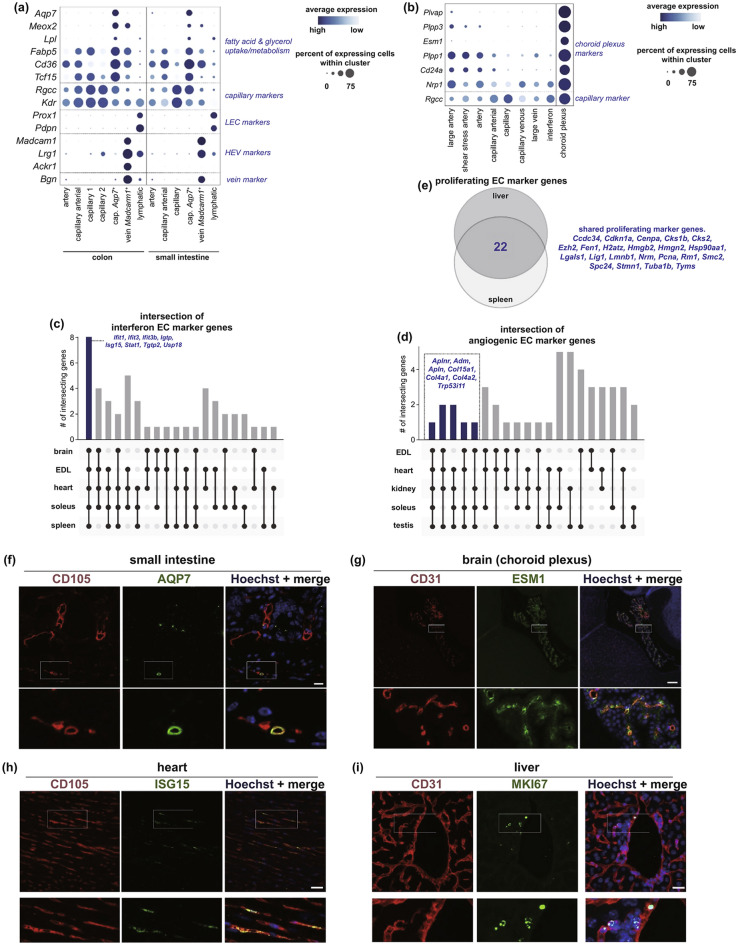
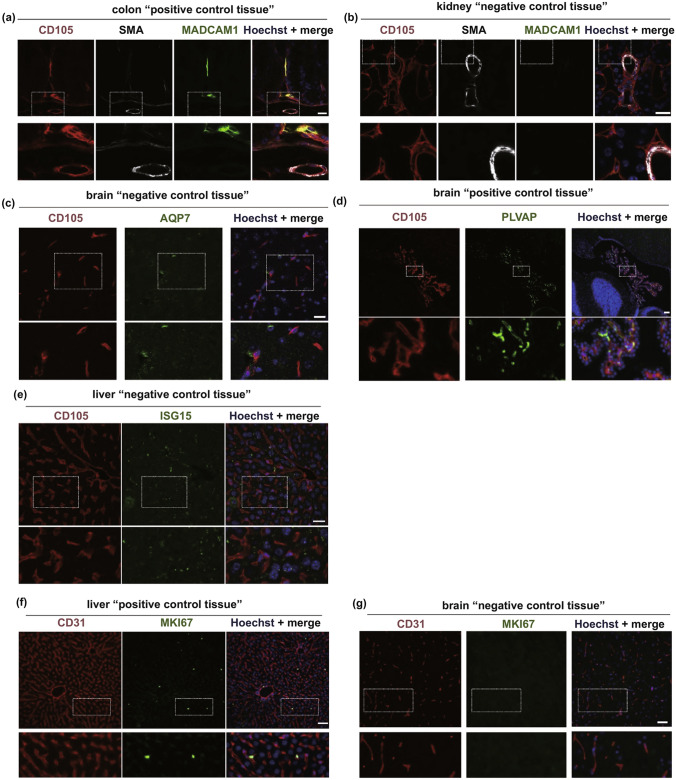
Specialized and unexpected endothelial cells phenotypes. a, b Dot-plot heatmap of markers enriched in intestinal Aqp7+ capillary and Madcam1+ vein ECs. c, d UpSet plot of intersections between the top 50 markers expressed by interferon-activated. e Venn diagram showing genes upregulated in proliferating ECs. fi Representative micrographs of mouse tissue sections. Reprinted from [95] with permission
Fig. 8
Fig. 8
Protein validation of specialized endothelial cells phenotypes. a, b Representative micrographs of mouse colon. c, d Representative micrographs of mouse brain sections (negative and positive control group). e–g Representative micrographs of mouse liver (negative and positive control groups) [95]
Fig. 9
Fig. 9
In vivo phases on the neovascularization’s experiments; a CD31 and CD45 stainings of microsphere scaffolds; b endothelial cell stainings of microsphere scaffolds; c, d endothelial cell stainings of Integra® scaffolds; e, f CD31 and CD45 stainings of type I collagen scaffolds [111]
Fig. 10
Fig. 10
Multiphoton microscopy of the stained microsphere scaffolds after 14 days [111]
Fig. 11
Fig. 11
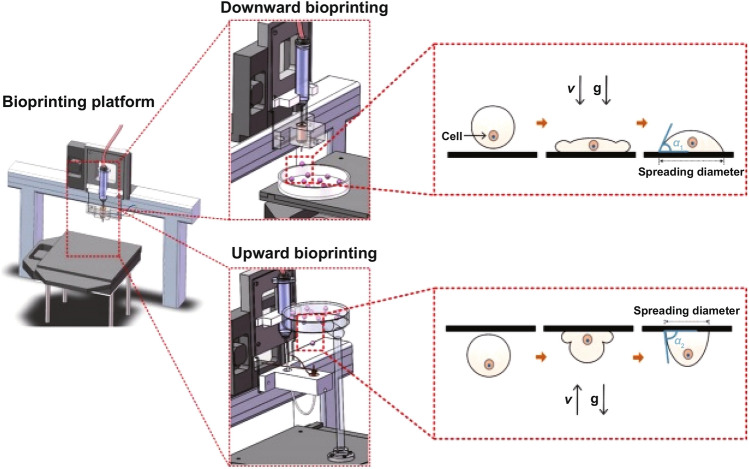
A schematic illustration of the upward and downward bioprinting devices, as an advanced and high-resolution droplet-based bioprinting systems. Reprinted with permission from [130]. Copyright 2021 American Chemical Society

References

    1. Gale BK, Jafek AR, Lambert CJ, Goenner BL, Moghimifam H, et al. A review of current methods in microfluidic device fabrication and future commercialization prospects. Inventions. 2018;3(3):60. doi: 10.3390/inventions3030060. - DOI
    1. Ren K, Zhou J, Wu HK. Materials for microfluidic chip fabrication. Acc. Chem. Res. 2013;46(11):2396–2406. doi: 10.1021/ar300314s. - DOI - PubMed
    1. Riahi R, Tamayol A, Shaegh SAM, Ghaemmaghami AM, Dokmeci MR, et al. Microfluidics for advanced drug delivery systems. Curr. Opin. Chem. Eng. 2015;7:101–112. doi: 10.1016/j.coche.2014.12.001. - DOI - PMC - PubMed
    1. Au AK, Huynh W, Horowitz LF, Folch A. 3d-printed microfluidics. Angew. Chem. Int. Ed. 2016;55(12):3862–3881. doi: 10.1002/anie.201504382. - DOI - PMC - PubMed
    1. Hasan A, Paul A, Vrana NE, Zhao X, Memic A, et al. Microfluidic techniques for development of 3d vascularized tissue. Biomaterials. 2014;35(26):7308–7325. doi: 10.1016/j.biomaterials.2014.04.091. - DOI - PMC - PubMed

LinkOut - more resources