


Testosterone in males with COVID-19: A 7-month cohort study
- PMID: 34409772
- PMCID: PMC8444879
- DOI: 10.1111/andr.13097
Testosterone in males with COVID-19: A 7-month cohort study
Abstract
Background: Circulating testosterone levels have been found to be reduced in men with severe acute respiratory syndrome coronavirus 2 infection, COVID-19, with lower levels being associated with more severe clinical outcomes.
Objectives: We aimed to assess total testosterone levels and the prevalence of total testosterone still suggesting for hypogonadism at 7-month follow-up in a cohort of 121 men who recovered from laboratory-confirmed COVID-19.
Materials and methods: Demographic, clinical, and hormonal values were collected for all patients. Hypogonadism was defined as total testosterone ≤9.2 nmol/L. The Charlson Comorbidity Index was used to score health-significant comorbidities. Descriptive statistics and multivariable linear and logistic regression models tested the association between clinical and laboratory variables and total testosterone levels at follow-up assessment.
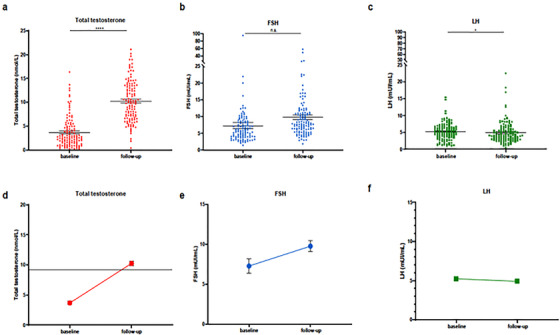
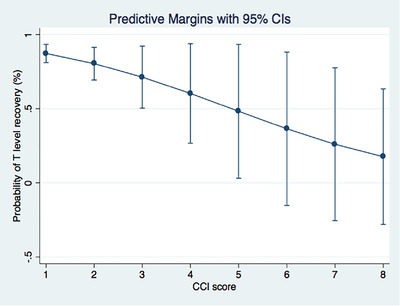
Results: Circulating total testosterone levels increased at 7-month follow-up compared to hospital admittance (p < 0.0001), while luteinizing hormone and 17β-estradiol levels significantly decreased (all p ≤ 0.02). Overall, total testosterone levels increased in 106 (87.6%) patients, but further decreased in 12 (9.9%) patients at follow-up, where a total testosterone level suggestive for hypogonadism was still observed in 66 (55%) patients. Baseline Charlson Comorbidity Index score (OR 0.36; p = 0.03 [0.14, 0.89]) was independently associated with total testosterone levels at 7-month follow-up, after adjusting for age, BMI, and IL-6 at hospital admittance.
Conclusions: Although total testosterone levels increased over time after COVID-19, more than 50% of men who recovered from the disease still had circulating testosterone levels suggestive for a condition of hypogonadism at 7-month follow-up. In as many as 10% of cases, testosterone levels even further decreased. Of clinical relevance, the higher the burden of comorbid conditions at presentation, the lower the probability of testosterone levels recovery over time.
Keywords: COVID-19; SARS-CoV-2; comorbidities; follow-up; male; testosterone.
© 2021 American Society of Andrology and European Academy of Andrology.
Conflict of interest statement
The authors declare that there is no conflict of interest.
Figures
Comment in
-
Male and Female Sexual Function and Dysfunction; Andrology.J Urol. 2022 Jun;207(6):1332-1335. doi: 10.1097/JU.0000000000002655. Epub 2022 Mar 23. J Urol. 2022. PMID: 35319261 No abstract available.
References
MeSH terms
Substances
Grants and funding
LinkOut - more resources
Full Text Sources
Medical
Miscellaneous
