


Clinical outcomes in cancer patients with COVID-19
- PMID: 34409775
- PMCID: PMC8420395
- DOI: 10.1002/cnr2.1413
Clinical outcomes in cancer patients with COVID-19
Abstract
Background: Early reports on cancer patients with coronavirus disease 2019 (COVID-19) corroborated speculation that cancer patients are at increased risk for becoming infected with severe acute respiratory syndrome coronavirus 2 (SARS-CoV-2) and developing severe COVID-19. However, cancer patients are a heterogeneous population and their corresponding risk may be different.
Aim: To compare COVID-19 presentation in patients with active malignancy to those with a history of cancer to determine the impact of cancer status on COVID-19 outcomes in the two groups.
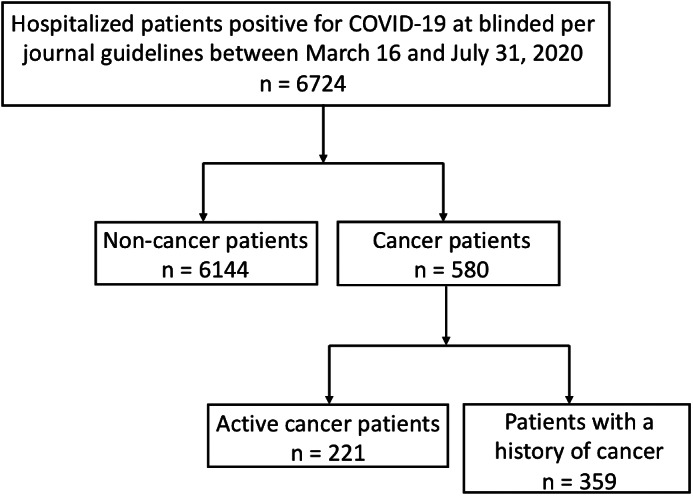
Methods and results: Of the 6724 patients who were hospitalized at NYU Langone Health (3/16/20-7/31/20) and tested positive for SARS-CoV-2, 580 had either active cancer (n = 221) or a history of cancer (n = 359). We compared the baseline clinicodemographic characteristics and hospital courses of the two groups. We studied the relationship between cancer status and the rate of admission to the intensive care unit (ICU), use of invasive mechanical ventilation (IMV), and all-cause mortality. The two groups had similar laboratory results associated with COVID-19 infection, incidence of venous thromboembolism, and incidence of severe COVID-19. Active cancer status was not associated with the rate of ICU admission (p = .307) or use of IMV (p = .236), but was significantly associated with worse all-cause mortality in both univariate and multivariate analysis with odds ratios of 1.48 (95% confidence interval [CI]: 1.04-2.09; p = .028) and 1.71 (95% CI: 1.12-2.63; p = .014), respectively.
Conclusion: Active cancer patients had worse survival outcomes compared to patients with a history of cancer despite similar COVID-19 disease characteristics in the two groups. Our data suggest that cancer care should continue with minimal interruptions during the pandemic to bring about response and remission as soon as possible.
Keywords: active malignancy; cancer; coronavirus disease 2019; outcomes; survivor.
© 2021 The Authors. Cancer Reports published by Wiley Periodicals LLC.
Conflict of interest statement
The authors have stated explicitly that there are no conflicts of interest in connection with this article.
References
-
- Kamboj M, Sepkowitz KA. Nosocomial infections in patients with cancer. Lancet Oncol. 2009;10(6):589‐597. - PubMed
-
- Chemaly RF, Ghosh S, Bodey GP, et al. Respiratory viral infections in adults with hematologic malignancies and human stem cell transplantation recipients: a retrospective study at a major cancer center. Medicine (Baltimore). 2006;85(5):278‐287. - PubMed
Publication types
MeSH terms
Grants and funding
LinkOut - more resources
Full Text Sources
Medical
Miscellaneous
