


Keeping an eye on pink eye: a global conjunctivitis outbreak expert survey
- PMID: 34409991
- PMCID: PMC9450638
- DOI: 10.1093/inthealth/ihab049
Keeping an eye on pink eye: a global conjunctivitis outbreak expert survey
Abstract
Background: Recurrent conjunctivitis epidemics are prevalent worldwide. Aetiologies are often undetermined.
Methods: We surveyed conjunctivitis researchers about perceived trends in prevalence, incidence and aetiologies of conjunctivitis epidemics.
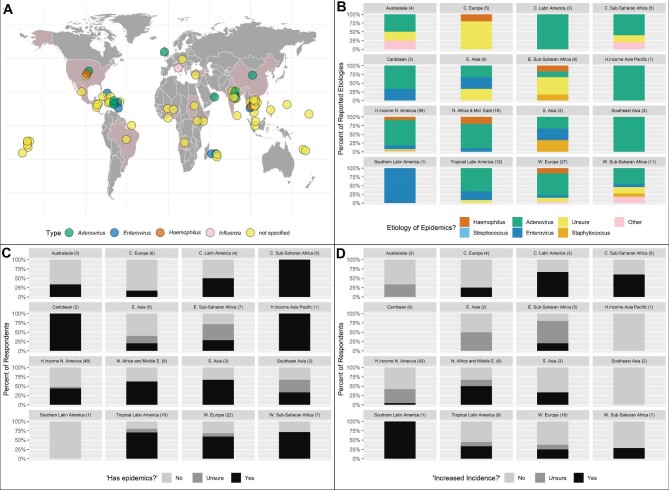
Results: Of the 155 participants, 7% endorsed globally variable and dynamic microbial aetiologies of conjunctivitis epidemics. Increased incidence of conjunctivitis epidemics over the last decade were reported by 21% of respondents. Peak seasons differed between the northern and southern hemispheres.
Conclusions: There is regional equipoise regarding the increasing incidence and emerging underlying aetiologies of epidemic conjunctivitis. Further investigation of global surveillance and microbial characterization of conjunctivitis outbreaks could improve prevention and outcomes.
Keywords: EKC; adenovirus; antimicrobial stewardship; conjunctivitis; epidemic; microbial surveillance.
© The Author(s) (2021). Published by Oxford University Press on behalf of the International Studies Association.
Figures
References
-
- Miller JJ. Asymptotic properties of maximum likelihood estimates in the mixed model of the analysis of variance. Ann Stat. 1977;5(4):746–62.
-
- Institute for Health Metrics and Evaluation. Global burden of diseases regions. Available from: http://www.healthdata.org/gbd/faq#What%20countries%20are%20in%20each%20r... [accessed 30 May 2019].
-
- Schneider J, Scheibling C, Segall Det al. Epidemiology and economic burden of conjunctivitis: a managed care perspective. J Manag Care Med. 2014;17(1):78–83.
