Review
. 2021 Aug;105(16-17):6215-6228.
doi: 10.1007/s00253-021-11462-0. Epub 2021 Aug 19.

Current state of and need for enzyme engineering of 2-deoxy-D-ribose 5-phosphate aldolases and its impact

Affiliations
Review

Current state of and need for enzyme engineering of 2-deoxy-D-ribose 5-phosphate aldolases and its impact

Juha Rouvinen et al. Appl Microbiol Biotechnol. 2021 Aug.

Abstract

Deoxyribose-5-phosphate aldolases (DERAs, EC 4.1.2.4) are acetaldehyde-dependent, Class I aldolases catalyzing in nature a reversible aldol reaction between an acetaldehyde donor (C2 compound) and glyceraldehyde-3-phosphate acceptor (C3 compound, C3P) to generate deoxyribose-5-phosphate (C5 compound, DR5P). DERA enzymes have been found to accept also other types of aldehydes as their donor, and in particular as acceptor molecules. Consequently, DERA enzymes can be applied in C-C bond formation reactions to produce novel compounds, thus offering a versatile biocatalytic alternative for synthesis. DERA enzymes, found in all kingdoms of life, share a common TIM barrel fold despite the low overall sequence identity. The catalytic mechanism is well-studied and involves formation of a covalent enzyme-substrate intermediate. A number of protein engineering studies to optimize substrate specificity, enzyme efficiency, and stability of DERA aldolases have been published. These have employed various engineering strategies including structure-based design, directed evolution, and recently also machine learning-guided protein engineering. For application purposes, enzyme immobilization and usage of whole cell catalysis are preferred methods as they improve the overall performance of the biocatalytic processes, including often also the stability of the enzyme. Besides single-step enzymatic reactions, DERA aldolases have also been applied in multi-enzyme cascade reactions both in vitro and in vivo. The DERA-based applications range from synthesis of commodity chemicals and flavours to more complicated and high-value pharmaceutical compounds. KEY POINTS: • DERA aldolases are versatile biocatalysts able to make new C-C bonds. • Synthetic utility of DERAs has been improved by protein engineering approaches. • Computational methods are expected to speed up the future DERA engineering efforts.

Keywords: Aldolase; Applications; Biocatalysis; C–C bond formation; DERA; Protein engineering.


Conflict of interest statement

The authors declare no competing interests.

Figures
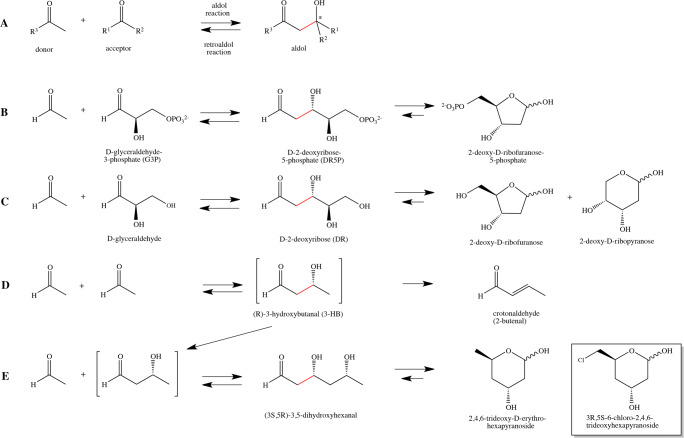
Fig. 1
Fig. 1
Chemical reactions catalyzed by DERA. (A) A general aldol reaction in which the carbonyl compound donor makes a covalent bond (in red) with the carbonyl compound acceptor. Depending on the donor, there is a possibility for formation of a new stereogenic center (*) in the product. (B) A reversible aldol reaction catalyzed in Nature by DERA, a Class I aldolase, between an acetaldehyde donor (C2 compound) and glyceraldehyde-3-phosphate acceptor (C3 compound, G3P) to generate deoxyribose-5-phosphate, DR5P (C5 compound) which forms a furanose isomer. (C) DERA-catalyzed reaction between acetaldehyde and a non-phosphorylated glyceraldehyde produces D-2-deoxyribose (DR), which is able to form furanose and pyranose isomers. (D) The reaction of two acetaldehydes, catalyzed by DERA, produces crotonaldehyde. (E) Crotonaldehyde can react further with a third acetaldehyde molecule in a DERA-catalyzed reaction, to produce 3,5-dihydroxyhexanal, which cyclizes to a more stable pyranose form
Fig. 2
Fig. 2
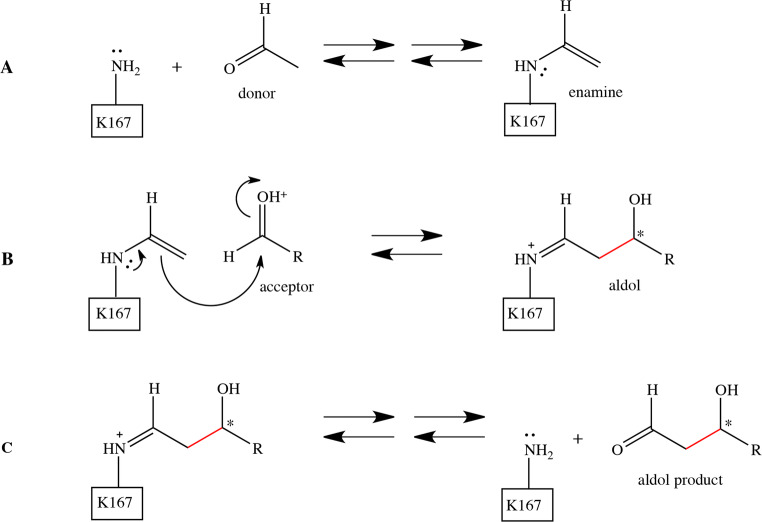
Main phases in the reaction mechanism of DERA-catalyzed aldol reaction. (A) The donor aldehyde makes a covalent bond with nucleophilic Lysine (Lys167 in E. coli DERA) of the enzyme, forming an enamine (in equilibrium with imine, the Schiff base). This enamine forming phase includes several intermediates. (B) Reaction of the enamine with the protonated acceptor aldehyde produces an aldol, covalently attached to the Lysine. (C) Release of aldol. This phase also includes several intermediates. The key catalytic residue is Lysine which make a covalent bond with the donor aldehyde. In addition, there are other residues in the active site which promote the reaction participating in protonation and deprotonation of intermediates
Fig. 3
Fig. 3
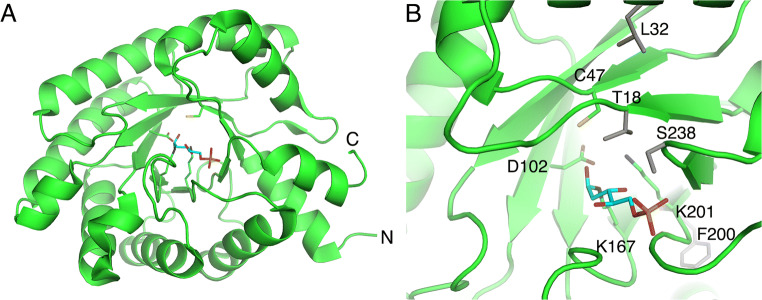
(A) The 3D structure of monomeric DERA from E. coli. (B) The active site of E. coli DERA with the covalently bound carbinolamine intermediate (in cyan) (PDB 1JCL). Key catalytic residues are presented as green sticks. The positions of four mutations described in the review are presented as grey sticks
Fig. 4
Fig. 4
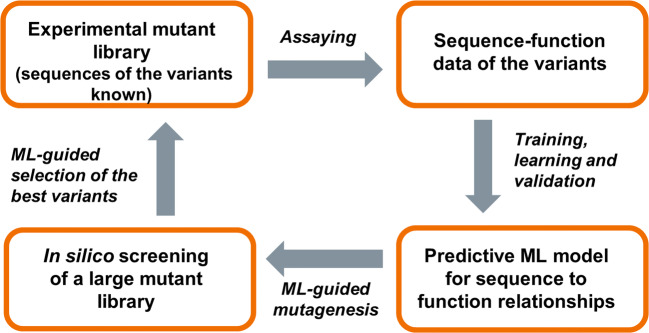
A schematic picture how machine learning (ML) methods can be applied to accelerate protein engineering work. ML models can be trained from a relatively limited set of experimental variant data to predict how amino acid sequence maps to function without requiring information about the 3D protein structure. The ML models can be used to predict the properties of variants not experimentally evaluated and to propose a new, limited set of experimental variants to be screened in the next evolution round in order to improve the protein properties

References

    1. Alford RF, Leaver-Fay A, Jeliazkov JR, O’Meara MJ, DiMaio FP, Park H, Shapovalov MV, Renfrew PD, Mulligan VK, Kappel K, Labonte JW, Pacella MS, Bonneau R, Bradley P, Dunbrack RL, Das R, Baker D, Kuhlman B, Kortemme T, Gray JJ. The Rosetta all-atom energy function for macromolecular modeling and design. J Chem Theory Comput. 2017;13:3031–3048. doi: 10.1021/acs.jctc.7b00125. - DOI - PMC - PubMed
    1. Arnold FH. Directed evolution: bringing new chemistry to life. Angew Chemie - Int Ed. 2018;57:4143–4148. doi: 10.1002/anie.201708408. - DOI - PMC - PubMed
    1. Barbas CF, Wang YF, Wong CH. Deoxyribose-5-phosphate aldolase as a synthetic catalyst. J Am Chem Soc. 1990;112:2013–2014. doi: 10.1021/ja00161a064. - DOI
    1. Bendl J, Stourac J, Sebestova E, Vavra O, Musil M, Brezovsky J, Damborsky J. HotSpot Wizard 2.0: automated design of site-specific mutations and smart libraries in protein engineering. Nucleic Acids Res. 2016;44:W479–W487. doi: 10.1093/nar/gkw416. - DOI - PMC - PubMed
    1. Bisterfeld C, Classen T, Küberl I, Henßen B, Metz A, Gohlke H, Pietruszka J. Redesigning aldolase stereoselectivity by homologous grafting. PLoS One. 2016;11:e0156525. doi: 10.1371/journal.pone.0156525. - DOI - PMC - PubMed

MeSH terms

LinkOut - more resources