


The Relationship Between SNS Usage and Disordered Eating Behaviors: A Meta-Analysis
- PMID: 34413807
- PMCID: PMC8367749
- DOI: 10.3389/fpsyg.2021.641919
The Relationship Between SNS Usage and Disordered Eating Behaviors: A Meta-Analysis
Abstract
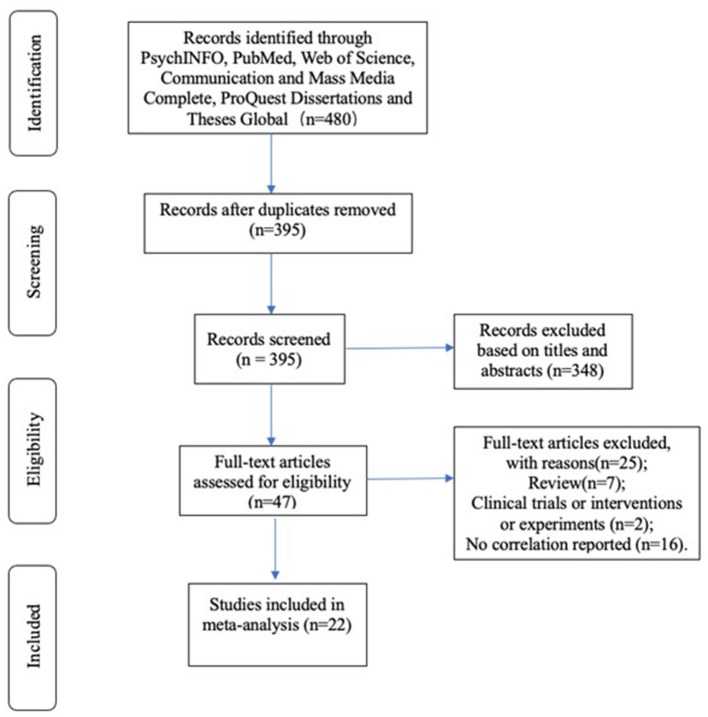
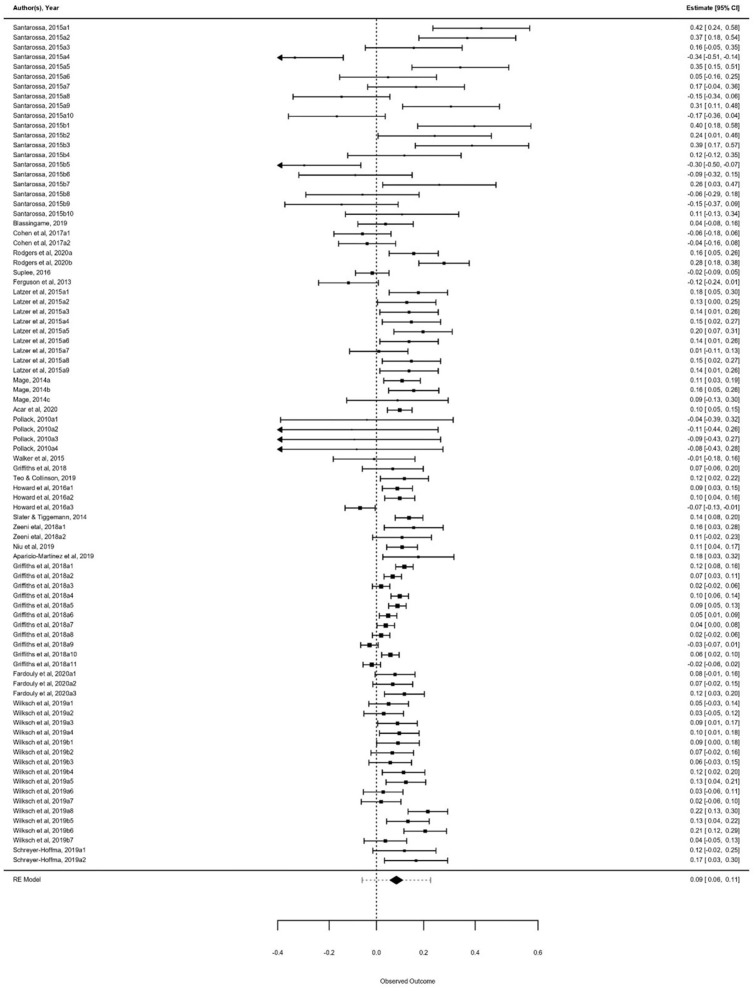
Social Networking Sites (SNSs) are common tools with which modern people share their lives and establish social relationships. However, some studies have found SNSs to be associated with eating disorders, although other have identified no connection between the two. To explore the interaction between SNSs and eating disorder behaviors, this study aimed to comprehensively synthesize previous studies using meta-analysis methods. Based on selection criteria, there were 87 effect sizes from 22 studies. After analysis using a three-level random-effects meta-analysis model, a positive correlation between the use of SNSs and irregular eating behaviors was found, r = 0.09 (95% CI: 0.06, 0.11; p < 0.001). In addition, by analyzing potential moderators, body mass index (r = -0.032; 95% CI: -0.058, -0.006; p = 0.019), survey methods, and sample sources was discovered could alter the relationship between SNSs and disordered eating behaviors. Specifically, there was a significantly larger association between SNSs results obtained by paper and pencil surveys and disordered eating behaviors (r = 0.114; 95% CI: 0.081, 0.147; p < 0.001) than that between SNSs results obtained by online surveys and disordered eating behaviors (r = -0.055; 95% CI: -0.102, -0.007; p < 0.01). University students showed a larger correlation between SNSs and disordered eating behavior than other samples (r = 0.089; 95% CI: 0.049, 0.129; p < 0.001). Overall, this meta-analysis confirms that the excessive use of SNSs is associated with an increased risks of disordered eating behaviors. It is hoped that this study can provide a reference for the management and intervention of dietary behaviors related to social networks in the future.
Keywords: BMI; disordered eating behaviors; eating disorder; social media; social networking sites.
Copyright © 2021 Zhang, Wang, Li and Wu.
Conflict of interest statement
The authors declare that the research was conducted in the absence of any commercial or financial relationships that could be construed as a potential conflict of interest. The Reviewer XX declared a shared affiliation with several of the authors, JZ, YW, and QL, to the handling editor at time of review.
Figures
References
-
- Acar M., Akgul S., Kizilkan M. P., Tuzun Z., Derman O., Kanbur N. (2020). Eating attitudes and physical appearance comparison with others in daily life versus on social media in adolescents. J. Adolesc. Health 66, S59–S60. - PubMed
-
- Aparicio-Martinez P., Perea-Moreno A. J., Martinez-Jimenez M. P., Redel-Macias M. D., Pagliari C., Vaquero-Abellan M. (2019). Social media, thin-ideal, body dissatisfaction and disordered eating attitudes: an exploratory analysis. Int. J. Environ. Res. Public Health 16:4177. 10.3390/ijerph16214177 - DOI - PMC - PubMed
-
- Ata R. N., Ludden A. B., Lally M. M. (2007). The effects of gender and family, friend, and media influences on eating behaviors and body image during adolescence. J. Youth Adolesc. 36, 1024–1037. 10.1007/s10964-006-9159-x - DOI
-
- Australian Psychological Society (2017). Digital Me: A Survey Exploring the Effect of Social Media and Digital Technology on Australians' Wellbeing. Melbourne, VIC: Australian Psychological Society.
-
- Bandura A. (1995). “Exercise of personal and collective efficacy in changing societies,” in Self-Efficacy in Changing Societies (New York, NY: Cambridge University Press; ), 1–45. 10.1017/CBO9780511527692.003 - DOI
Publication types
LinkOut - more resources
Full Text Sources
