. 2021 Dec;186(6):739-754.
doi: 10.1007/s11046-021-00584-8. Epub 2021 Aug 19.

Epidemiology and Pathophysiology of COVID-19-Associated Mucormycosis: India Versus the Rest of the World

Affiliations

Epidemiology and Pathophysiology of COVID-19-Associated Mucormycosis: India Versus the Rest of the World

Valliappan Muthu et al. Mycopathologia. 2021 Dec.

Abstract

The coronavirus disease 2019 (COVID-19) pandemic has led to a concerning resurgence of mucormycosis. More than 47,000 cases of mucormycosis were reported in three months from India. We update our systematic review on COVID-19-associated mucormycosis (CAM) till June 21st, 2021, comparing cases reported from India and elsewhere. We included individual patient details of 275 cases of CAM, of which 233 were reported from India and 42 from the rest of the world. Diabetes mellitus was the most common underlying risk factor for CAM in India than in other countries. The fatality rate of cases reported from India (36.5%) was less than the globally reported cases (61.9%), probably due to the predominance of rhino-orbital mucormycosis. On a multivariate analysis, we found that pulmonary or disseminated mucormycosis cases and admission to the intensive care unit were associated with increased mortality, while combination medical therapy improved survival. The paucity of pulmonary and disseminated mucormycosis cases from India suggests that these cases were either not diagnosed or reported, further supported by a trend of search data from the Google search engine. In this review, we discuss the factors explaining the substantial rise in cases of CAM. We also propose a hypothetical model describing the epidemiologic triad of CAM.

Keywords: Healthcare; Hospital; Mucorales; Outbreak; Rhizopus; SARS-CoV-2.


Conflict of interest statement

All authors declare that they have no conflict of interest.

Figures
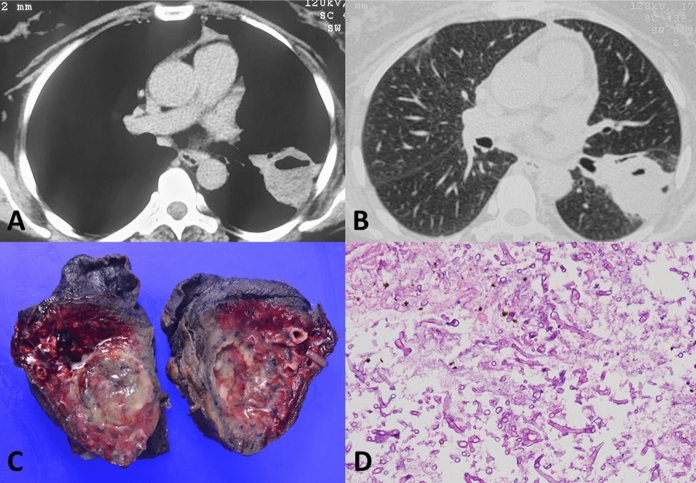
Fig. 1
Fig. 1
Computed tomography images of a patient with pulmonary mucormycosis (following COVID-19) showing a thick-walled cavity with an air-fluid level in the left lower lobe (A and B). Gross photograph (C) of the resected specimen showing cavity filled with necrotic material. Photomicrograph (D) demonstrating broad aseptate fungal hyphae conforming to the morphology of mucormycosis in a necrotic background (H&E, × 200)
Fig. 2
Fig. 2
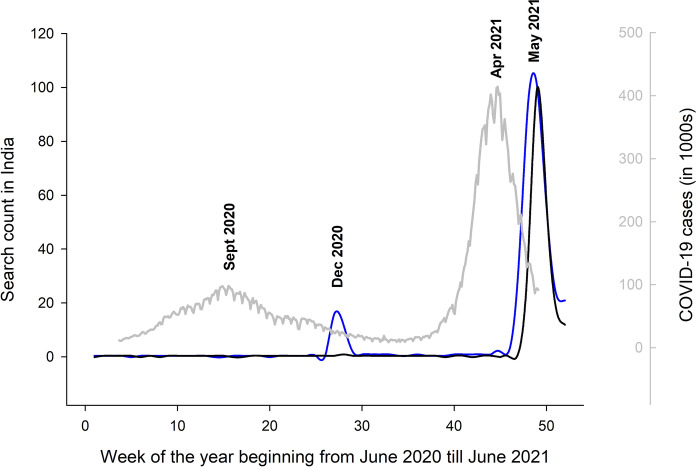
Google search trends from India over one year (52 weeks beginning from June 10th 2020 till June 10th 2021). The vertical axis on the left shows the number of searches in the search engine (obtained from publicly available data). The graph in blue depicts the search count for the term “mucormycosis” in the search engine, while the graph in black color represents the search term “black fungus.” The graphs are superimposed on the number of COVID-19 cases reported from India (in gray color) over the same period. The vertical axis (marked in gray) on the right side of the figure represents the number of COVID-19 cases in thousands
Fig. 3
Fig. 3
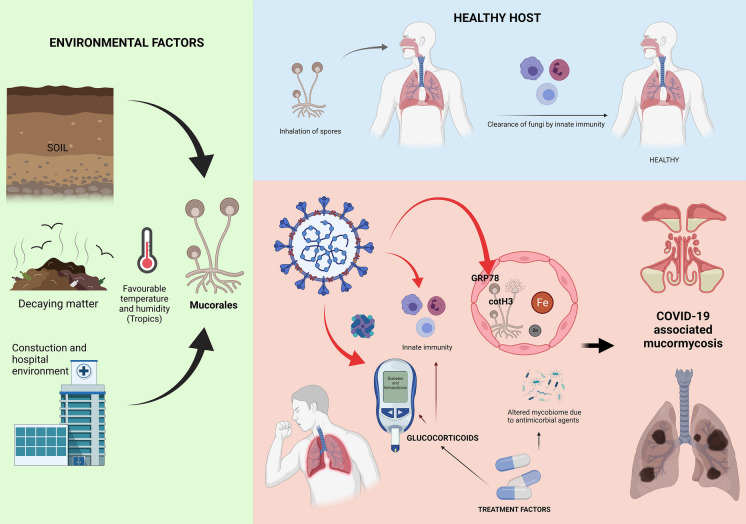
A proposed pathophysiological model of COVID-19-associated mucormycosis. The Mucorales spores are ubiquitous in the environment and are cleared by the innate immunity of a healthy host (Top panel). In a SARS-CoV-2 infected individual, several factors may be involved in the pathogenesis of COVID-19-associated mucormycosis (CAM). Glucose-regulated 78 kDa protein (GRP78) on the human endothelial cells is an essential receptor for vascular invasion by Mucorales through its spore coat protein (CotH3). Hyperglycemia, diabetic ketoacidosis, and the presence of iron favor this interaction and promote the growth of the fungi. SARS-CoV-2 may also be directly (marked by red arrows) increase expression of GRP78, precipitate diabetic ketoacidosis, and possibly alter innate immune cell functions. Additionally, glucocorticoids used in the treatment of COVID-19 cause hyperglycemia and immunosuppression

References

    1. Wu Z, Mcgoogan JM. Characteristics of and important lessons from the coronavirus disease 2019 (Covid-19) outbreak in China: summary of a report of 72314 cases from the Chinese center for disease control and prevention. JAMA. 2020;323(13):1239–42. doi: 10.1001/Jama.2020.2648. - DOI - PubMed
    1. Garg D, Muthu V, Sehgal I, Ramachandran R, Kaur H, Bhalla A, et al. Coronavirus disease (Covid-19) associated mucormycosis (CAM): case report and systematic review of literature. Mycopathologia. 2021;186(2):289–98. doi: 10.1007/S11046-021-00528-2. - DOI - PMC - PubMed
    1. Patel A, Agarwal R, Rudramurthy S, Shevkani M, Xess I, Sharma R, et al. Multicenter epidemiologic study of coronavirus disease-associated mucormycosis. India. Emerg Infect Dis. 2021 doi: 10.3201/Eid2709.210934. - DOI - PMC - PubMed
    1. Sharma R, Gujarat: with scarcity, fungus experts suggest alternative drugs. www://Timesofindia.Indiatimes.Com/Articleshow/82813984.Cms?Utm_Source=Contento.... Times Of India (2021)
    1. Cornely OA, Alastruey-Izquierdo A, Arenz D, Chen S, Dannaoui E, Hochhegger B, et al. Global guideline for the diagnosis and management of mucormycosis: an initiative of the European confederation of medical mycology in cooperation with the mycoses study group education and research consortium. Lancet Infect Dis. 2019 doi: 10.1016/S1473-3099(19)30312-3. - DOI - PMC - PubMed

Publication types