. 2021 Nov:3:100041.
doi: 10.1016/j.lana.2021.100041. Epub 2021 Aug 16.

Clinical characteristics of the first and second COVID-19 waves in the Bronx, New York: A retrospective cohort study

Affiliations

Clinical characteristics of the first and second COVID-19 waves in the Bronx, New York: A retrospective cohort study

Wouter S Hoogenboom et al. Lancet Reg Health Am. 2021 Nov.

Abstract

Background: There is limited clinical patient data comparing the first and second waves of the coronavirus disease 2019 (COVID-19) in the United States and the effects of a COVID-19 resurgence on different age, racial and ethnic groups. We compared the first and second COVID-19 waves in the Bronx, New York, among a racially and ethnically diverse population.

Methods: Patients in this retrospective cohort study were included if they had a laboratory-confirmed SARS-CoV-2 infection by a real-time PCR test of a nasopharyngeal swab specimen detected between March 11, 2020, and January 21, 2021. Main outcome measures were critical care, in-hospital acquired disease and death. Patient demographics, comorbidities, vitals, and laboratory values were also collected.

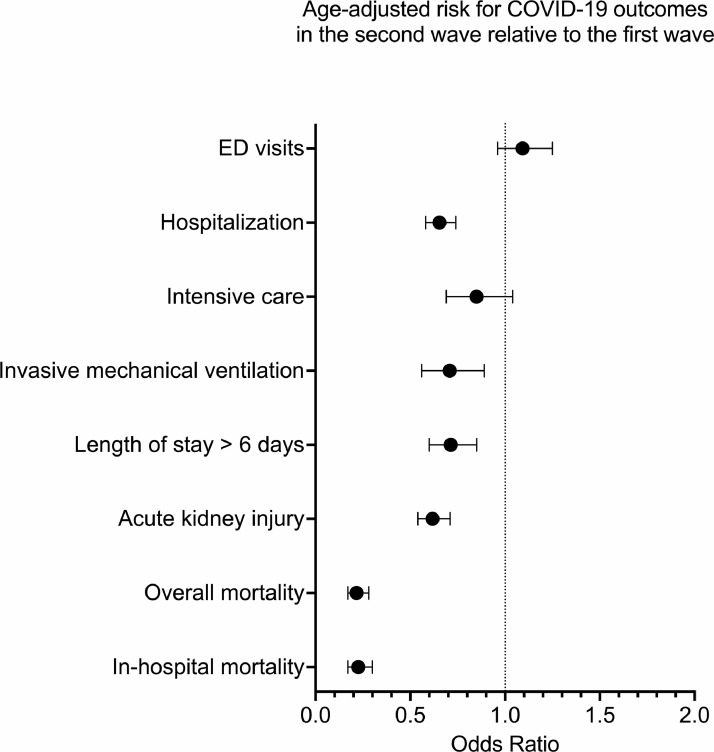
Findings: A total of 122,983 individuals were tested for SARS-CoV-2 infection, of which 12,659 tested positive. The second wave was characterized by a younger demographic, fewer comorbidities, less extreme laboratory values at presentation, and lower risk of adverse outcomes, including in-hospital mortality (adj. OR = 0·23, 99·5% CI = 0·17 to 0·30), hospitalization (adj. OR = 0·65, 99·5% CI = 0·58 to 0·74), invasive mechanical ventilation (adj. OR = 0·70, 99·5% CI = 0·56 to 0·89), acute kidney injury (adj. OR = 0·62, 99·5% CI = 0·54 to 0·71), and length of stay (adj. OR = 0·71, 99·5% CI = 0·60 to 0·85), with Black and Hispanic patients demonstrating most improvement in clinical outcomes.

Interpretation: The second COVID-19 wave in the Bronx exhibits improved clinical outcomes compared to the first wave across all age, racial, and ethnic groups, with minority groups showing more improvement, which is encouraging news in the battle against health disparities.

Keywords: Bronx; COVID-19; Coronavirus; Ethnicity; Mortality; Race; Resurgence; SARS-CoV-2.


Conflict of interest statement

None.

Figures
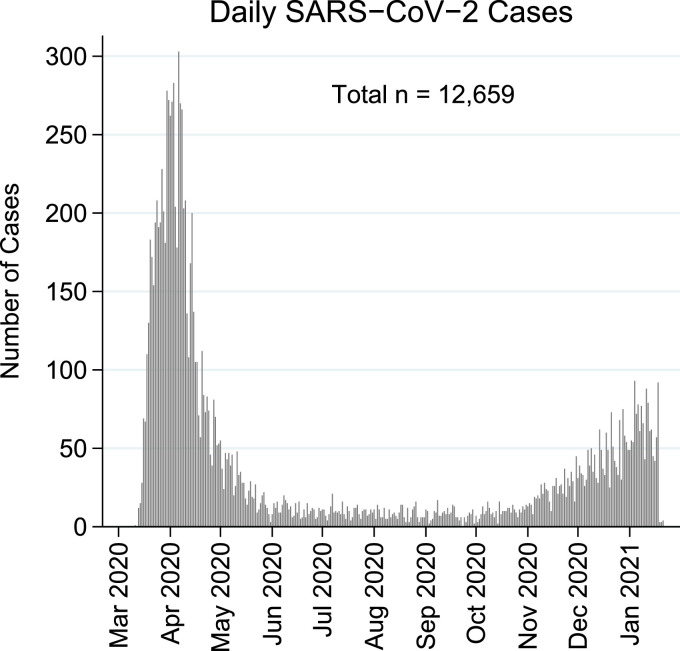
Fig 1
Fig. 1
Daily SARS-CoV-2 positive cases in the Bronx. Between March 11, 2020, and January 21, 2021, there were 12,659 positive SARS-CoV-2 cases in the Montefiore Health System. Data demonstrates a bimodal distribution of infections with its first peak in April 2020, a subsequent period with low infections during the summer followed by a second rise in the winter.
Fig 2
Fig. 2
Age-adjusted odds ratios for COVID-19 related clinical outcomes in the second wave cohort relative to the first wave cohort. Logistic Regression showed lower risk for adverse COVID-19 outcomes in the second wave (i.e., OR < 1, and 99·5% confidence intervals < 1), including hospitalization, need for invasive mechanical ventilation, length of stay, acute kidney injury, overall mortality and in-hospital mortality, but not emergency department (ED) visits or intensive care unit admission. Error bars represent 99·5% confidence intervals.
Fig 3
Fig. 3
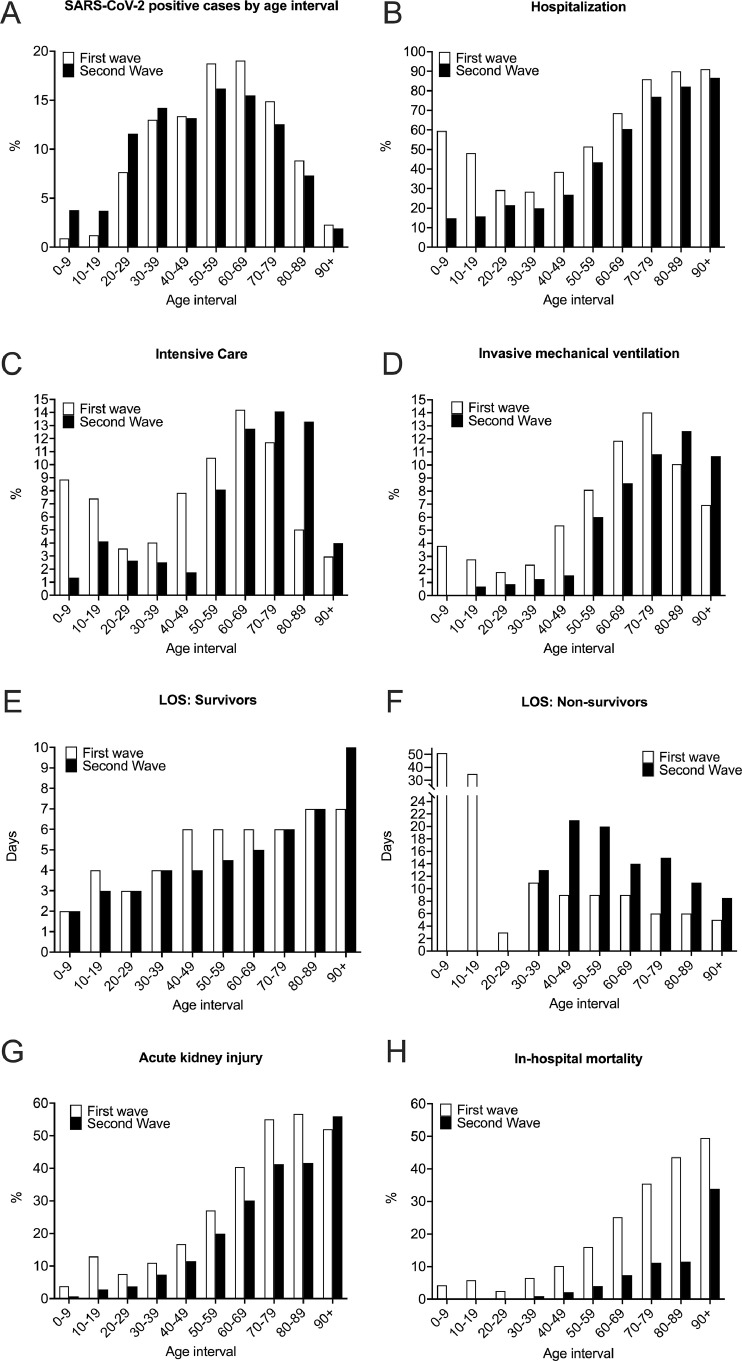
COVID-19 outcomes by 10-year age intervals. Compared to the first wave, there were relatively more SARS-CoV-2 infections under age 40, and relatively fewer infections over age 50 in the second wave (A). Hospitalization rate was lower for all age groups (B). Intensive care admission was lower for all age groups, except 70+ (C). Invasive mechanical ventilator use was lower for all age groups, except for 80+ age groups (D). Hospital median length of stay (LOS) was shorter for survivors (E), but longer for non-survivors (F). Incidence of acute kidney injury (G) and in-hospital mortality (H) were lower for all age groups in the second wave.
Fig 4
Fig. 4
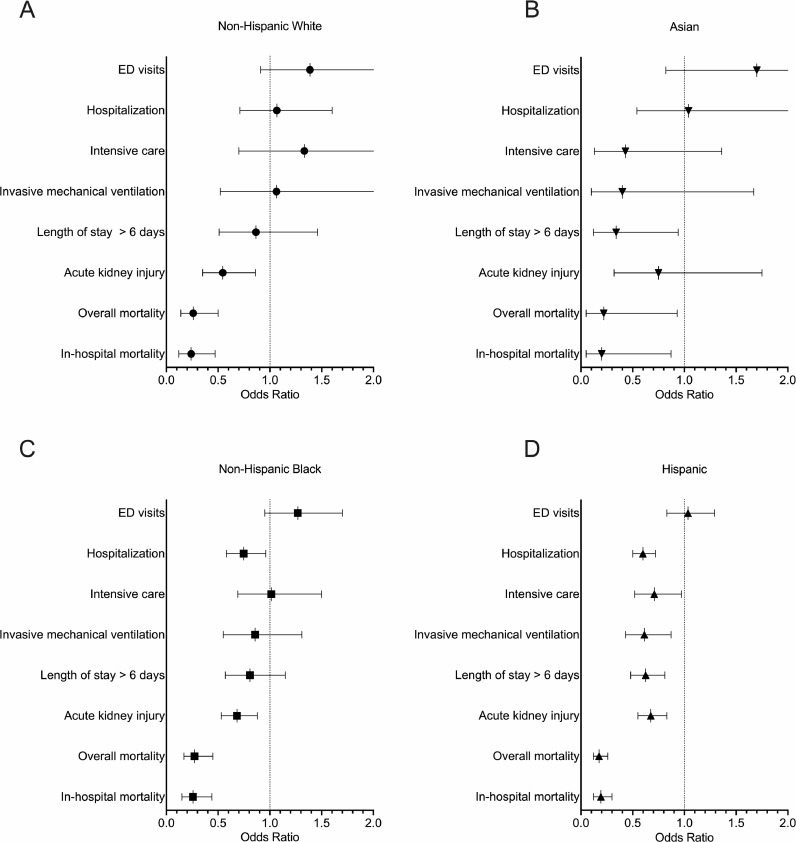
Stratified by racial and ethnic groups, age-adjusted odds ratios for primary COVID-19 outcomes in the second wave cohort relative to the first wave cohort. In the second wave, all racial and ethnic groups (A-D) had lower risk of mortality (OR < 1, 99·5% CI < 1) relative to the first wave. However, Black (C) and Hispanic (D) COVID-19 patients had more improved COVID-19 outcomes, including lower risk of hospitalization and acute kidney injury than White (A) and Asian (B) COVID-19 patients. More detailed information with exact odds ratios and 99·5% confidence intervals can be found in Supplemental Table 1.

References

    1. Zhu N., Zhang D., Wang W., et al. A novel coronavirus from patients with pneumonia in China, 2019. N Engl J Med. 2020;382(8):727–733. doi: 10.1056/NEJMoa2001017. Feb 20. - DOI - PMC - PubMed
    1. Huang C., Wang Y., Li X., et al. Clinical features of patients infected with 2019 novel coronavirus in Wuhan, China. Lancet. 2020;395(10223):497–506. doi: 10.1016/S0140-6736(20)30183-5. Feb 15. - DOI - PMC - PubMed
    1. Del Rio C., Collins L.F., Malani P. Long-term health consequences of COVID-19. JAMA. 2020 doi: 10.1001/jama.2020.19719. Oct 5. - DOI - PMC - PubMed
    1. Apea V.J., Wan Y.I., Dhairyawan R., et al. Ethnicity and outcomes in patients hospitalised with COVID-19 infection in East London: an observational cohort study. BMJ Open. 2021;11(1) doi: 10.1136/bmjopen-2020-042140. 01. - DOI - PMC - PubMed
    1. Golestaneh L., Neugarten J., Fisher M., et al. The association of race and COVID-19 mortality. EClinicalMedicine. 2020;25 doi: 10.1016/j.eclinm.2020.100455. Aug. - DOI - PMC - PubMed