


Dopamine D1R Receptor Stimulation as a Mechanistic Pro-cognitive Target for Schizophrenia
- PMID: 34423843
- PMCID: PMC8781338
- DOI: 10.1093/schbul/sbab095
Dopamine D1R Receptor Stimulation as a Mechanistic Pro-cognitive Target for Schizophrenia
Abstract
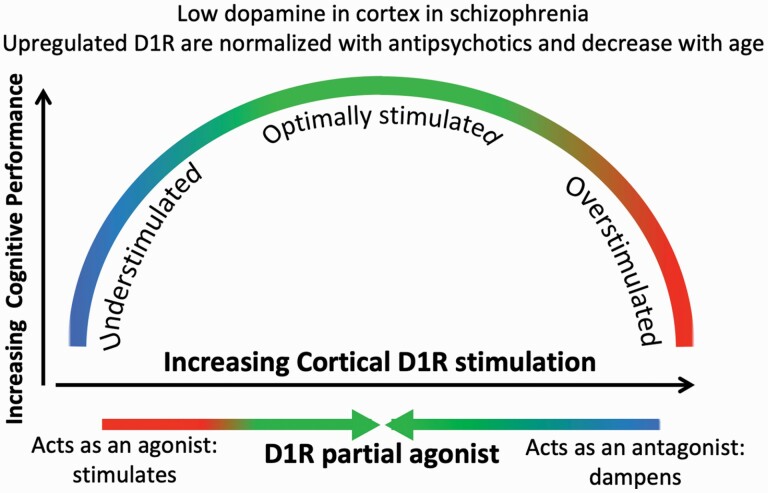
Decades of research have highlighted the importance of optimal stimulation of cortical dopaminergic receptors, particularly the D1R receptor (D1R), for prefrontal-mediated cognition. This mechanism is particularly relevant to the cognitive deficits in schizophrenia, given the abnormalities in cortical dopamine (DA) neurotransmission and in the expression of D1R. Despite the critical need for D1R-based therapeutics, many factors have complicated their development and prevented this important therapeutic target from being adequately interrogated. Challenges include determination of the optimal level of D1R stimulation needed to improve cognitive performance, especially when D1R expression levels, affinity states, DA levels, and the resulting D1R occupancy by DA, are not clearly known in schizophrenia, and may display great interindividual and intraindividual variability related to cognitive states and other physiological variables. These directly affect the selection of the level of stimulation necessary to correct the underlying neurobiology. The optimal mechanism for stimulation is also unknown and could include partial or full agonism, biased agonism, or positive allosteric modulation. Furthermore, the development of D1R targeting drugs has been complicated by complexities in extrapolating from in vitro affinity determinations to in vivo use. Prior D1R-targeted drugs have been unsuccessful due to poor bioavailability, pharmacokinetics, and insufficient target engagement at tolerable doses. Newer drugs have recently become available, and these must be tested in the context of carefully designed paradigms that address methodological challenges. In this paper, we discuss how a better understanding of these challenges has shaped our proposed experimental design for testing a new D1R/D5R partial agonist, PF-06412562, renamed CVL-562.
Keywords: D1 partial agonism; D1 receptor; cognition; schizophrenia.
© The Author(s) 2021. Published by Oxford University Press on behalf of the Maryland Psychiatric Research Center. All rights reserved. For permissions, please email: journals.permissions@oup.com.
Figures
References
-
- Saykin AJ, Shtasel DL, Gur RE, et al. . Neuropsychological deficits in neuroleptic naive patients with first-episode schizophrenia. Arch Gen Psychiatry. 1994;51(2):124–131. - PubMed
-
- Elvevåg B, Goldberg TE. Cognitive impairment in schizophrenia is the core of the disorder. Crit Rev Neurobiol. 2000;14(1):1–21. - PubMed
-
- Riley EM, McGovern D, Mockler D, et al. . Neuropsychological functioning in first-episode psychosis – evidence of specific deficits. Schizophr Res. 2000;43(1):47–55. - PubMed
-
- Weinberger DR. Implications of normal brain development for the pathogenesis of schizophrenia. Arch Gen Psychiatry. 1987;44(7):660–669. - PubMed
-
- Weinberger DR, Berman KF, Zec RF. Physiologic dysfunction of dorsolateral prefrontal cortex in schizophrenia. I. Regional cerebral blood flow evidence. Arch Gen Psychiatry. 1986;43(2):114–124. - PubMed
Publication types
MeSH terms
Substances
Grants and funding
LinkOut - more resources
Full Text Sources
Medical
