


Case-control study on the interplay between immunoparalysis and delirium after cardiac surgery
- PMID: 34425856
- PMCID: PMC8381527
- DOI: 10.1186/s13019-021-01627-3
Case-control study on the interplay between immunoparalysis and delirium after cardiac surgery
Abstract
Background: Delirium occurs frequently following cardiothoracic surgery, and infectious disease is an important risk factor for delirium. Surgery and cardiopulmonary bypass induce suppression of the immune response known as immunoparalysis. We aimed to investigate whether delirious patients had more pronounced immunoparalysis following cardiothoracic surgery than patients without delirium, to explain this delirium-infection association.
Methods: A prospective matched case-control study was performed in two university hospitals. Cytokine production (tumor necrosis factor (TNF)-α, interleukin (IL)-6, IL-8 and IL-10) of ex vivo lipopolysaccharide (LPS)-stimulated whole blood was analyzed in on-pump cardiothoracic surgery patients preoperatively, and at 5 timepoints up to 3 days after cardiothoracic surgery. Delirium was assessed by trained staff using two validated delirium scales and chart review.
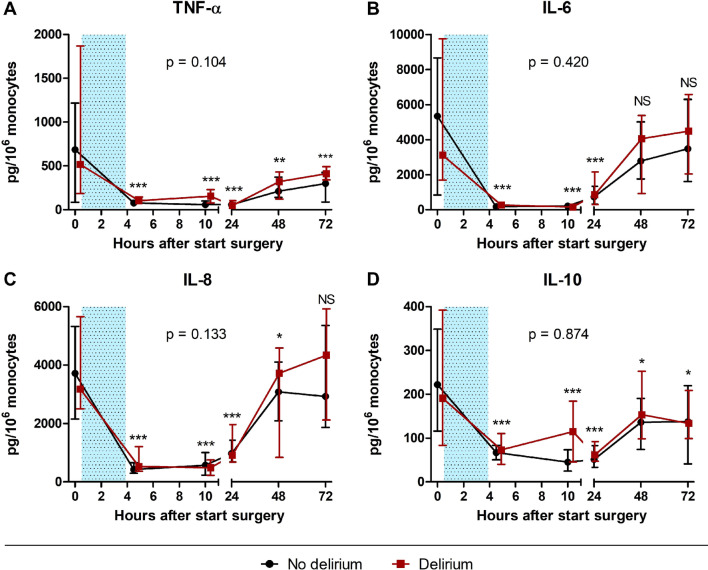
Results: A total of 89 patients were screened of whom 14 delirious and 52 non-delirious patients were included. Ex vivo-stimulated production of TNF-α, IL-6, IL-8, and IL-10 was severely suppressed following cardiothoracic surgery compared to pre-surgery. Postoperative release of cytokines in non-delirious patients was attenuated by 84% [IQR: 13-93] for TNF-α, 95% [IQR: 78-98] for IL-6, and 69% [IQR: 55-81] for IL-10. The attenuation in ex vivo-stimulated production of these cytokines was not significantly different in patients with delirium compared to non-delirious patients (p > 0.10 for all cytokines).
Conclusions: The post-operative attenuation of ex vivo-stimulated production of pro- and anti-inflammatory cytokines was comparable between patients that developed delirium and those who remained delirium-free after on-pump cardiothoracic surgery. This finding suggests that immunoparalysis is not more common in cardiothoracic surgery patients with delirium compared to those without.
Keywords: Cardiothoracic surgery; Cytokines; Delirium; Immunity; Intensive care medicine.
© 2021. The Author(s).
Conflict of interest statement
The authors declare no conflicts of interest.
Figures
References
-
- van den Boogaard M, Kox M, Quinn KL, van Achterberg T, van der Hoeven JG, Schoonhoven L, et al. Biomarkers associated with delirium in critically ill patients and their relation with long-term subjective cognitive dysfunction; indications for different pathways governing delirium in inflamed and noninflamed patients. Crit Care. 2011;15(6):R297. doi: 10.1186/cc10598. - DOI - PMC - PubMed
MeSH terms
Substances
Grants and funding
LinkOut - more resources
Full Text Sources
Medical
