


Jejunal closed-loop obstruction without prior abdominal surgery during COVID-19 ICU admittance: A case report
- PMID: 34426766
- PMCID: PMC8373852
- DOI: 10.1016/j.amsu.2021.102729
Jejunal closed-loop obstruction without prior abdominal surgery during COVID-19 ICU admittance: A case report
Abstract
Introduction: and importance: Closed-loop obstruction is a specific case of small bowel obstruction in which two sites of the bowel obstruct at one adjacent location. This can result in strangulation with high mortality. This condition is most often observed after abdominal surgery. The exact underlying pathology in patients without prior abdominal surgery is still largely unclear, and only scarce literature on the role of COVID-19 or long-term prone position is available.
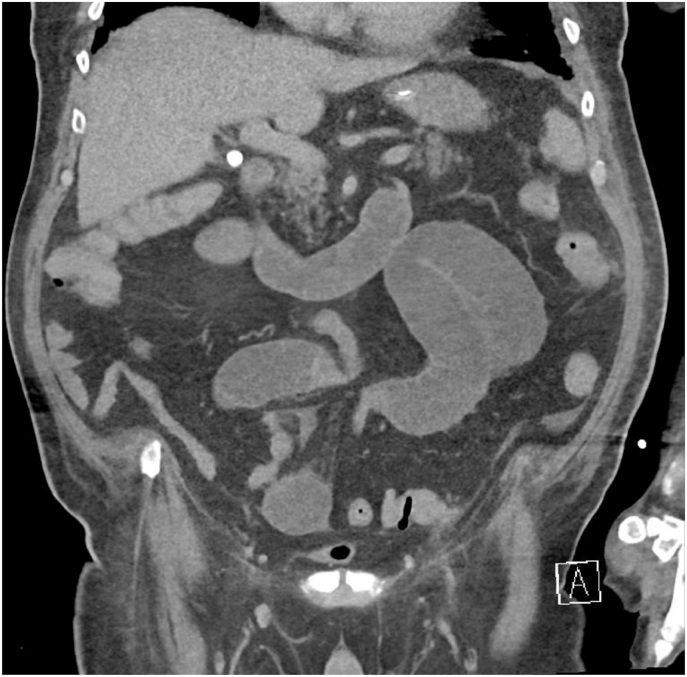
Case presentation: A 74-year-old male patient without prior abdominal surgery was presented to the emergency department with pulmonary and gastro-intestinal symptoms of COVID-19. The patient was known to have diverticulosis of colon and sigmoid. After a complicated ICU course, the patient developed a jejunal closed loop obstruction, and a diagnostic laparoscopy was performed. Fixation of the omentum to the retroperitoneum was released, without observation of further adhesions, bowel torsion or ischemic bowel. Further abdominal course was uncomplicated, however, unfortunately the patient died following pulmonary deterioration.
Clinical discussion: The differential diagnosis of small bowel obstruction is extensive; however, adhesions are most often observed. In patients without prior surgery, also adhesions are observed, mainly caused by earlier infections. There might be a role for abdominal COVID-19 infection and prolonged prone position in the emergence of adhesions; however, literature is lacking. Alternatively, asymptomatic diverticulitis might have led to adhesion formation.
Conclusion: Closed loop obstructions in patients without prior abdominal surgery are uncommon and post-infectious abdominal status might cause adhesions. It is unclear whether abdominal manifestations of COVID-19 and prolonged prone position can also cause adhesions and, thereby, small bowel obstructions.
Keywords: Adhesion; COVID-19; Case report; Jejunal closed loop obstruction; Prone position; Virgin abdomen.
© 2021 The Authors.
Conflict of interest statement
The authors do not have any conflicts of interest. This is disclosed at the end of the text.
Figures



References
-
- Rami Reddy S.R., Cappell M.S. A systematic review of the clinical presentation, diagnosis, and treatment of small bowel obstruction. Curr. Gastroenterol. Rep. 2017;19:28. - PubMed
-
- Millet I., Ruyer A., Alili C. Adhesive small-bowel obstruction: value of CT in identifying findings associated with the effectiveness of nonsurgical treatment. Radiology. 2014;273:425–432. - PubMed
-
- Balthazar E.J., George W., Holmes Lecture. CT of small-bowel obstruction. AJR Am. J. Roentgenol. 1994;162:255–261. - PubMed
-
- Agha R.A., Franchi T., Sohrabi C. The SCARE 2020 guideline: updating consensus surgical CAse REport (SCARE) guidelines. Int. J. Surg. 2020;84:226–230. - PubMed
Publication types
LinkOut - more resources
Full Text Sources
