. 2021 Aug 24;16(8):e0256306.
doi: 10.1371/journal.pone.0256306. eCollection 2021.

Immunohistochemical typing of amyloid in fixed paraffin-embedded samples by an automatic procedure: Comparison with immunofluorescence data on fresh-frozen tissue

Affiliations

Immunohistochemical typing of amyloid in fixed paraffin-embedded samples by an automatic procedure: Comparison with immunofluorescence data on fresh-frozen tissue

Antonella Barreca et al. PLoS One. .

Abstract

Amyloidosis comprises a spectrum of disorders characterized by the extracellular deposition of amorphous material, originating from an abnormal serum protein. The typing of amyloid into its many variants represents a pivotal step for a correct patient management. Several methods are currently used, including mass spectrometry, immunofluorescence, immunohistochemistry, and immunogold labeling. The aim of the present study was to investigate the accuracy and reliability of immunohistochemistry by means of a recently developed amyloid antibody panel applicable on fixed paraffin-embedded tissues in an automated platform. Patients with clinically and pathologically proven amyloidosis were divided into two cohorts: a pilot one, which included selected amyloidosis cases from 2009 to 2018, and a retrospective one (comprising all consecutive amyloidosis cases analyzed between November 2018 and May 2020). The above-referred panel of antibodies for amyloid classification was tested in all cases using an automated immunohistochemistry platform. When fresh-frozen material was available, immunofluorescence was also performed. Among 130 patients, a total of 143 samples from different organs was investigated. They corresponded to 51 patients from the pilot cohort and 79 ones from the retrospective cohort. In 82 cases (63%), fresh-frozen tissue was tested by immunofluorescence, serving to define amyloid subtype only in 30 of them (36.6%). On the contrary, the automated immunohistochemistry procedure using the above-referred new antibodies allowed to establish the amyloid type in all 130 cases (100%). These included: ALλ (n = 60, 46.2%), ATTR (n = 29, 22.3%), AA (n = 19, 14.6%), ALκ (n = 18, 13.8%), ALys (n = 2, 1.5%), and Aβ2M amyloidosis (n = 2, 1.5%). The present immunohistochemistry antibody panel represents a sensitive, reliable, fast, and low-cost method for amyloid typing. Since immunohistochemistry is available in most pathology laboratories, it may become the new gold standard for amyloidosis classification, either used alone or combined with mass spectrometry in selected cases.


Conflict of interest statement

The authors have declared that no competing interests exist.

Figures
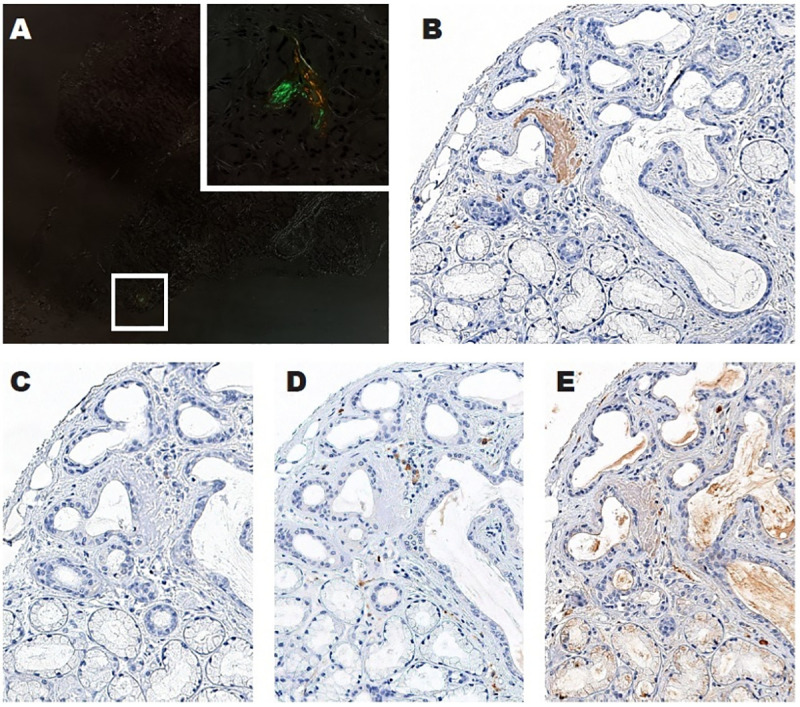
Fig 1
Fig 1. Amyloidosis diagnosis and characterization.
In this case of ATTR amyloidosis, only a quite small deposit of amyloid was identified adjacent to a duct on a salivary gland biopsy, showing the typical apple-green birefringence under cross-polarized light following Congo red staining (A, x30; inset x400). The connective tissue exhibits an unspecific white refringence. IHC allowed the characterization of this deposit, which turned out to be intensely positive for anti-ATTR (B, x400). No significant consistent staining was observed within the amyloid deposit for anti-AA (C, x400), anti-ALκ (D, x400), and anti-ALλ (E, x400). As expected, these two latter antibodies were positive in stromal plasma cells, whereas anti-ALλ had a weak non-specific background outside the amyloid deposit.
Fig 2
Fig 2. Immunohistochemistry of amyloid deposits.
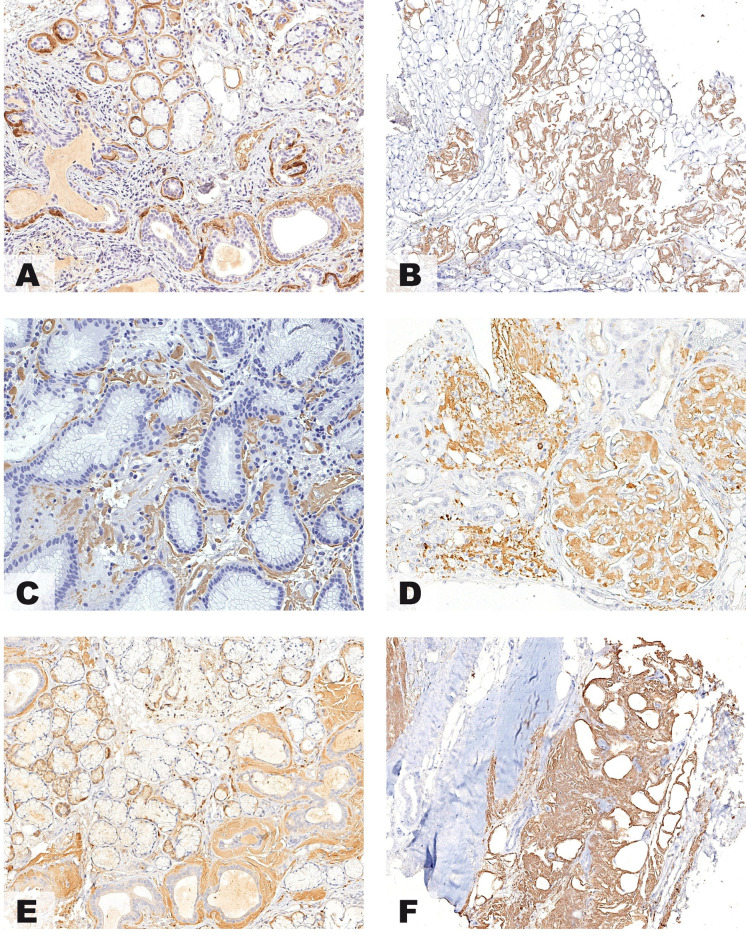
Minor salivary glands biopsy detected areas of amyloid substance in periductal and periacinar location that stained strongly only for anti-ALλ (ULI-LAT) (A, x200). Periumbilical fat biopsy in an 80-year-old male demonstrated a septal and vascular pattern of amyloid deposition that resulted brightly positive only for anti-ATTR (TIE) (B, x200). Antral gastric biopsy revealed interstitial and vascular amyloid deposits that were strongly positive only for anti-AA (red clone) (C, x200). Renal biopsy demonstrated glomerular and interstitial amyloid deposition with bright positivity for anti-ALk (KRA/KUN) (D, x200). Minor salivary glands biopsy detected, in this 42-year-old female, amyloid deposits located in the interstitium and around ducts which turned out to be intensely positive for anti-Alys (E, x200). In this case of Aβ2M amyloidosis, Congo Red staining demonstrated large deposits of amyloid in the extracapsular fibroadipose tissue of the transplanted kidney with strong positivity only for anti-Aβ2M (F, x200).

References

    1. Hawkins PN. Amyloidosis. Blood Rev. 1988Dec;2(4):270–80. doi: 10.1016/0268-960x(88)90016-1 - DOI - PubMed
    1. Linke RP. Highly sensitive diagnosis of amyloid and various amyloid syndromes using Congo red fluorescence. Virchows Arch. 2000May;436(5):439–48. doi: 10.1007/s004280050471 - DOI - PubMed
    1. Benson MD, Buxbaum JN, Eisenberg DS, Merlini G, Saraiva MJM, Sekijima Y, et al.. Amyloid nomenclature 2020: update and recommendations by the International Society of Amyloidosis (ISA) nomenclature committee. Amyloid. 2020;27(4):217–222. doi: 10.1080/13506129.2020.1835263 - DOI - PubMed
    1. Benson MD, Waddington-Cruz M, Berk JL, Polydefkis M, Dyck PJ, Wang AK, et al.. Inotersen Treatment for Patients with Hereditary Transthyretin Amyloidosis. N Engl J Med. 2018Jul5;379(1):22–31. doi: 10.1056/NEJMoa1716793 - DOI - PubMed
    1. Adams D, Gonzalez-Duarte A, O’Riordan WD, Yang CC, Ueda M, Kristen AV, et al.. Patisiran, an RNAi Therapeutic, for Hereditary Transthyretin Amyloidosis. N Engl J Med. 2018Jul5;379(1):11–21. doi: 10.1056/NEJMoa1716153 - DOI - PubMed