Policy Review and Modeling Analysis of Mitigation Measures for Coronavirus Disease Epidemic Control, Health System, and Disease Burden, South Korea
- PMID: 34429188
- PMCID: PMC8544960
- DOI: 10.3201/eid2711.203779
Policy Review and Modeling Analysis of Mitigation Measures for Coronavirus Disease Epidemic Control, Health System, and Disease Burden, South Korea
Abstract
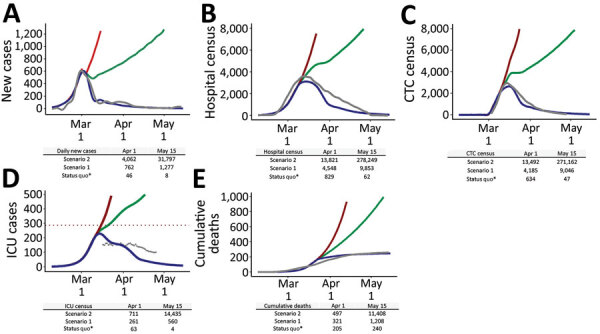
We reviewed the timeline of key policies for control of the coronavirus disease epidemic and determined their impact on the epidemic and hospital burden in South Korea. Using a discrete stochastic transmission model, we estimated that multilevel policies, including extensive testing, contact tracing, and quarantine, reduced contact rates by 90% and rapidly decreased the epidemic in Daegu and nationwide during February‒March 2020. Absence of these prompt responses could have resulted in a >10-fold increase in infections, hospitalizations, and deaths by May 15, 2020, relative to the status quo. The model suggests that reallocation of persons who have mild or asymptomatic cases to community treatment centers helped avoid overwhelming hospital capacity and enabled healthcare workers to provide care for more severely and critically ill patients in hospital beds and negative-pressure intensive care units. As small outbreaks continue to occur, contact tracing and maintenance of hospital capacity are needed.
Keywords: COVID-19; SARS-CoV-2; South Korea; coronavirus disease; coronaviruses; epidemic model; infection control; mathematical modelling; respiratory infections; severe acute respiratory syndrome coronavirus 2; viruses; zoonoses.
Figures
Similar articles
-
Transmission dynamics and control of two epidemic waves of SARS-CoV-2 in South Korea.BMC Infect Dis. 2021 May 26;21(1):485. doi: 10.1186/s12879-021-06204-6. BMC Infect Dis. 2021. PMID: 34039296 Free PMC article.
-
Cluster of Coronavirus Disease Associated with Fitness Dance Classes, South Korea.Emerg Infect Dis. 2020 Aug;26(8):1917-1920. doi: 10.3201/eid2608.200633. Epub 2020 May 15. Emerg Infect Dis. 2020. PMID: 32412896 Free PMC article.
-
Initial Assessment of the Impact of the Emergency State Lockdown Measures on the 1st Wave of the COVID-19 Epidemic in Portugal.Acta Med Port. 2020 Nov 2;33(11):733-741. doi: 10.20344/amp.14129. Epub 2020 Nov 2. Acta Med Port. 2020. PMID: 33160423
-
Childcare Exposure to Severe Acute Respiratory Syndrome Coronavirus 2 for 4-Year-Old Presymptomatic Child, South Korea.Emerg Infect Dis. 2021 Feb;27(2):341-347. doi: 10.3201/eid2702.203189. Epub 2020 Nov 30. Emerg Infect Dis. 2021. PMID: 33252327 Free PMC article. Review.
-
Human and novel coronavirus infections in children: a review.Paediatr Int Child Health. 2021 Feb;41(1):36-55. doi: 10.1080/20469047.2020.1781356. Epub 2020 Jun 25. Paediatr Int Child Health. 2021. PMID: 32584199 Review.
Cited by
-
The Effect of the COVID-19 Pandemic on Early Adolescent Fractures in the Republic of Korea.Medicina (Kaunas). 2023 Sep 15;59(9):1671. doi: 10.3390/medicina59091671. Medicina (Kaunas). 2023. PMID: 37763789 Free PMC article.
-
Changes in the mean incidence and variance of orthopedic diseases before and during the COVID-19 pandemic in Korea: a retrospective study.BMC Musculoskelet Disord. 2023 Jul 1;24(1):540. doi: 10.1186/s12891-023-06634-0. BMC Musculoskelet Disord. 2023. PMID: 37393227 Free PMC article.
References
-
- World Health Organization. WHO coronavirus disease (COVID-19) dashboard, 2021. [cited 2021 Aug 12]. https://covid19.who.int - PubMed
-
- Daegu Disaster Management Headquarters. COVID-19 daily briefing in Daegu metropolitan City, 2020. [cited 2020 Jun 30]. https://www.daegu.go.kr/dgcontent/index.do?menu_id=00936590
Publication types
MeSH terms
LinkOut - more resources
Full Text Sources
Medical
Research Materials
Miscellaneous