Review
. 2021 Aug 25;12(1):121.
doi: 10.1186/s13244-021-01035-0.

Role of diagnostic imaging in psoriatic arthritis: how, when, and why

Affiliations
Review

Role of diagnostic imaging in psoriatic arthritis: how, when, and why

Ana María Crespo-Rodríguez et al. Insights Imaging. .

Abstract

Psoriasis is a common skin disease. Up to 30% of patients with psoriasis develop psoriatic arthritis (PsA) resulting, by far, the most prevalent coexisting condition. Heterogeneity of clinical and radiological presentation is a major challenge to diagnosis of PsA. Initial reports about PsA emphasized a benign course in most patients, but it is now recognized that psoriatic arthritis often leads to impaired function and a reduced quality of life. PsA is a progressive disease characterized by diverse clinical features, often resulting in diagnostic delay and treatment that are associated with poor clinical and structural outcomes. New effective treatments may halt PsA progression, and consequently, treatment goals have evolved from simple reduction of pain to achieving full remission or minimal disease activity. This emerging treat-to-target strategy paradigm emphasize a need for early diagnosis; sensitive imaging techniques may be of value in this process. While radiography and CT depict structural damage, US and MRI have emerged as helpful tools to evaluate magnitude and severity of active inflammatory lesions. This review aims to describe the role of imaging modalities in diagnosis, follow-up and prognosis of PsA.

Keywords: Arthritis; Magnetic resonance imaging; Psoriatic arthritis; Radiography; Ultrasound.


Figures

Fig. 1
Fig. 1
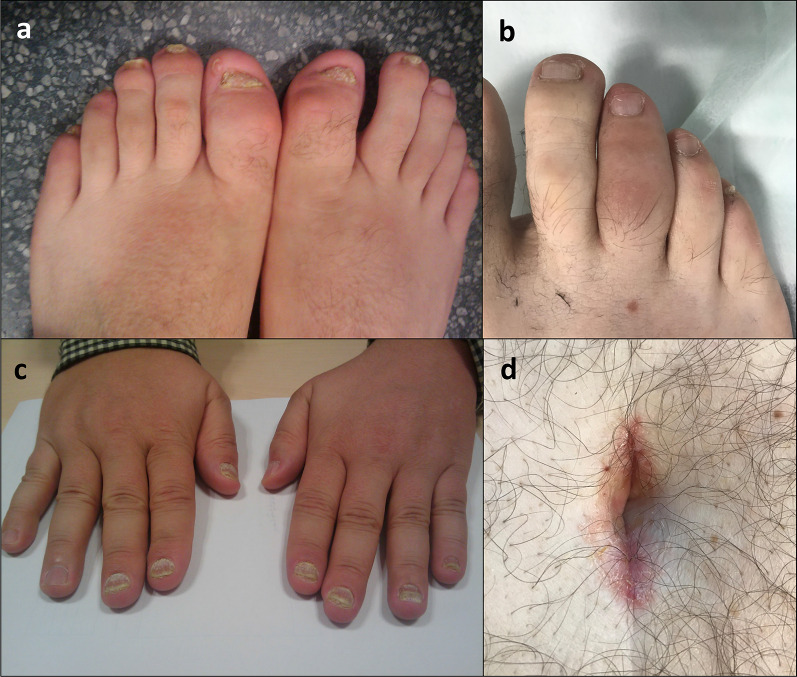
a, c Pitting and ridging of the nails is a common sign of psoriasis and also in psoriatic arthritis. b Dactylitis, uniform sausage-like swelling of the whole digit either finger or toe, is a hallmark clinical feature of PsA. d Umbilicus, as well as behind the ears and at the top of the natal cleft are hidden areas for skin psoriasis
Fig. 2
Fig. 2
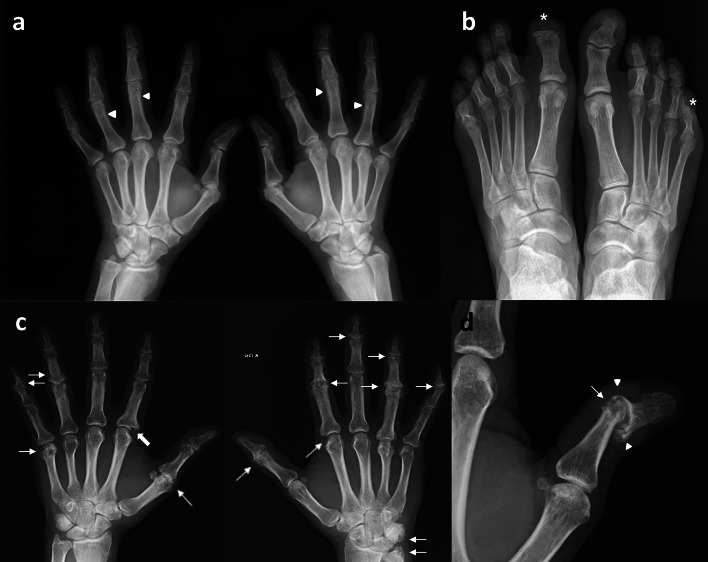
A characteristic patter of PsA is the coexistence of erosive changes and new bone formation as in this example where the same patient (a, b) presented with fluffy periotitis in the proximal phalanges in both hands (arrow head) and acro-osteolysis (*) in the distal phalanges of the first toe in the right foot and the fifth toe of the left foot. c Polyarticular and asymmetrical PsA on hands with interphalangeal joints involved showing articular space narrowing and erosions (thin arrows), one of them is a Ω shaped erosion (thick arrow). d Subluxation and pencil-in-cup appereance in interphalangeal joint of the thumb in this particular case is another example of typical radiological changes in peripheral PsA. Bony erosions narrowed the end of the proximal phalange as a “pencil” (thin arrows) which rested in “cup” formed by the expanded base of the adjacent phalange (arrow head)
Fig. 3
Fig. 3
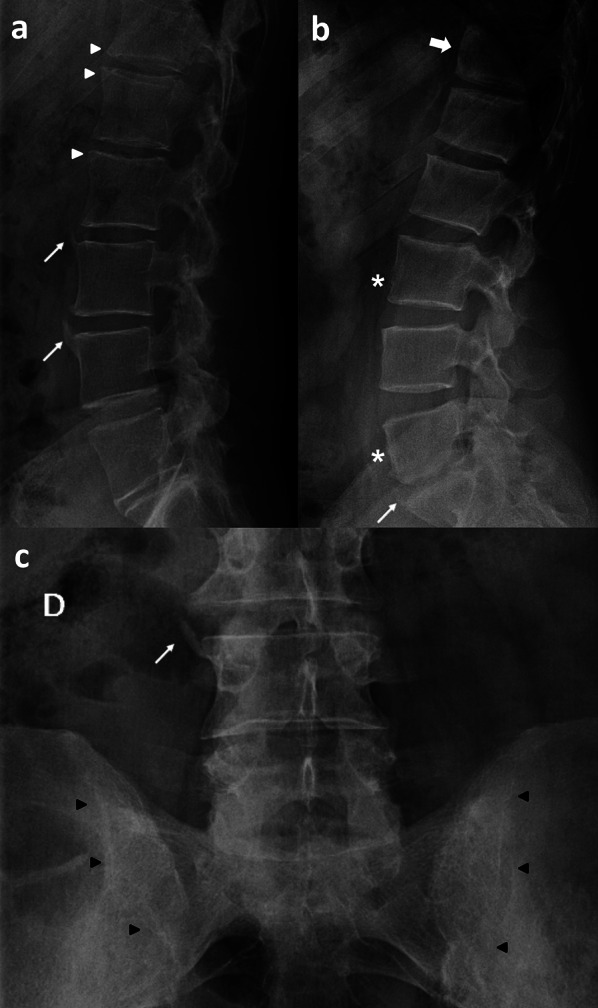
a Syndesmophytes at the anterosuperior endplate of L3 and L4 vertebrae (thin arrows) and Romanus lesions (erosions) at the anterior endplate of T12, L1 and L2 vertebrae (white arrow heads). b Square vertebrae (*) and barrel‐shaped vertebrae (thick arrow) show straightening or convex bulging of the ventral aspect of the vertebral body, mainly in the thoracolumbar junction and lumbar segments as a result of inflammation. c Right lateral syndesmophyte (thin arrow) at the superior endplate of L4 vertebra and sacroiliac ankyloses (black arrow heads)
Fig. 4
Fig. 4
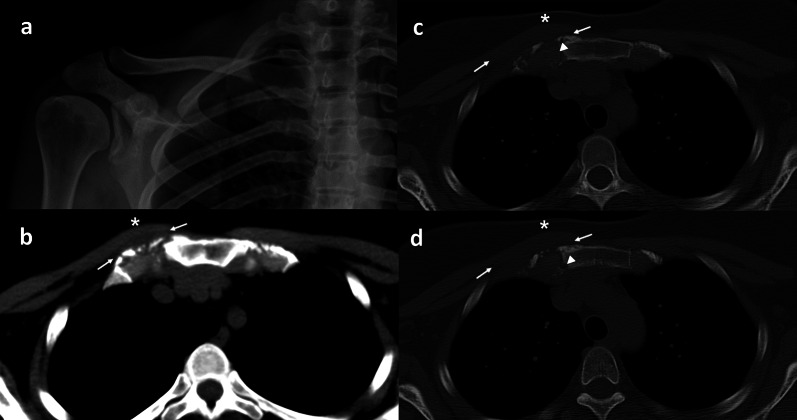
Right first sternochondral psoriatic arthritis in a 36-year-old woman. CT adds valuable information in anatomical complex areas like in this patient with normal X-ray examination of the right shoulder girdle including the right sternoclavicular joint (a). Axial CT images, either on soft tissue windowing (a) or bone algorithm (c, d) show asymmetry (*) and the loss of definition of the surrounding fat planes (thin arrows) between the first sternochondral joint and the muscles can also be appreciated. Small erosions in the sternal side are also visible (arrow heads)
Fig. 5
Fig. 5
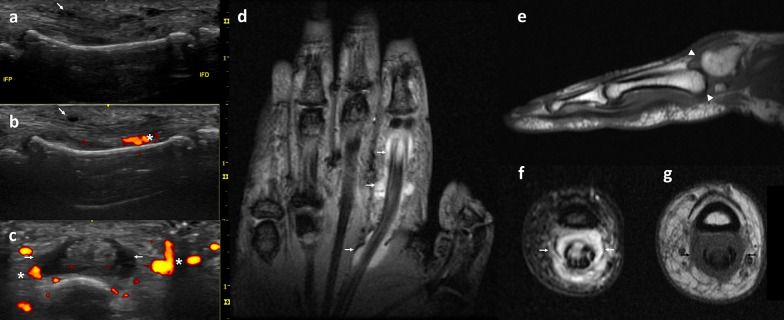
A 48-year-old woman presenting with dactylitis of the second finger of the hand. US examination (ac) shows a hypoechoic swelling surrounding the flexor digitorum tendons (thin arrow) with Power Doppler signal showing hypervascularity (*) related to tenosynovitis of flexor tendon of the second finger on longitudinal (a, b) and axial (c) views. MR examination adds a general view of the hand in this coronal STIR wi (d) that shows fluid surrounding the second flexor digitorum tendons (thin arrows). Sagittal T1 wi (e) shows subluxation of the second carpo-metacarpal joint (arrow heads). Axial views weigthed on STIR (f) and T1 (g) show extensive tenosynovitis (thin arrows) of the flexor tendons
Fig. 6
Fig. 6
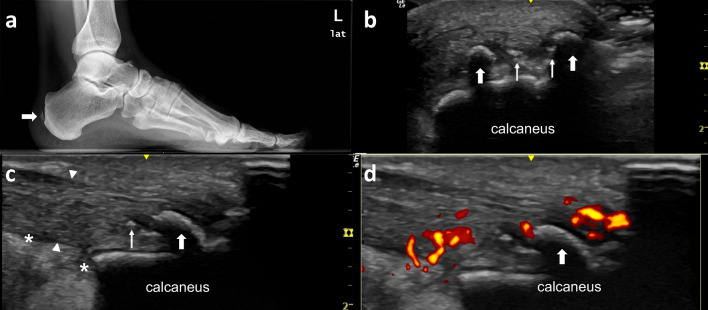
The Achilles tendon is among the most frequent sites of enthesopathic involvement in PsA. Forty-two-year-old male presenting with heel pain and difficulty walking. a Lateral X-Ray film shows a gross calcifications (thick arrow) at the distal Achilles tendon. These calficiations do not contact with the calcaneous bone and margins are ill-defined. On US examinations (b) these gross calcifications are identified as hyperechogenic surface with a posterior shadow (thick arrows) while other puntiforms hyperechogenic foci (thin arrow) do not have shadow and seems to be incipient calcification. c The Achilles tendon insertion is diffuse thickened (arrow head) and there is some fluid (*) at Kagger’s fat pad. d Color Doppler examination shows hypervascularity at the thickened Achilles tendon insertion at the calcaneous
Fig. 7
Fig. 7
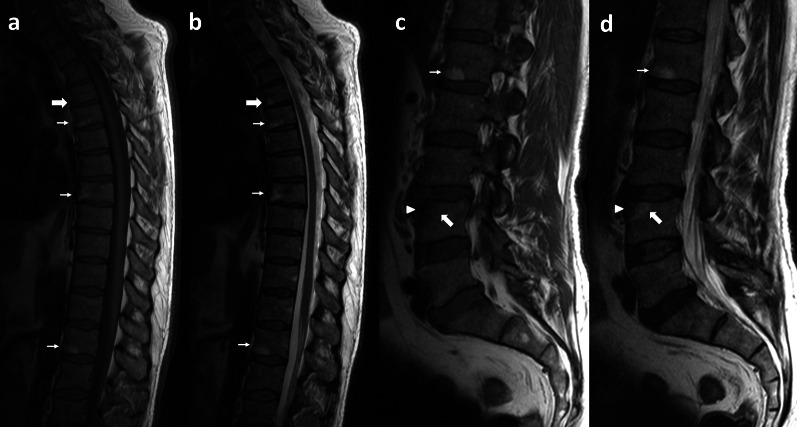
Sixty-year-old male with axial and peripheral PsA. Psoriatic spondiloarthropathy in this particular case presents with skip Romanus lesions at different stages. All of them shows bone erosion at the vertebral body corners. Signal intensity of adjacent bone reveals chronology of the lesion: Acute Romanus lesions at the anteroinferior endplate of T4 vertebra shows low signal intensity on T1 wi (a) and high signal intensity on T2 wi (b) due to bony edema. Subacute Romanus lesions at the anteroinferior endplate of T5, T8 and L1 vertebra shows high signal intensity on T1 wi (a, c) and high signal intensity on T2 wi (b, d) in relation to fatty replacement. Romanus lesion at the anterosuperior endplate of L4 vertebra shows chronic features with erosion and sclerosis (arrow head) and peripherally inflammatory changes with bone edema (thick arrow)

References

    1. Ritchlin CT, Colbert RA, Gladman DD. Psoriatic arthritis. N Engl J Med. 2017;376:957–970. doi: 10.1056/NEJMra1505557. - DOI - PubMed
    1. Veale DJ, Fearon U. The pathogenesis of psoriatic arthritis. Lancet. 2018;391(10136):2273–2284. doi: 10.1016/S0140-6736(18)30830-4. - DOI - PubMed
    1. Nijsten T, Wakkee M. Complexity of the association between psoriasis and comorbidities. J Invest Dermatol. 2009;129:1601–1603. doi: 10.1038/jid.2009.55. - DOI - PubMed
    1. Gladman DD. Current concepts in psoriatic arthritis. Curr Opin Rheumatol. 2002;14:361–366. doi: 10.1097/00002281-200207000-00005. - DOI - PubMed
    1. Alamanos Y, Voulgari PV, Drosos AA. Incidence and prevalence of psoriatic arthritis: a systematic review. J Rheumatol. 2008;35:1354–1358. - PubMed