


Impact of the COVID-19 pandemic on the incidence of dengue fever in Peru
- PMID: 34436792
- PMCID: PMC8661613
- DOI: 10.1002/jmv.27298
Impact of the COVID-19 pandemic on the incidence of dengue fever in Peru
Abstract
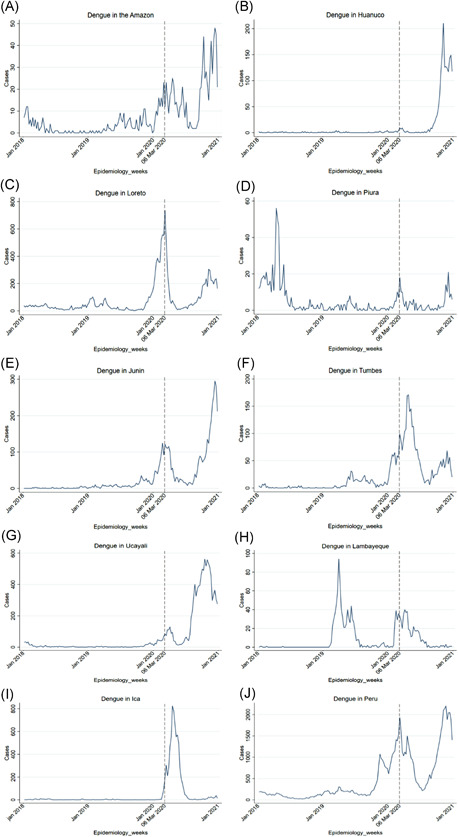
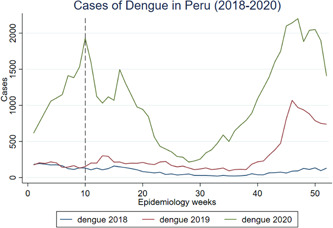
Dengue virus and severe acute respiratory syndrome coronavirus 2 coexist in dengue-endemic countries; therefore, the adoption of preventive measures is essential to control the spread of both viruses. We conducted an ecological study to compare the temporal patterns of the incidence of dengue before and during the Coronavirus disease 2019 (COVID-19) pandemic in Peru. A time-series analysis comparing the incidence of dengue using a Student's t test with variance correction was performed. Poisson regression was applied to determine the incidence rate ratio (IRR) of dengue before and during the COVID-19 pandemic. The incidence of dengue was found to be increased in all endemic regions of Peru during the COVID-19 pandemic, with the highest incidences registered in Ica (IRR = 90.14), Huánuco (IRR = 38.6), and Ucayali (IRR = 23.78), with the exception of Piura (IRR = 0.83). The highest increases in the number of dengue cases per million inhabitants were in Ucayali (393.38), Tumbes (233.19), Ica (166.08), and Loreto (129.93). The gradient of dengue cases was positive in all endemic regions during the COVID-19 pandemic. The number of dengue cases per million increased during the COVID-19 pandemic throughout Peru and in several endemic regions, with the exception of Piura.
Keywords: COVID-19; SARS-CoV-2; dengue; interrupted time series analysis, Peru.
© 2021 Wiley Periodicals LLC.
Conflict of interest statement
The authors declare that there are no conflict of interests.
Figures
References
-
- WHO Dengue and severe dengue [sede Web]. Washington D.C. USA; 2020. https://www.who.int/news-room/fact-sheets/detail/dengue-and-severe-dengue. Accessed August 18, 2020.
-
- Ledermann DW. El hombre y sus epidemias a través de la historia. Revista chilena de infectología. 2003;20:13‐17.
-
- Caylà JA. Epidemias mediáticas: una reflexión para la salud pública. Gac Sanit. 2009;23:362‐364. - PubMed
-
- Organización Mundial de la Salud . COVID‐19: cronología de la actuación de la OMS. [sede Web]. Washington. [Última actualización: 29 de enero de 2021; acceso: 10 de febrero de 2021]. Disponible en: https://www.who.int/es/news/item/29-06-2020-covidtimeline
MeSH terms
LinkOut - more resources
Full Text Sources
Medical
Miscellaneous
