. 2021 Aug 21;10(8):1017.
doi: 10.3390/antibiotics10081017.

Thermal Shock and Ciprofloxacin Act Orthogonally on Pseudomonas aeruginosa Biofilms

Affiliations

Thermal Shock and Ciprofloxacin Act Orthogonally on Pseudomonas aeruginosa Biofilms

Haydar Aljaafari et al. Antibiotics (Basel). .

Abstract

Bacterial biofilm infections are a major liability of medical implants, due to their resistance to both antibiotics and host immune response. Thermal shock can kill established biofilms, and some evidence suggests antibiotics may enhance this efficacy, despite having an insufficient effect themselves. The nature of this interaction is unclear, however, complicating efforts to integrate thermal shock into implant infection treatment. This study aimed to determine whether these treatments were truly synergistic or simply orthogonal (i.e., independent). Pseudomonas aeruginosa biofilms of different architectures and stationary-phase population density were subjected to various thermal shocks, antibiotic exposures, or combinations thereof, and examined either immediately after treatment or after subsequent reincubation. Population decreases from the combination treatment matched the product of the decreases of individual treatments, indicating their orthogonality. However, reincubation showed binary behavior, where biofilms with an immediate population decrease beyond a critical factor (~104) died off completely during reincubation, while biofilms with a smaller immediate decrease regrew. This critical factor was independent of the initial population density and the combination of treatments that achieved the immediate decrease. While antibiotics do not appear to enhance thermal shock directly, their contribution to achieving a critical population decrease for biofilm elimination can make the treatments appear strongly synergistic, strongly decreasing the intensity of thermal shock needed.

Keywords: antibacterial agents; biofilms; ciprofloxacin; heat shock; prosthesis-related infections.


Conflict of interest statement

The authors declare no conflict of interest, and the funders had no role in the design of the study; in the collection, analyses, or interpretation of data; in the writing of the manuscript, or in the decision to publish the results.

Figures
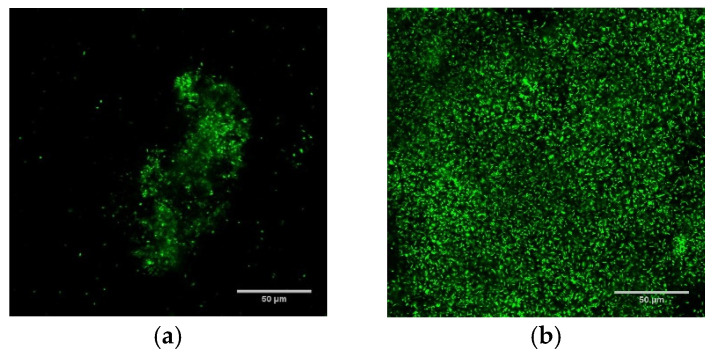
Figure 1
Figure 1
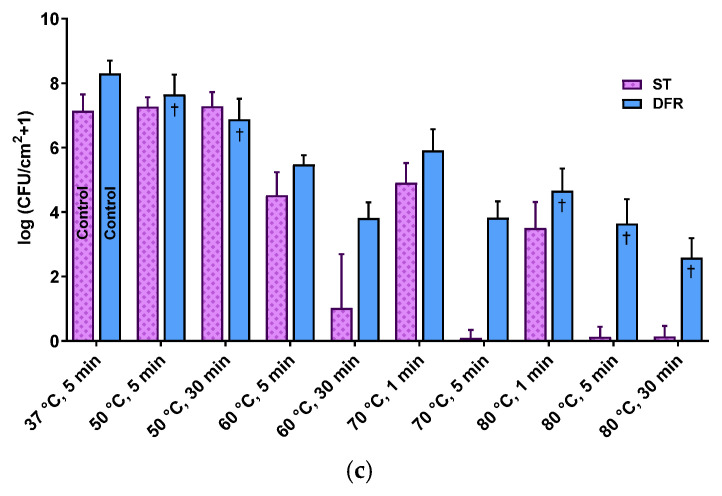
Culture protocols produce biofilm with starkly different population density, architecture, and thermal susceptibility. (a,b) are overhead views of confocal fluorescent images of shaker table (a) and drip flow reactor (b) biofilms. (c) Effect of thermal shock on population density of P. aeruginosa ST and DFR biofilms. † from [35].
Figure 1
Figure 1
Culture protocols produce biofilm with starkly different population density, architecture, and thermal susceptibility. (a,b) are overhead views of confocal fluorescent images of shaker table (a) and drip flow reactor (b) biofilms. (c) Effect of thermal shock on population density of P. aeruginosa ST and DFR biofilms. † from [35].
Figure 2
Figure 2
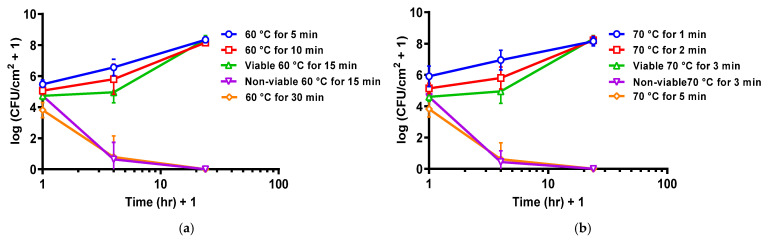
Critical population density for DFR biofilm reincubation. (a) Population density for DFR biofilm reincubation after thermal shock at 60 °C. (b) Population density for DFR biofilm reincubation after thermal shock at 70 °C. Error bars indicate standard deviation for at least six slides from three different dishes.
Figure 3
Figure 3
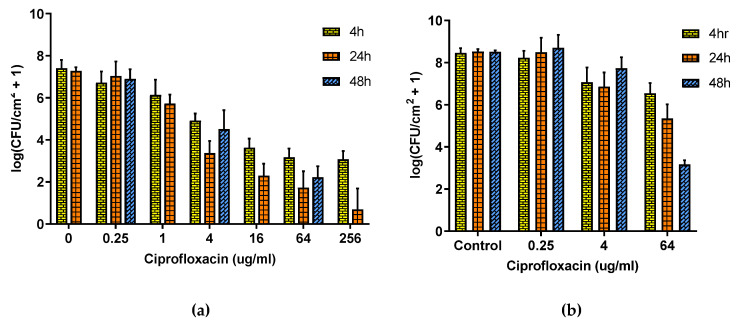
Effect of Ciprofloxacin on ST and DFR biofilms. (a) Effect of Ciprofloxacin on ST biofilm. (b) Effect of Ciprofloxacin on DFR biofilm. Error bars indicate standard deviation for at least six slides from three different dishes.
Figure 4
Figure 4
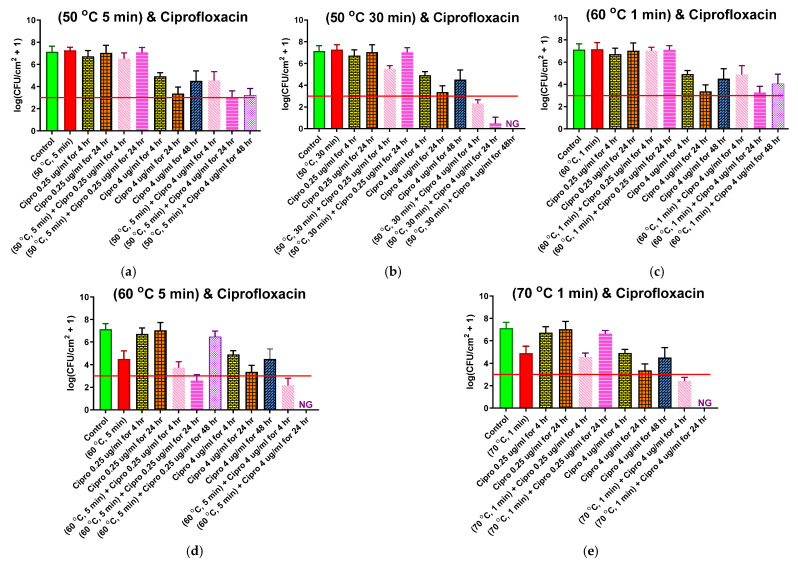
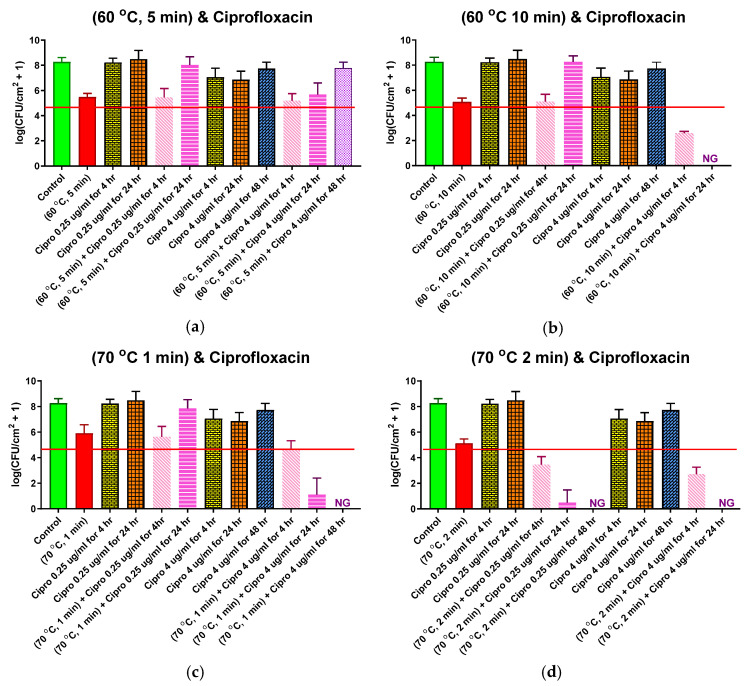
Combined ciprofloxacin and thermal shock effect on the P. aeruginosa shaker table biofilm population. Each panel shows results for the thermal shock and antibiotic exposure indicated. Red horizontal lines show the critical population density below which thermal shocked bacterial biofilms are not viable. Error bars indicate standard deviation for at least six slides from three different dishes.
Figure 5
Figure 5
Combined ciprofloxacin and thermal shock effect on the P. aeruginosa drip flow reactor biofilm population. Each panel shows results for the thermal shock and antibiotic exposure indicated. Red horizontal lines show the critical population density below which thermal shocked bacterial biofilms are not viable. Error bars indicate standard deviation for at least six slides from three different dishes.

References

    1. McDermott K.W., Freeman W.J., Elixhauser A. Overview of Operating Room Procedures during Inpatient Stays in U.S. Hospitals, 2014. Agency for Healthcare Research and Quality; Rockville, MD, USA: 2017. HCUP Statistical brief #233. - PubMed
    1. O’Toole P., Maltenfort M.G., Chen A.F., Parvizi J. Projected increase in periprosthetic joint infections secondary to rise in diabetes and obesity. J. Arthroplast. 2016;31:7–10. doi: 10.1016/j.arth.2015.07.034. - DOI - PubMed
    1. Parvizi J., Ghanem E., Azzam K., Davis E., Jaberi F., Hozack W. Periprosthetic infection: Are current treatment strategies adequate? Acta Orthop. Belg. 2008;74:793–800. - PubMed
    1. Phillips J.E., Crane T.P., Noy M., Elliott T.S.J., Grimer R.J. The incidence of deep prosthetic infections in a specialist orthopaedic hospital. J. Bone Jt. Surg. Br. Vol. 2006;88:943–948. doi: 10.1302/0301-620X.88B7.17150. - DOI - PubMed
    1. Cui Q., Mihalko W.M., Shields J.S., Ries M., Saleh K.J. Antibiotic-impregnated cement spacers for the treatment of infection associated with total hip or knee arthroplasty. J. Bone Jt. Surg. Am. Vol. 2007;89:871–882. doi: 10.2106/00004623-200704000-00026. - DOI - PubMed

LinkOut - more resources