. 2021 Aug 4;9(8):957.
doi: 10.3390/biomedicines9080957.

Persistent Endothelial Dysfunction in Post-Acute COVID-19 Syndrome: A Case-Control Study

Affiliations

Persistent Endothelial Dysfunction in Post-Acute COVID-19 Syndrome: A Case-Control Study

Pasquale Ambrosino et al. Biomedicines. .

Abstract

Background: Endothelial dysfunction has a key role in the pathogenesis of coronavirus disease 2019 (COVID-19) and its disabling complications. We designed a case-control study to assess the alterations of endothelium-dependent flow-mediated dilation (FMD) among convalescent COVID-19 patients.

Methods: COVID-19 patients referred to a Pulmonary Rehabilitation Unit within 2 months from swab test negativization were consecutively evaluated for inclusion and compared to controls matched for age, gender, and cardiovascular risk factors.

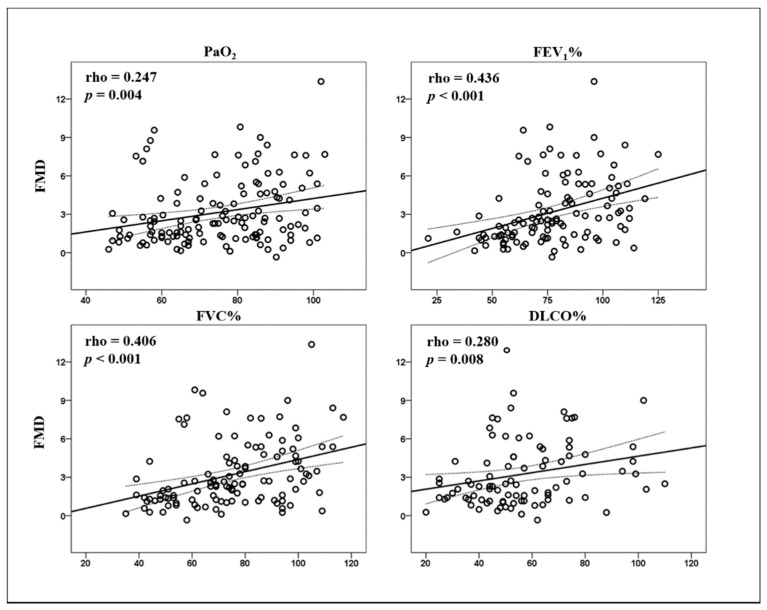
Results: A total of 133 convalescent COVID-19 patients (81.2% males, mean age 61.6 years) and 133 matched controls (80.5% males, mean age 60.4 years) were included. A significantly lower FMD was documented in convalescent COVID-19 patients as compared to controls (3.2% ± 2.6 vs. 6.4% ± 4.1 p < 0.001), confirmed when stratifying the study population according to age and major clinical variables. Among cases, females exhibited significantly higher FMD values as compared to males (6.1% ± 2.9 vs. 2.5% ± 1.9, p < 0.001). Thus, no significant difference was observed between cases and controls in the subgroup analysis on females (6.1% ± 2.9 vs. 5.3% ± 3.4, p = 0.362). Among convalescent COVID-19 patients, FMD showed a direct correlation with arterial oxygen tension (rho = 0.247, p = 0.004), forced expiratory volume in 1 s (rho = 0.436, p < 0.001), forced vital capacity (rho = 0.406, p < 0.001), and diffusing capacity for carbon monoxide (rho = 0.280, p = 0.008). Overall, after adjusting for major confounders, a recent COVID-19 was a major and independent predictor of FMD values (β = -0.427, p < 0.001).

Conclusions: Post-acute COVID-19 syndrome is associated with a persistent and sex-biased endothelial dysfunction, directly correlated with the severity of pulmonary impairment.

Keywords: COVID-19; biomarkers; disability; endothelial function; exercise; outcomes; rehabilitation.


Conflict of interest statement

The authors declare no conflict of interest.

Figures

Figure 1
Figure 1
Difference in flow-mediated dilation (FMD) between convalescent coronavirus disease 2019 (COVID-19) patients and controls stratified according to demographic and clinical characteristics. CV: Cardiovascular.
Figure 2
Figure 2
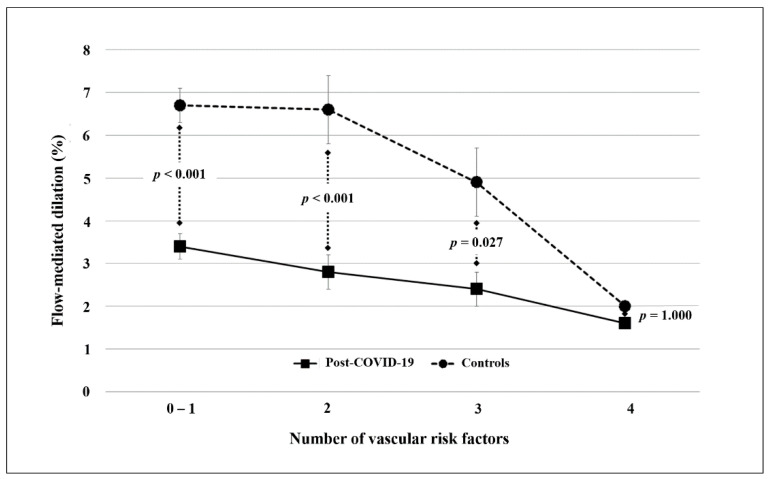
Difference in flow-mediated dilation (FMD) between convalescent coronavirus disease 2019 (COVID-19) patients and controls stratified according to the number of vascular risk factors.
Figure 3
Figure 3
Scatter plot of Spearman’s correlations between flow-mediated dilation (FMD) and arterial oxygen tension (PaO2), forced expiratory volume in 1 s (FEV1%), forced vital capacity (FVC%), and diffusing capacity for carbon monoxide (DLCO%) in convalescent coronavirus disease 2019 (COVID-19) patients.
Figure 4
Figure 4
Physiopathology of endothelial dysfunction and gender differences in coronavirus disease 2019 (COVID-19). SARS-CoV-2: Severe acute respiratory syndrome coronavirus 2; TNFα: Tumor necrosis factor alfa; ADAM17: A disintegrin and metalloprotease 17; ACE2: Angiotensin converting enzyme 2; Ang II: Angiotensin II; Ang 1–7: Angiotensin1–7; MAS: Proto-oncogene G-protein–coupled receptor; AT1: Angiotensin receptor type 1; AT2: Angiotensin receptor type 2; AT4: Angiotensin receptor type 4; Gα12/13: Guanine nucleotide-binding protein alpha 12/13; RhoA: Ras homolog family member A; ROCK: Rho-associated protein kinase; p38 MAPK: p38 mitogen-activated protein kinase; NO: Nitric oxide.

References

    1. Wang F.S., Zhang C. What to do next to control the 2019-nCoV epidemic? Lancet. 2020;395:391–393. doi: 10.1016/S0140-6736(20)30300-7. - DOI - PMC - PubMed
    1. Jin Y., Yang H., Ji W., Wu W., Chen S., Zhang W., Duan G. Virology, Epidemiology, Pathogenesis, and Control of COVID-19. Viruses. 2020;12:372. doi: 10.3390/v12040372. - DOI - PMC - PubMed
    1. Hu B., Guo H., Zhou P., Shi Z.L. Characteristics of SARS-CoV-2 and COVID-19. Nat. Rev. Microbiol. 2021;19:141–154. doi: 10.1038/s41579-020-00459-7. - DOI - PMC - PubMed
    1. Huang C., Wang Y., Li X., Ren L., Zhao J., Hu Y., Zhang L., Fan G., Xu J., Gu X., et al. Clinical features of patients infected with 2019 novel coronavirus in Wuhan, China. Lancet. 2020;395:497–506. doi: 10.1016/S0140-6736(20)30183-5. - DOI - PMC - PubMed
    1. Kamal M., Abo Omirah M., Hussein A., Saeed H. Assessment and characterisation of post-COVID-19 manifestations. Int. J. Clin. Pract. 2021;75:e13746. doi: 10.1111/ijcp.13746. - DOI - PMC - PubMed

LinkOut - more resources