. 2021 Aug 9;9(8):981.
doi: 10.3390/biomedicines9080981.

HMP-S7 Is a Novel Anti-Leukemic Peptide Discovered from Human Milk

Affiliations

HMP-S7 Is a Novel Anti-Leukemic Peptide Discovered from Human Milk

Wararat Chiangjong et al. Biomedicines. .

Abstract

Chemotherapy in childhood leukemia is associated with late morbidity in leukemic survivors, while certain patient subsets are relatively resistant to standard chemotherapy. It is therefore important to identify new agents with sensitivity and selectivity towards leukemic cells, while having less systemic toxicity. Peptide-based therapeutics has gained a great deal of attention during the last few years. Here, we used an integrative workflow combining mass spectrometric peptide library construction, in silico anticancer peptide screening, and in vitro leukemic cell studies to discover a novel anti-leukemic peptide having 3+ charges and an alpha helical structure, namely HMP-S7, from human breast milk. HMP-S7 showed cytotoxic activity against four distinct leukemic cell lines in a dose-dependent manner but had no effect on solid malignancies or representative normal cells. HMP-S7 induced leukemic cell death by penetrating the plasma membrane to enter the cytoplasm and cause the leakage of lactate dehydrogenase, thus acting in a membranolytic manner. Importantly, HMP-S7 exhibited anti-leukemic effects against patient-derived leukemic cells ex vivo. In conclusion, HMP-S7 is a selective anti-leukemic peptide with promise, which requires further validation in preclinical and clinical studies.

Keywords: anticancer peptide; drug discovery; human milk; leukemia; machine learning; mass spectrometry; peptidomics.


Conflict of interest statement

The authors declare no conflict of interest.

Figures
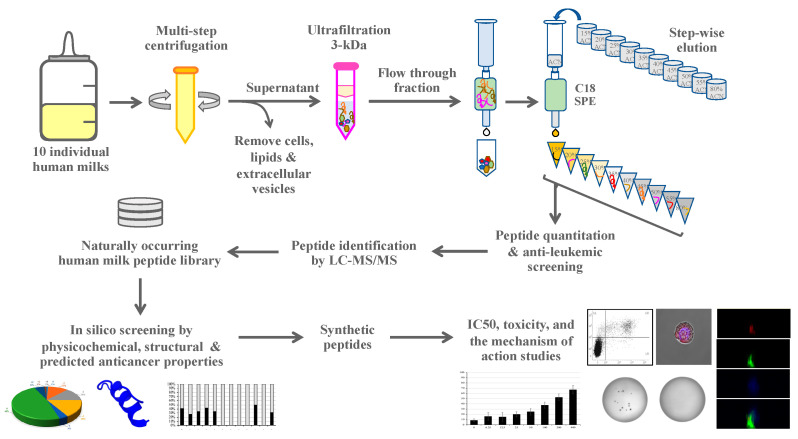
Figure 1
Figure 1
A conceptual framework of the integrative strategy for discovering a novel human-milk-derived antileukemic peptide. This strategy combines the strengths of mass spectrometry for high-throughput peptide identification, in silico screening for prioritizing peptide candidates, and experimental validation for antileukemic activities. Abbreviations: LC-MS/MS, liquid chromatography-tandem mass spectrometry; IC50, half-maximal inhibitory concentration; SPE, solid-phase extraction.
Figure 2
Figure 2
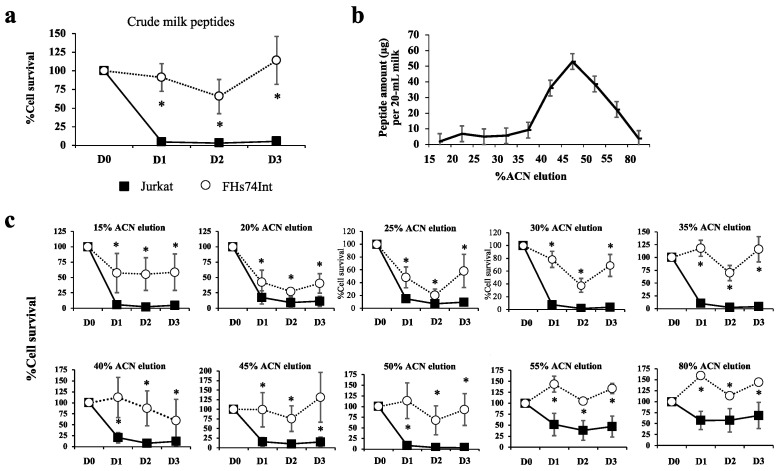
Fractionation of peptides from human milk and cytotoxicity of fractions towards leukemic and normal cells. Ten samples of human milk were divided into 3 pools. Twenty milliliters of each pool were centrifuged at 4 °C to remove cells, lipid, and extracellular vesicles. The crude milk peptides obtained from each pool were separately eluted through a cut-off column of <3 kDa, and the eluate was loaded to a C18 SPE column. Milk peptides bound to the C18 SPE column were eluted with various concentrations of acetonitrile (ACN) from 15% ACN to 80% ACN (1 mL each). Eluted fractions of milk peptides were dried using a SpeedVac concentrator, resuspended in a culture medium and then used to treat Jurkat (black square) and FHs74Int cells (white circle), using 3 biological replicates. WST-1 assay was applied to measure cell viability. (a) % cell survival (mean ± SEM) after the treatment of cells with crude milk peptides for 1 (D1), 2 (D2), or 3 (D3) days, compared to those of the untreated control (D0); (b) amounts of peptides eluted from the C18 SPE column eluted in a stepwise manner using 1 mL each of increasing ACN concentrations of 15%, 20%, 25%, 30%, 35%, 40%, 45%, 50%, 55%, and 80% ACN. Peptides were quantitated by the Bradford method and shown as mean ± SEM; (c) % cell survival (mean ± SEM) after the treatment of cells with eluates obtained at different %ACN concentration, for 1 day (D1), 2 days (D2), or 3 (D3) days, compared to those of the untreated controls (D0). * p < 0.05 comparing to the untreated condition.
Figure 3
Figure 3
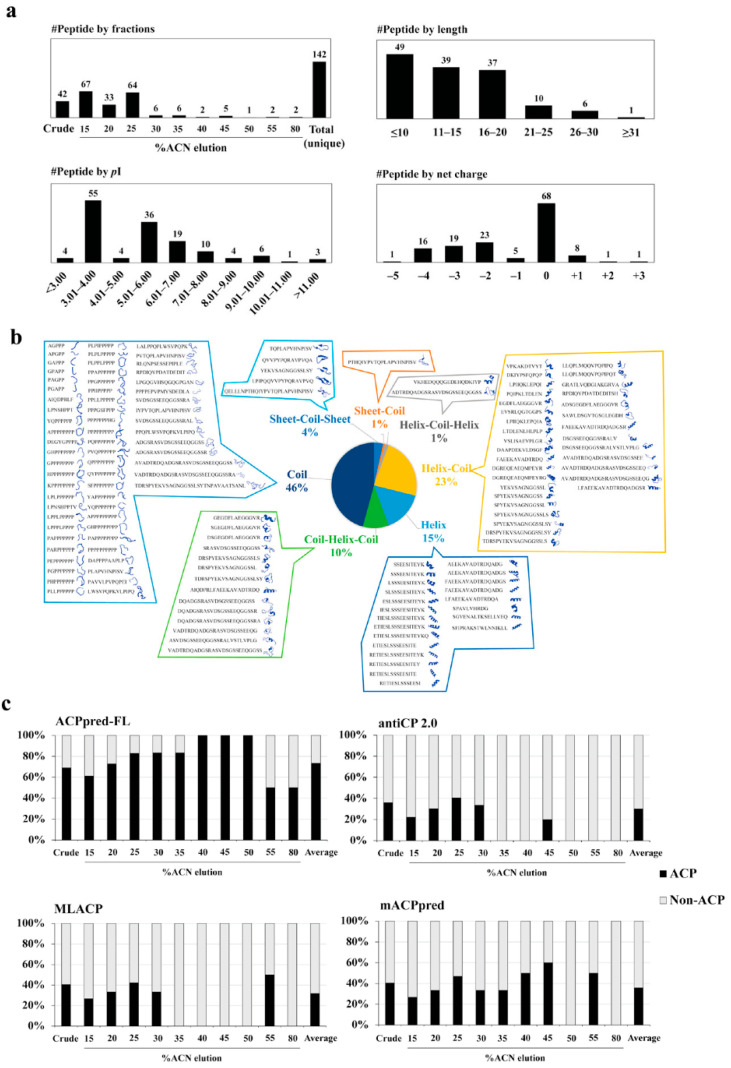
Predicted physicochemical, structural, and machine learning-based anticancer peptide screening of naturally occurring human milk peptides. (a) Distribution of the unique human milk peptides identified by LC-MS/MS; (b) the distribution and secondary structure of all identified peptides predicted by PEP-FOLD3 software; (c) proportions of predicted anticancer property (ACP) vs. non-ACP peptides using four ACP machine learning programs, including ACPpred-FL, antiCP 2.0, MLACP, and mACPpred. The percentages of ACP (black) and non-ACP (gray) peptides were calculated as: number of ACP or non-ACP predictions/number of total identified peptides in each individual fraction × 100%. Full results of in silico ACP screening are provided in Table S2.
Figure 4
Figure 4
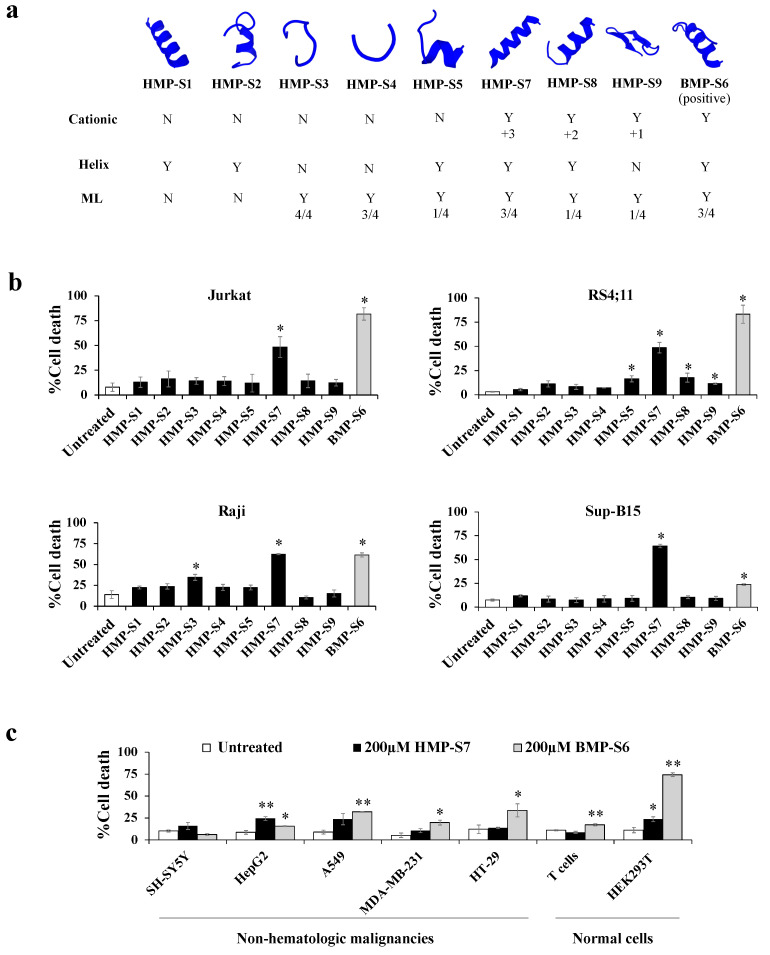
Effect of the 8 synthetic human milk peptides (HMPs) on leukemic and nonleukemic cell lines. (a) Eight HMPs and a positive control (BMP-S6) were selected and synthesized to test for antileukemic activity. The properties of these peptides are summarized, namely predicted secondary structure, cationic nature, helix content, machine learning (ML) prediction of ACP (details of the selected peptides are summarized in Table S3); (b) four leukemic cell lines, namely Jurkat, Raji, RS4;11, and Sup-B15, were treated with the 8 synthetic HMPs and the control BMP-S6 at 200 µM, and % cell death was observed after 24 h treatment using the trypan blue exclusion assay under a light microscope. The % cell death was calculated as: number of death cells/total cell number × 100%. The percentages of cell death of all 4 leukemic cell lines after HMP-S7 treatment were significantly increased; (c) in addition to leukemic cells, HMP-S7 was also tested on nonhematological malignant cell lines, including neuroblastoma (SH-SY5Y), hepatoblastoma (HepG2), lung cancer (A549), triple-negative breast cancer (MDA-MB-231), colon cancer (HT-29), as well as on normal cells, such as T cells and HEK293T embryonic kidney cells. Statistical significance of differences in % cell death was calculated using three biological replicates. * p < 0.05, ** p < 0.01 compared to untreated cells.
Figure 5
Figure 5
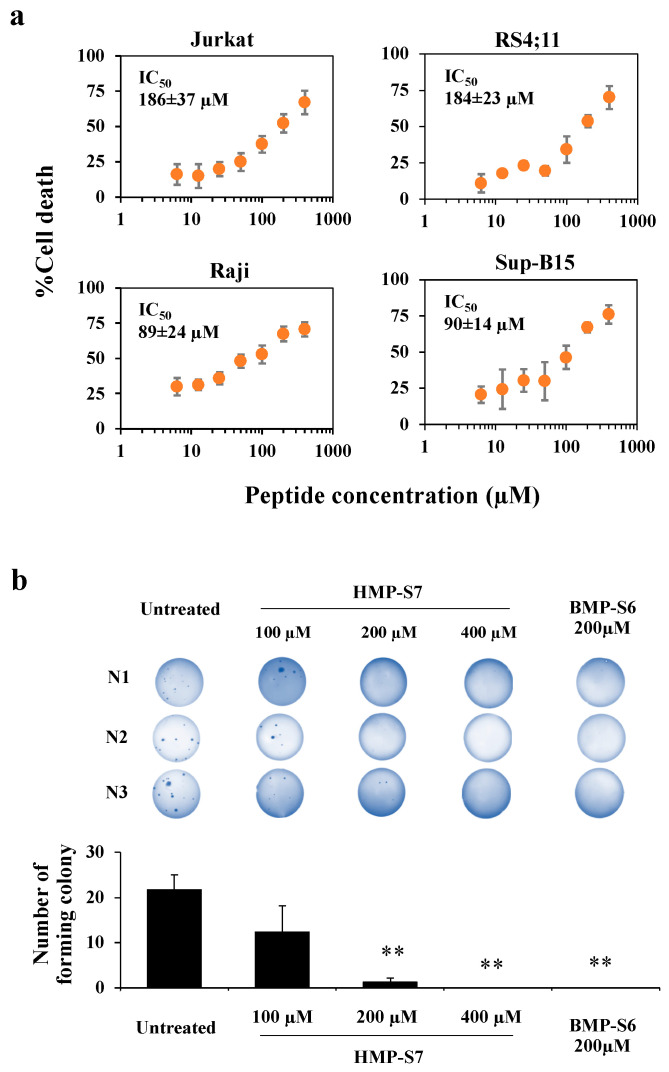
The inhibitory action of HMP-S7 on leukemic cells. (a) Four leukemic cell lines, namely Jurkat, Raji, RS4;11, and Sup-B15 cells, were treated with HMP-S7 at various concentrations (0–400 µM) for 24 h, and the % cell death (mean ± SD) was determined using trypan blue exclusion assay; (b) effects of HMP-S7 (100, 200, and 400 µM) and the positive control BMP-S6 (200 µM) on the colony forming ability of Jurkat cells (three independent experiments; N1–N3). After the treatment with the test peptide for 24 h, cell suspensions were allowed to form colonies in soft agar for 20 days. The colonies in the soft agar were stained with crystal violet and counted. ** p < 0.01 compared to untreated condition (n = 3 biological replicates).
Figure 6
Figure 6
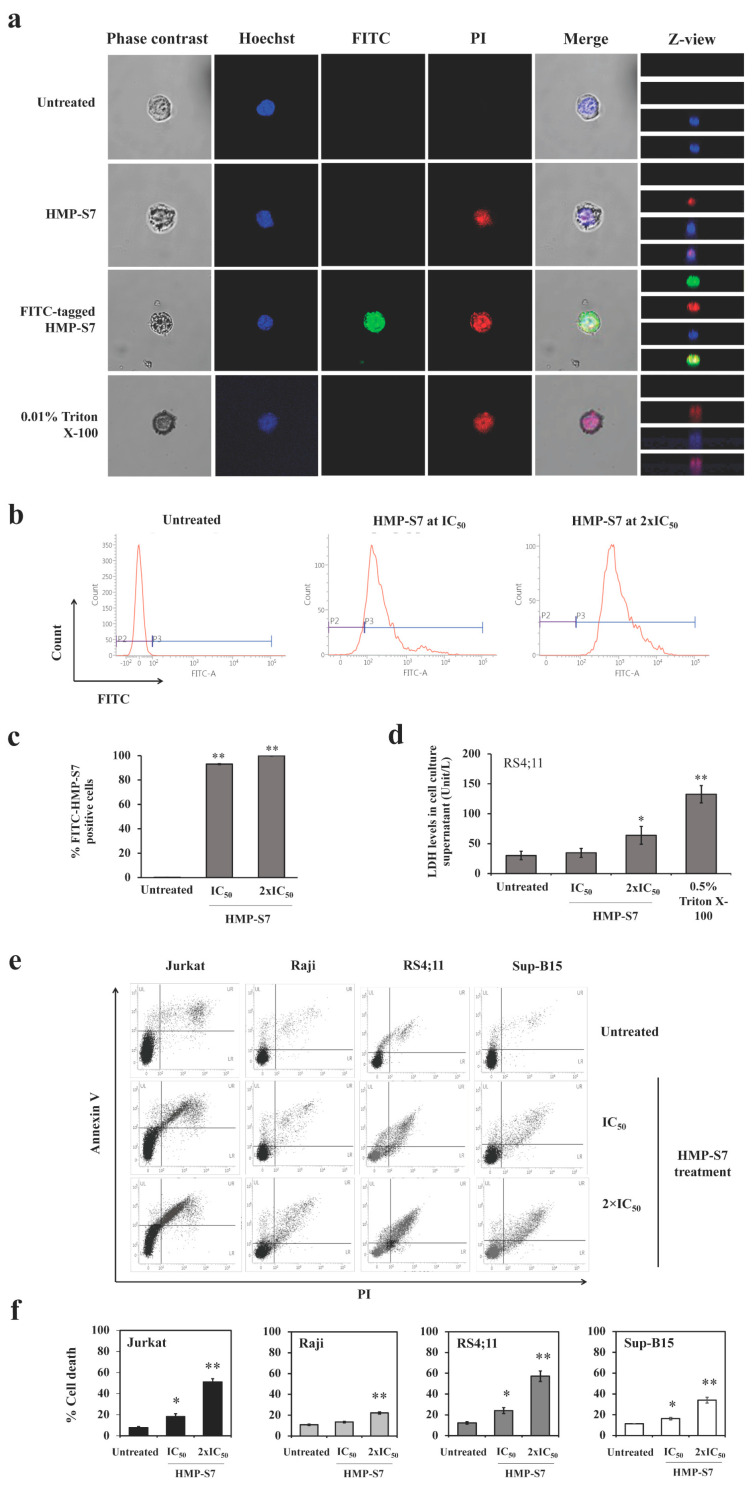
HMP-S7 action on internalization and leukemic cell death. Jurkat cells were treated with HMP-S7 conjugated with or without fluorescein isothiocyanate (FITC) at IC50 and 0.01% Triton X-100 (positive control) and stained with propidium iodide (PI) to observe membrane permeability. (a) The FITC-tagged HMP-S7 (at IC50 and 2 × IC50) was internalized into the cytoplasm of Jurkat cells; (b) flow cytometry of FITC-tagged HMP-S7-treated Jurkat cells; (c) flow cytometric results as %FITC-positive Jurkat cells; (d) lactate dehydrogenase (LDH) release assay showing the LDH level in the culture supernatant as the evidence of cellular membrane disruption of RS4;11 cells treated with HMP-S7 at IC50 and 2 × IC50 for 24 h. Triton X-100 treated cells were used as a positive control; (e) flow cytometric cell death assay using Annexin-V/PI co-staining. Four leukemic cell lines, namely Jurkat, Raji, RS4;11, and Sup-B15, were treated with HMP-S7 at IC50 and 2 × IC50 for 24 h; (f) % cell death composed of the upper left, upper right, and lower right quadrants (early and late apoptosis and necrosis) of flow cytometric data. * p < 0.05, ** p < 0.01 compared to untreated condition. All experiments were performed in three biological replicates.
Figure 7
Figure 7
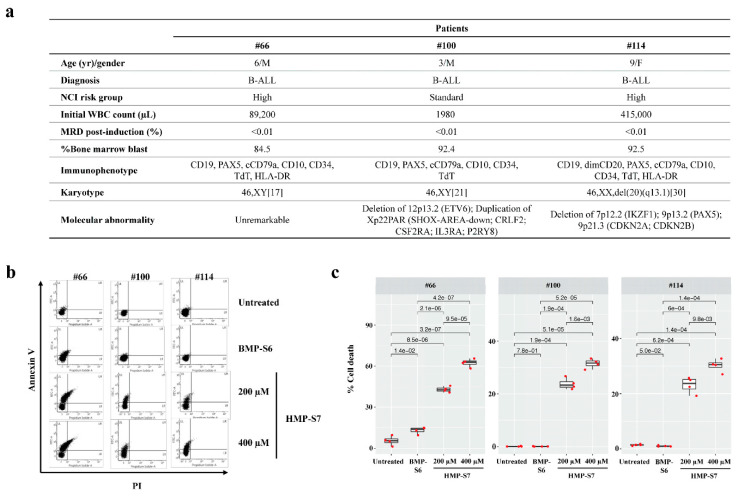
HMP-S7 induced patient-derived leukemic cell death ex vivo. Bone-marrow-derived lymphoblasts were collected from three leukemic patients and were processed as described in “Materials and Methods” section. (a) Demographic data of three leukemic patients. Patient-derived lymphoblasts were treated with two doses of HMP-S7 or with BMP-S6 (a positive control from previous experiments); (b) flow cytometric analysis with annexin V/PI co-staining at 72-h post-treatment. Patient-derived leukemic cells were treated with 200 and 400 µM HMP-S7, while 200 µM BMP-S6 was included for comparison; (c) % cell death including the upper left, upper right, and lower right quadrants of flow cytometric data (n = 4 replicates per condition). Abbreviations: B-ALL, B-cell acute lymphoblastic leukemia; F, female; M, male; MRD, minimal residual disease; NCI, National Cancer Institute; WBC, white blood cells.

References

    1. Torre L.A., Siegel R.L., Ward E.M., Jemal A. Global Cancer Incidence and Mortality Rates and Trends—An Update. Cancer Epidemiol. Biomark. Prev. 2016;25:16–27. doi: 10.1158/1055-9965.EPI-15-0578. - DOI - PubMed
    1. Siegel R.L., Miller K.D., Jemal A. Cancer statistics, 2016. CA Cancer J. Clin. 2016;66:7–30. doi: 10.3322/caac.21332. - DOI - PubMed
    1. Kantarjian H.M., Keating M.J., Freireich E.J. Toward the potential cure of leukemias in the next decade. Cancer. 2018;124:4301–4313. doi: 10.1002/cncr.31669. - DOI - PubMed
    1. Robison L.L., Bhatia S. Late-effects among survivors of leukaemia and lymphoma during childhood and adolescence. Br. J. Haematol. 2003;122:345–359. doi: 10.1046/j.1365-2141.2003.04499.x. - DOI - PubMed
    1. Mulrooney D.A., Hyun G., Ness K.K., Bhakta N., Pui C.H., Ehrhardt M.J., Krull K.R., Crom D.B., Chemaitilly W., Srivastava D.K., et al. The changing burden of long-term health outcomes in survivors of childhood acute lymphoblastic leukaemia: A retrospective analysis of the St Jude Lifetime Cohort Study. Lancet Haematol. 2019;6:e306–e316. doi: 10.1016/S2352-3026(19)30050-X. - DOI - PMC - PubMed

LinkOut - more resources