Review
. 2021 Jul 23;11(8):734.
doi: 10.3390/life11080734.

The Rise of SARS-CoV-2 Variants and the Role of Convalescent Plasma Therapy for Management of Infections

Affiliations
Review

The Rise of SARS-CoV-2 Variants and the Role of Convalescent Plasma Therapy for Management of Infections

Mohamed Moubarak et al. Life (Basel). .

Abstract

Novel therapies for the treatment of COVID-19 are continuing to emerge as the SARS-Cov-2 pandemic progresses. PCR remains the standard benchmark for initial diagnosis of COVID-19 infection, while advances in immunological profiling are guiding clinical treatment. The SARS-Cov-2 virus has undergone multiple mutations since its emergence in 2019, resulting in changes in virulence that have impacted on disease severity globally. The emergence of more virulent variants of SARS-Cov-2 remains challenging for effective disease control during this pandemic. Major variants identified to date include B.1.1.7, B.1.351; P.1; B.1.617.2; B.1.427; P.2; P.3; B.1.525; and C.37. Globally, large unvaccinated populations increase the risk of more and more variants arising. With successive waves of COVID-19 emerging, strategies that mitigate against community transmission need to be implemented, including increased vaccination coverage. For treatment, convalescent plasma therapy, successfully deployed during recent Ebola outbreaks and for H1N1 influenza, can increase survival rates and improve host responses to viral challenge. Convalescent plasma is rich with cytokines (IL-1β, IL-2, IL-6, IL-17, and IL-8), CCL2, and TNFα, neutralizing antibodies, and clotting factors essential for the management of SARS-CoV-2 infection. Clinical trials can inform and guide treatment policy, leading to mainstream adoption of convalescent therapy. This review examines the limited number of clinical trials published, to date that have deployed this therapy and explores clinical trials in progress for the treatment of COVID-19.

Keywords: COVID-19 convalescent therapy; COVID-19 therapy; COVID-19 vaccine; Ebola; SARS-CoV-2 infection; coronavirus; human antibodies; variants of concern.


Conflict of interest statement

The authors declare no conflict of interests exist.

Figures
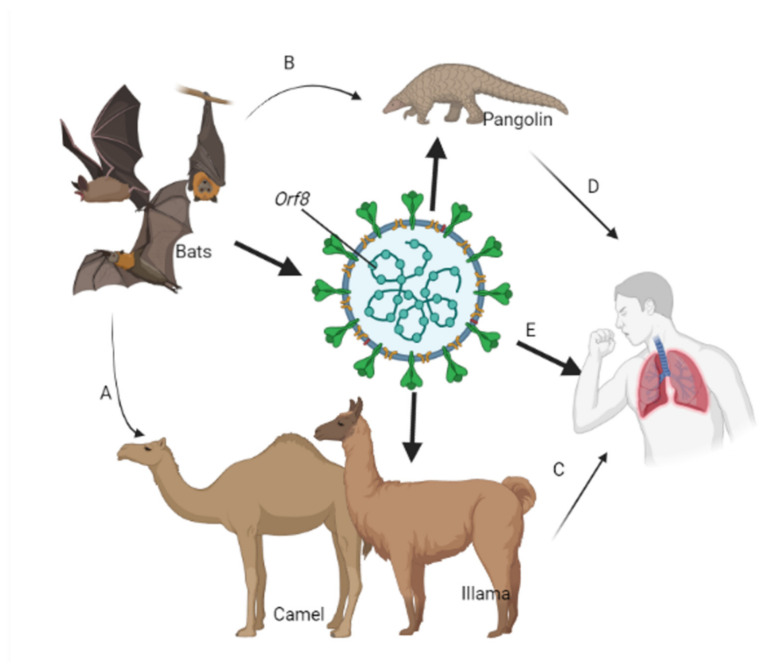
Figure 1
Figure 1
Zoonotic transmission of coronaviruses. Coronaviruses originally from wildlife species such as bats have undergone evolutionary changes to generate SARS-CoV and MERS-CoV genotypes through genetic recombination especially in the Orf8 and S proteins. SARS-CoV-2 is transmitted to other wildlife species either through the domestic (A) or the sylvatic (B) cycle. Human interaction with host species through livestock communal activities (C) and wildlife poaching (D) leads to the introduction of SARS-CoV-2 variants in susceptible populations. Infections in humans are complicated by mutations in the SARS-CoV-2 genome (E), making routine control of infection challenging.
Figure 2
Figure 2
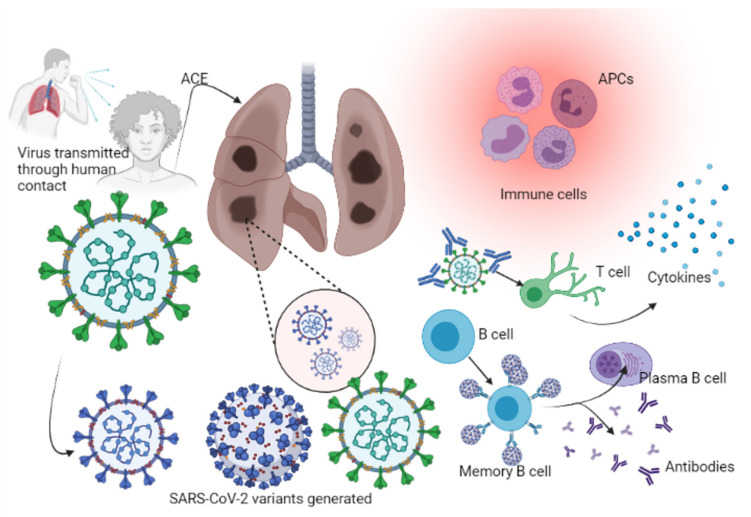
Immunopathogenesis of SARS-CoV-2 in humans. Colonization by SARS-CoV-2 is enhanced by ACE through which further viral replication takes place. Increased viral exposure leads to the generation of variants. Immune cells (APCs) including basophils, neutrophils, macrophages, and monocytes help to identify the infection. APCs work with T cells by binding to specific T cell receptors, which leads to the activation of CD4 and CD8 cells and the production of cytokines. The humoral response involves B cells, which are activated once an APC cell presents the antigen through the B cell receptors, leading to the activation of memory B cells and plasma B cells for the production of more antibodies to neutralize infection.
Figure 3
Figure 3
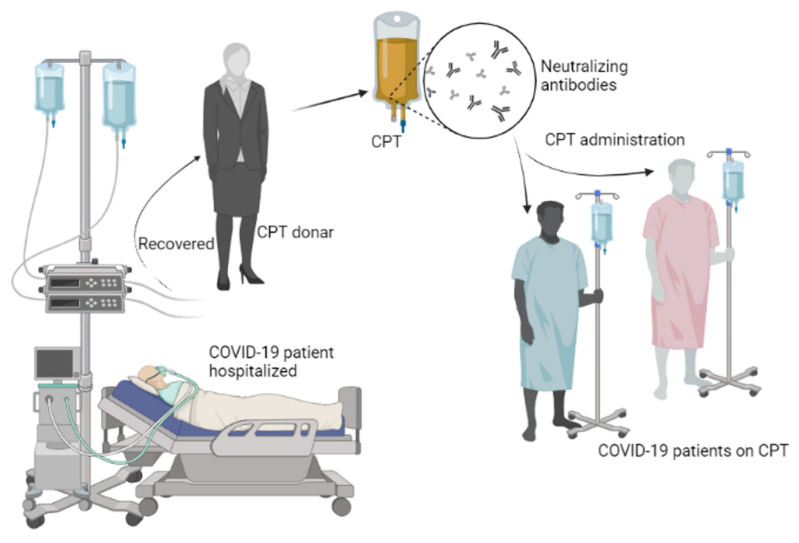
Adaptation of CPT for the management of SARS-CoV-2 patients. Immunity against SARS-CoV-2 is strongest amongst those who have had severe COVID-19. Recovered patients are ideal candidates as CPT donors. Active antibodies are administered to COVID-19 patients to help boost their immune system against infection.

References

    1. Lai C.-C., Shih T.-P., Ko W.-C., Tang H.-J., Hsueh P.-R. Severe Acute Respiratory Syndrome Coronavirus 2 (SARS-CoV-2) and Coronavirus Disease-2019 (COVID-19): The Epidemic and the Challenges. Int. J. Antimicrob. Agents. 2020;55:105924. doi: 10.1016/j.ijantimicag.2020.105924. - DOI - PMC - PubMed
    1. Tyrrell D.A., Bynoe M.L. Cultivation of a Novel Type of Common-Cold Virus in Organ Cultures. Br. Med. J. 1965;1:1467–1470. doi: 10.1136/bmj.1.5448.1467. - DOI - PMC - PubMed
    1. Monto A.S., Cowling B., Peiris J.S.M. Coronaviruses. Viral Infect. Hum. Epidemiol. Control. 2014:199–223. doi: 10.1007/978-1-4899-7448-8_10. - DOI
    1. Hamre D., Procknow J.J. A New Virus Isolated from the Human Respiratory Tract. Exp. Biol. Med. 1966;121:190–193. doi: 10.3181/00379727-121-30734. - DOI - PubMed
    1. McIntosh K. Commentary: McIntosh K, Chao R.K., Krause H.E., Wasil R, Mocega H.E., Mufson M.A. Coronavirus Infection in Acute Lower Respiratory Tract Disease of Infants. J Infect Dis 1974; 130:502–7. J. Infect. Dis. 2004;190:1033–1041. doi: 10.1086/422851. - DOI - PMC - PubMed

LinkOut - more resources