


Implicit Memory and Anesthesia: A Systematic Review and Meta-Analysis
- PMID: 34440594
- PMCID: PMC8400596
- DOI: 10.3390/life11080850
Implicit Memory and Anesthesia: A Systematic Review and Meta-Analysis
Abstract
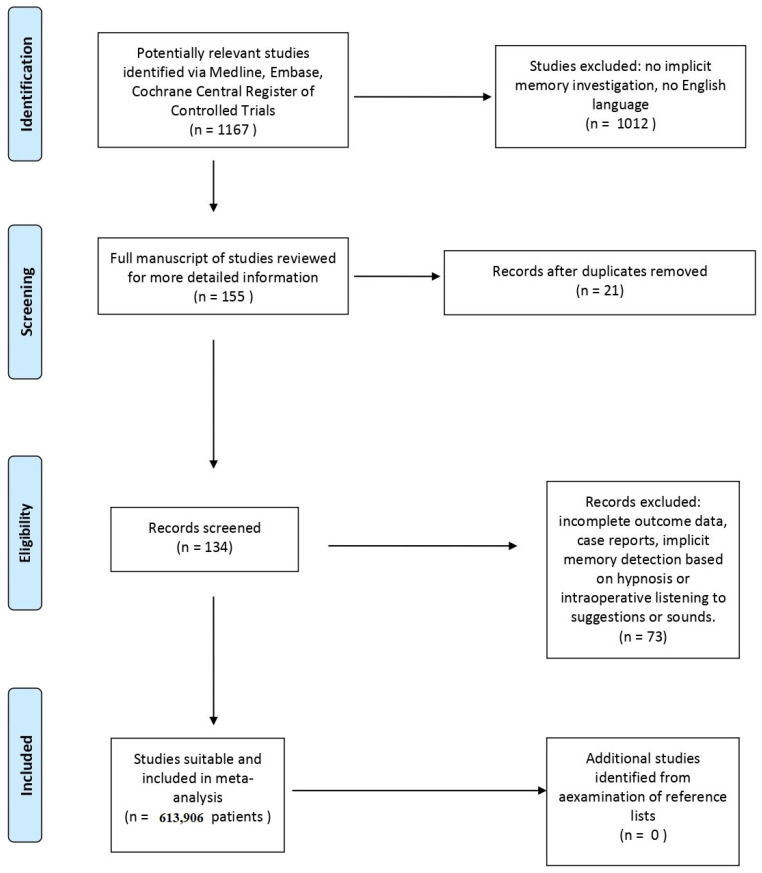
General anesthesia should induce unconsciousness and provide amnesia. Amnesia refers to the absence of explicit and implicit memories. Unlike explicit memory, implicit memory is not consciously recalled, and it can affect behavior/performance at a later time. The impact of general anesthesia in preventing implicit memory formation is not well-established. We performed a systematic review with meta-analysis of studies reporting implicit memory occurrence in adult patients after deep sedation (Observer's Assessment of Alertness/Sedation of 0-1 with spontaneous breathing) or general anesthesia. We also evaluated the impact of different anesthetic/analgesic regimens and the time point of auditory task delivery on implicit memory formation. The meta-analysis included the estimation of odds ratios (ORs) and 95% confidence intervals (CIs). We included a total of 61 studies with 3906 patients and 119 different cohorts. For 43 cohorts (36.1%), implicit memory events were reported. The American Society of Anesthesiologists (ASA) physical status III-IV was associated with a higher likelihood of implicit memory formation (OR:3.48; 95%CI:1.18-10.25, p < 0.05) than ASA physical status I-II. Further, there was a lower likelihood of implicit memory formation for deep sedation cases, compared to general anesthesia (OR:0.10; 95%CI:0.01-0.76, p < 0.05) and for patients receiving premedication with benzodiazepines compared to not premedicated patients before general anesthesia (OR:0.35; 95%CI:0.13-0.93, p = 0.05).
Keywords: anesthesia brain monitor; awareness; benzodiazepines; general anesthesia; implicit memory.
Conflict of interest statement
The authors declare that they have no conflict of interests.
Figures
References
-
- Chernik A.D., Gillings D., Laine H., Hendler J., Silver J.M., Davidson A.B., Schwam E.M., Siegel J.L. Validity and reliability of the Observer’s Assessment of Alertness/Sedation Scale: Study with intravenous midazolam. J. Clin. Psychopharmacol. 1990;10:244–251. - PubMed
Publication types
LinkOut - more resources
Full Text Sources
