Review
. 2021 Jul 23;10(8):1875.
doi: 10.3390/cells10081875.

Mast Cells and the Pancreas in Human Type 1 and Type 2 Diabetes

Affiliations
Review

Mast Cells and the Pancreas in Human Type 1 and Type 2 Diabetes

Matilde Masini et al. Cells. .

Abstract

Mast cells are highly differentiated, widely distributed cells of the innate immune system, that are currently considered as key regulators of both innate and adaptive immunity. Mast cells play a key role in health and survival mechanisms, especially as sentinel cells that can stimulate protective immune responses. On the other hand, it has been shown that mast cells are involved in the pathogenesis of several diseases, and recently a possible pathogenetic role of mast cells in diabetes has been proposed. In this review we summarize the evidence on the increased presence of mast cells in the pancreas of subjects with type 1 diabetes, which is due to the autoimmune destruction of insulin secreting beta cells, and discuss the differences with type 2 diabetes, the other major form of diabetes. In addition, we describe some of the pathophysiological mechanisms through which mast cells might exert their actions, which could be targeted to potentially protect the beta cells in autoimmune diabetes.

Keywords: insulin secretion; mast cells; pancreatic beta cells; type 1 diabetes; type 2 diabetes.


Conflict of interest statement

The authors declare no conflict of interest.

Figures
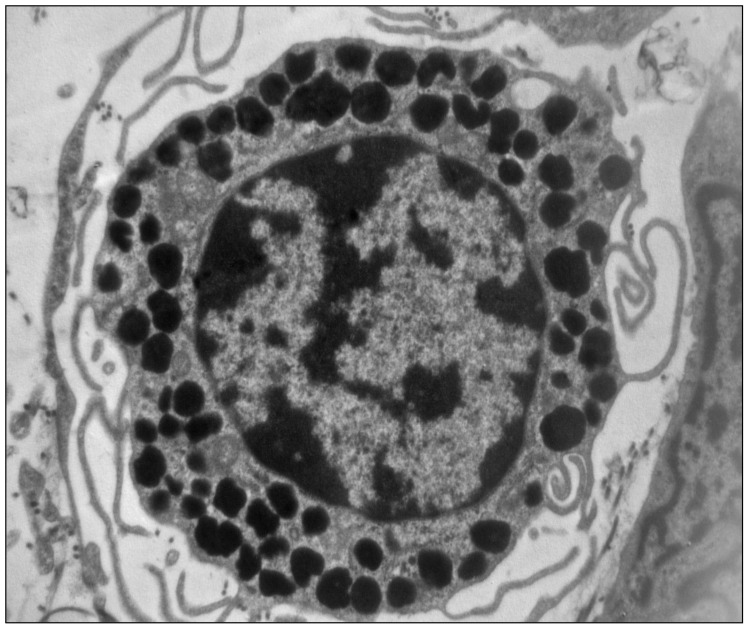
Figure 1
Figure 1
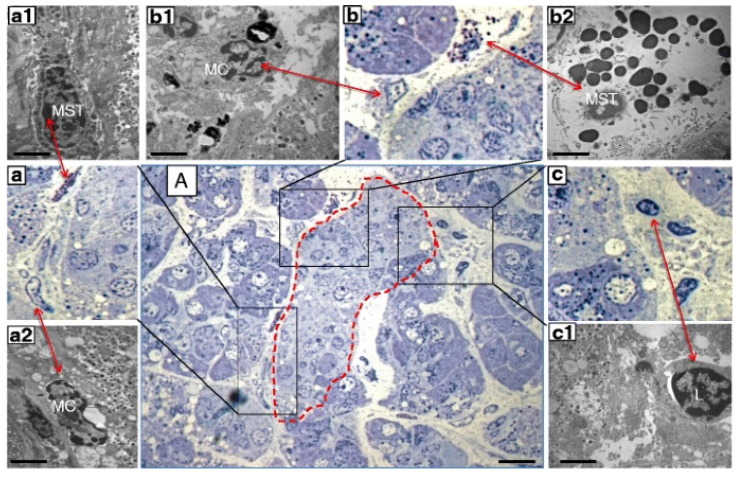
Electron micrography of a mast cell showing the characteristic cytoplasmic granules containing histamine (×10,000) (unpublished image, courtesy of M. Masini).
Figure 2
Figure 2
Consecutive semithin and ultrathin sections of a pancreas sample from a donor with type 1 diabetes showing (A) a pancreatic islet (dashed line) surrounded by infiltrate containing different inflammatory cells (×1000). The comparison between consecutive semithin and ultrathin sections illustrates how the identification of the different types of inflammatory cells in the semithin section was confirmed by electron microscopy. (ac) ×1000 magnification (semithin sections) of the corresponding images in (A); (a1,a2) electron microscopy images of a mast cell (MST) and macrophage (MC) identified in (a) (×10,000); (b1,b2) electron microscopy images of an MC and degranulating MST identified in (b) (×10,000); (c1) electron microscopy of a lymphocyte (L) identified in (c) (×10,000). Scale bars correspond to 10 μm in A, and to 1 μm in (a1,a2,b1,b2,c1). Reproduced with permission from Ref. [62].

References

    1. Ehrlich P. Inaugural Dissertation. Ph.D. Thesis. Universität Leipzig; Leipzig, Germany: 1878. Beiträge zut Theorie und Praxis der histologischen Färbung.
    1. Wong G.W., Zhuo L., Kimata K., Lam B.K., Satoh N., Stevens R.L. Ancient origin of mast cells. Biochem. Biophys. Res. Commun. 2014;451:314–318. doi: 10.1016/j.bbrc.2014.07.124. - DOI - PMC - PubMed
    1. Chen C.-C., Grimbaldeston M.A., Tsai M., Weissman I.L., Galli S.J. From The Cover: Identification of mast cell progenitors in adult mice. Proc. Natl. Acad. Sci. USA. 2005;102:11408–11413. doi: 10.1073/pnas.0504197102. - DOI - PMC - PubMed
    1. Kitamura Y., Oboki K., Ito A. Molecular Mechanisms of Mast Cell Development. Immunol. Allergy Clin. N. Am. 2006;26:387–405. doi: 10.1016/j.iac.2006.05.004. - DOI - PubMed
    1. Dahlin J.S., Ekoff M., Grootens J., Löf L., Amini R.-M., Hagberg H., Ungerstedt J.S., Olsson-Strömberg U., Nilsson G. KIT signaling is dispensable for human mast cell progenitor development. Blood. 2017;130:1785–1794. doi: 10.1182/blood-2017-03-773374. - DOI - PMC - PubMed

Publication types

MeSH terms