Review
. 2021 Jul 30;10(8):1941.
doi: 10.3390/cells10081941.

May the Force Be with You (Or Not): The Immune System under Microgravity

Affiliations
Review

May the Force Be with You (Or Not): The Immune System under Microgravity

Mei ElGindi et al. Cells. .

Abstract

All terrestrial organisms have evolved and adapted to thrive under Earth's gravitational force. Due to the increase of crewed space flights in recent years, it is vital to understand how the lack of gravitational forces affects organisms. It is known that astronauts who have been exposed to microgravity suffer from an array of pathological conditions including an impaired immune system, which is one of the most negatively affected by microgravity. However, at the cellular level a gap in knowledge exists, limiting our ability to understand immune impairment in space. This review highlights the most significant work done over the past 10 years detailing the effects of microgravity on cellular aspects of the immune system.

Keywords: immune cells; immunology; mechanotransduction; microgravity; space biology; space research.


Conflict of interest statement

The authors declare that there are no competing interests.

Figures
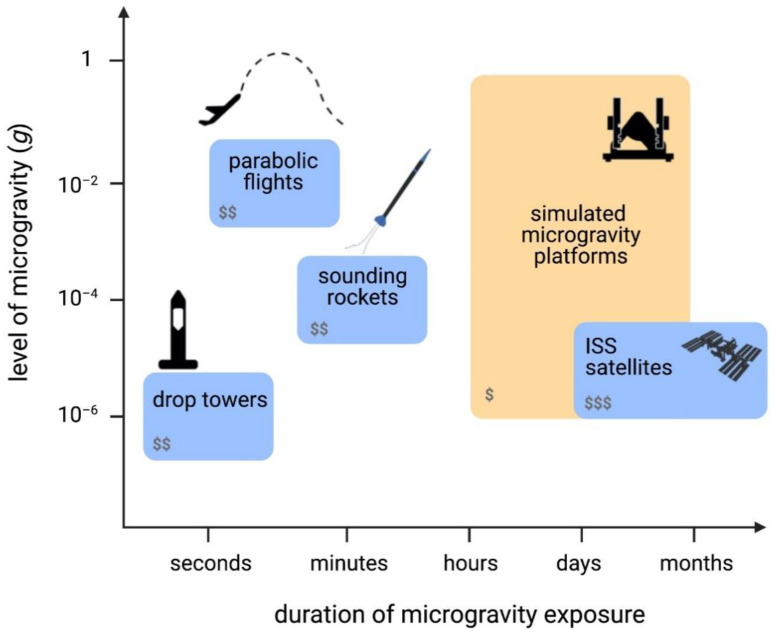
Figure 1
Figure 1
An overview of microgravity platforms. Overview of real (blue) and simulated (yellow) microgravity platforms in terms of duration of microgravity exposure and level of microgravity reached compared to Earth g (where g = 9.81 m/s2). Number of $ represents relative cost of running experiments on each platform.
Figure 2
Figure 2
Overview of immune cells in the innate and adaptive immune systems. The schematic provides an overview of the two arms of the immune system: the innate immune system and the adaptive immune system. The innate immune system consists of granulocytes (basophils, neutrophils, and eosinophils), natural killer cells, monocytes, macrophages, and dendritic cells. The adaptive immune system consists of T cells and B cells with dendritic cells being the main bridge between the two systems.
Figure 3
Figure 3
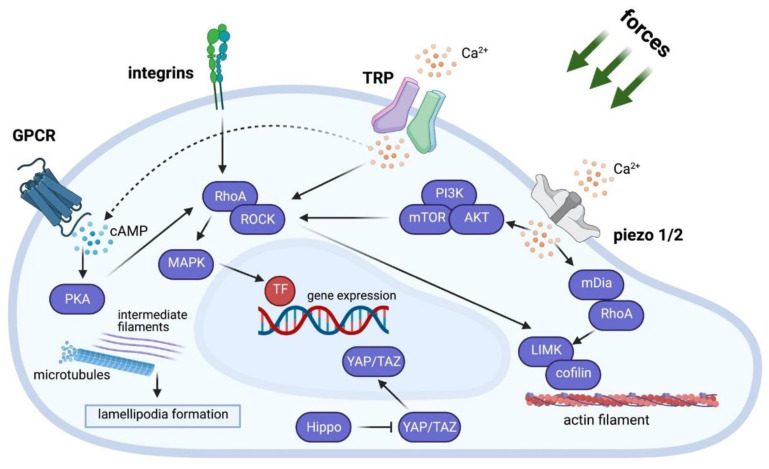
A simplified overview of the mechanotransduction pathways. Illustration depicting the major mechanotransduction pathways that are influenced by force and ultimately affect cell gene expression.
Figure 4
Figure 4
Cell culture techniques for improved physiological relevance in microgravity research. (A) Biocompatible and easy to use microvessels developed for high throughput studies [119]. (B) 2D and 3D biomimetic cell culture model showing more rounded cells in 3D culture compared to 2D [69]. (C) Organ on a chip technology by combining 3D cell culture and microfluidic systems [120].

References

    1. Van Ombergen A., Demertzi A., Tomilovskaya E., Jeurissen B., Sijbers J., Kozlovskaya I.B., Parizel P.M., Van de Heyning P.H., Sunaert S., Laureys S., et al. The effect of spaceflight and microgravity on the human brain. J. Neurol. 2017;264:18–22. doi: 10.1007/s00415-017-8427-x. - DOI - PMC - PubMed
    1. Grimm D., Grosse J., Wehland M., Mann V., Reseland J.E., Sundaresan A., Corydon T.J. The impact of microgravity on bone in humans. Bone. 2016;87:44–56. doi: 10.1016/j.bone.2015.12.057. - DOI - PubMed
    1. Tanaka K., Nishimura N., Kawai Y. Adaptation to microgravity, deconditioning, and countermeasures. J. Physiol. Sci. 2017;67:271–281. doi: 10.1007/s12576-016-0514-8. - DOI - PMC - PubMed
    1. White R.J., Averner M. Humans in space. Nature. 2001;409:1115–1118. doi: 10.1038/35059243. - DOI - PubMed
    1. Sonnenfeld G. The immune system in space and microgravity. Med. Sci. Sport. Exerc. 2002;34:2021–2027. doi: 10.1097/00005768-200212000-00024. - DOI - PubMed

Publication types