


Treatment Resistance: A Time-Based Approach for Early Identification in First Episode Psychosis
- PMID: 34442355
- PMCID: PMC8400307
- DOI: 10.3390/jpm11080711
Treatment Resistance: A Time-Based Approach for Early Identification in First Episode Psychosis
Abstract
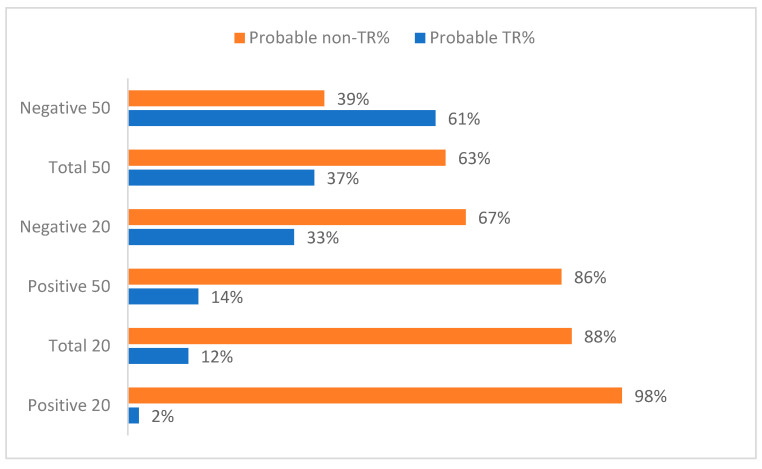
Although approximately 1/3 of individuals with schizophrenia are Treatment Resistant (TR), identifying these subjects prospectively remains challenging. The Treatment Response and Resistance in Psychosis working group defines <20% improvement as an indicator of TR, though its utility in First Episode Schizophrenia (FES) remains unknown. In a prospective cohort of FES (n = 129) followed up for 5 years, we evaluated two improvement thresholds for 'probable TR'; <20% and <50% based on positive, negative, and total symptoms. We ascertained (1) the ecological validity (i.e., the ability to identify an expected subgroup of 1/3rd of patients); (2) the predictive validity (i.e., ability to predict poor global functioning) and (3) the clinical utility (association with clozapine use at the 5th year). Using the criteria of a total symptom reduction of <50% or negative symptom reduction of <20% resulted in 'probable TR' rates of 37% and 33%, respectively. Using <20% positive or total symptoms criteria resulted in very low rates, indicating minimal utility in FES. <50% total symptom criterion best predicted the global functioning over 5 years. Clozapine use was only predicted by positive symptom criterion. Prospective characterization of TRS is possible at 6 months after FES through a time-based approach using a 50% threshold for symptom change in treatment-adherent patients.
Keywords: early intervention; first episode psychosis; first episode schizophrenia; treatment resistant schizophrenia; treatment response.
Conflict of interest statement
LP receives book royalties from Oxford University Press and income from the SPMM MRCPsych course. In the last 5 years, his spousal pension funds held shares of Shire Inc., and GlaxoSmithKline. He has received investigator initiated educational grants from Otsuka Canada and Janssen Canada in 2017 as well as speaker fees from Otsuka Canada in 2017. PS reports personal speaker honorarium from Lundbeck Canada in the last 3 years.
Figures
References
-
- Agid O., Arenovich T., Sajeev G., Zipursky R.B., Kapur S., Foussias G., Remington G. An Algorithm-Based Approach to First-Episode Schizophrenia: Response Rates over 3 Prospective Antipsychotic Trials with a Retrospective Data Analysis. J. Clin. Psychiatry. 2011;72:1439–1444. doi: 10.4088/JCP.09m05785yel. - DOI - PubMed
-
- Sutterland A.L., van der Pluijm M., Becker H.E., van de Giessen E., de Haan L. Shortening Duration of Treatment Resistance: The Next Step in the Treatment of Schizophrenia. Schizophr. Bull. Open. 2020;1 doi: 10.1093/schizbullopen/sgaa030. - DOI
-
- Howes O.D., McCutcheon R., Agid O., de Bartolomeis A., van Beveren N.J.M., Birnbaum M.L., Bloomfield M.A.P., Bressan R.A., Buchanan R.W., Carpenter W.T., et al. Treatment-Resistant Schizophrenia: Treatment Response and Resistance in Psychosis (TRRIP) Working Group Consensus Guidelines on Diagnosis and Terminology. Am. J. Psychiatry. 2017;174:216–229. doi: 10.1176/appi.ajp.2016.16050503. - DOI - PMC - PubMed
Grants and funding
LinkOut - more resources
Full Text Sources
Miscellaneous
