


Perceptions about Research Participation among Individuals at Risk and Individuals with Premanifest Huntington's Disease: A Survey Conducted by the European Huntington Association
- PMID: 34442459
- PMCID: PMC8400079
- DOI: 10.3390/jpm11080815
Perceptions about Research Participation among Individuals at Risk and Individuals with Premanifest Huntington's Disease: A Survey Conducted by the European Huntington Association
Abstract
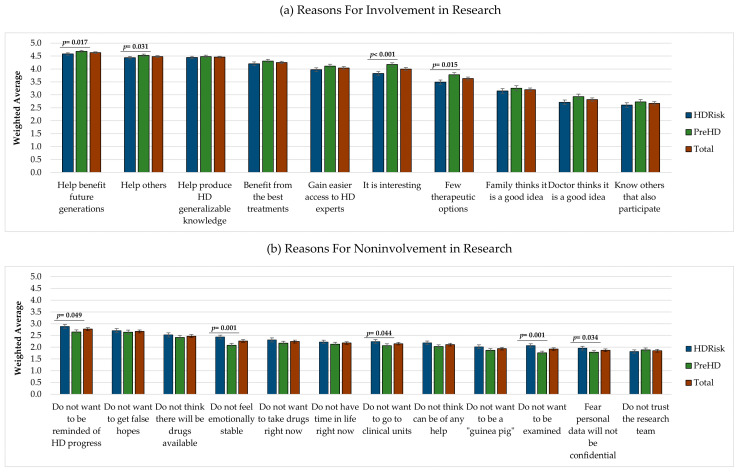
There has been great progress in Huntington's disease (HD) research. Yet, effective treatments to halt disease before the onset of disabling symptoms are still unavailable. Scientific breakthroughs require an active and lasting commitment from families. However, they are traditionally less involved and heard in studies. Accordingly, the European Huntington Association (EHA) surveyed individuals at risk (HDRisk) and with premanifest HD (PreHD) to determine which factors affect their willingness to participate in research. Questions assessed research experience and knowledge, information sources, reasons for involvement and noninvolvement, and factors preventing and facilitating participation. The survey included 525 individuals, of which 68.8% never participated in studies and 38.6% reported limited research knowledge. Furthermore, 52% trusted patient organizations to get research information. Reasons for involvement were altruistic and more important than reasons for noninvolvement, which were related to negative emotions. Obstacles included time/financial constraints and invasive procedures, while professional support was seen as a facilitator. PreHD individuals reported less obstacles to research participation than HDRisk individuals. Overall, a high motivation to participate in research was noted, despite limited experience and literacy. This motivation is influenced by subjective and objective factors and, importantly, by HD status. Patient organizations have a key role in fostering motivation through education and support.
Keywords: Huntington’s disease; clinical research; clinical trials; premanifest Huntington’s disease; survey.
Conflict of interest statement
While this work was partially funded by F. Hoffmann-La Roche Ltd., the sponsor had no role in the design of the study; in the collection, analyses, or interpretation of data; in the writing of the manuscript, or in the decision to publish the results. All those directly involved in the study are independent and have no vested interest in the outcome of this study.
Figures
References
-
- European Huntington Association. [(accessed on 2 March 2021)]; Available online: https://eurohuntington.org/stronger-together-2/
-
- HD Trial Finder. [(accessed on 2 March 2021)]; Available online: https://hdtrialfinder.net/
Grants and funding
LinkOut - more resources
Full Text Sources
