. 2021 Aug 10;9(8):1701.
doi: 10.3390/microorganisms9081701.

Differences in Gut Virome Related to Barrett Esophagus and Esophageal Adenocarcinoma

Affiliations

Differences in Gut Virome Related to Barrett Esophagus and Esophageal Adenocarcinoma

Tianli Ma et al. Microorganisms. .

Abstract

The relationship between viruses (dominated by bacteriophages or phages) and lower gastrointestinal (GI) tract diseases has been investigated, whereas the relationship between gut bacteriophages and upper GI tract diseases, such as esophageal diseases, which mainly include Barrett's esophagus (BE) and esophageal adenocarcinoma (EAC), remains poorly described. This study aimed to reveal the gut bacteriophage community and their behavior in the progression of esophageal diseases. In total, we analyzed the gut phage community of sixteen samples from patients with esophageal diseases (six BE patients and four EAC patients) as well as six healthy controls. Differences were found in the community composition of abundant and rare bacteriophages among three groups. In addition, the auxiliary metabolic genes (AMGs) related to bacterial exotoxin and virulence factors such as lipopolysaccharides (LPS) biosynthesis proteins were found to be more abundant in the genome of rare phages from BE and EAC samples compared to the controls. These results suggest that the community composition of gut phages and functional traits encoded by them were different in two stages of esophageal diseases. However, the findings from this study need to be validated with larger sample sizes in the future.

Keywords: LPS biosynthesis proteins; bacterial exotoxin; esophageal carcinogenesis; esophageal diseases; gut bacteriophages.


Conflict of interest statement

The authors declare no conflict of interest.

Figures
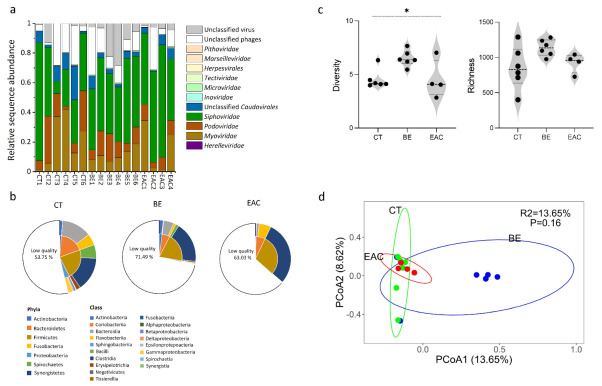
Figure 1
Figure 1
Composition of CT, BE, and EAC VLPs. (a) Relative abundance of viral families in CT, BE, and EAC; (b) The percentage of predicted bacterial hosts in CT, BE, and EAC. The inner cycle represents bacterial hosts at the phylum level, the outer cycle represents bacterial hosts at the class level. The low quality represents bacterial hosts predicted by contigs with a length lower than 10 kb and the score was lower than 95%; (c) Viral alpha diversity including richness (Ace) and diversity (Shannon) in samples from CT, BE, and EAC; (d) PCoA plot of the viral community composition based on the Bray–Curtis distances in CT, BE, and EAC samples. CT represents stool samples from healthy controls; BE represents stool samples from Barrett Esophagus patients; EAC represents stool samples from Esophageal Adenocarcinoma patients. Error bars indicate the average ± SE. Statistical significance was determined by Kruskal–Wallis, Dunn’s post hoc test, asterisk indicates p < 0.05.
Figure 2
Figure 2
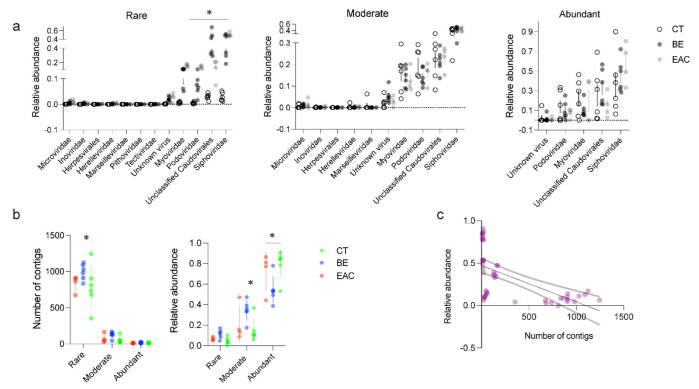
Composition of the rare, moderate, and abundant gut viruses in CT, BE and EAC samples. Rare, moderate, and abundant viruses were categorized based on the viral contig level. Abundant viruses represent viral contigs whose relative abundance was more than 1% in total contigs, moderate viruses represent viral contigs whose relative abundance was more than 0.1% and less than 1% in total contigs, and rare viruses represent viral contigs whose relative abundance was less than 0.1% in total contigs. (a) The relative abundance of viral families; (b) Number of contigs generated each viral contig category, rare, moderate, and abundant, on left and relative abundance of them on right. (c) Negative correlation between number of contigs, from rare, moderate, and abundant phages, and their relative abundance. CT represents stool samples from healthy controls; BE represents stool samples from Barrett Esophagus patients; EAC represents stool samples from Esophageal Adenocarcinoma patients. Statistical significance was determined by two–way analysis of variance [ANOVA], Tukey’s post hoc test, asterisk indicates p < 0.05.
Figure 3
Figure 3
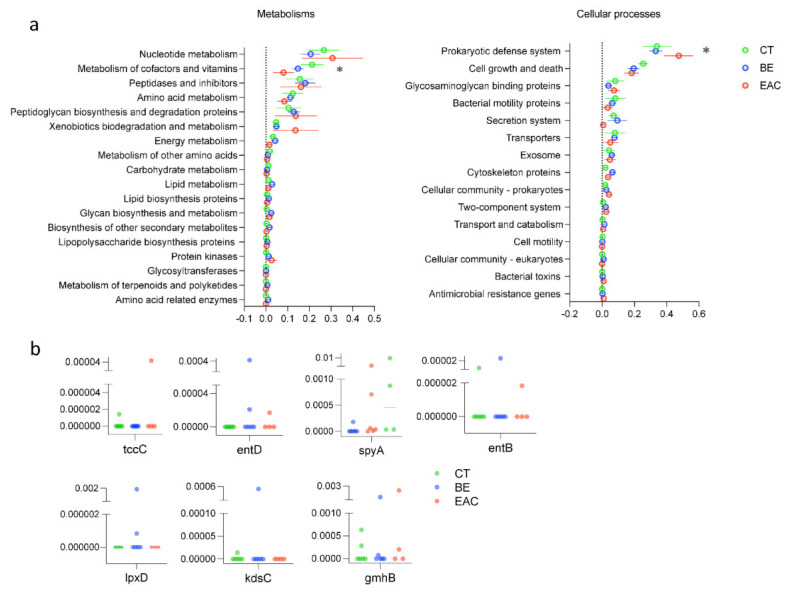
Viral functional traits. (a) The relative abundance of different functional traits in viral sequences; (b) The relative abundance of genes encoding four different bacterial toxins with higher abundance in BE and EAC samples compared with CT on the top, and genes encoding the LPS biosynthesis proteins on the bottom. Error bars indicate the average ± SE. Statistical significance was determined by two–way analysis of variance [ANOVA], Tukey’s post hoc test, asterisk indicates p < 0.05.

References

    1. He Y., Li D., Shan B., Liang D., Shi J., Chen W., He J. Incidence and mortality of esophagus cancer in China, 2008–2012. Chin. J. Cancer Res. 2019;31:426–434. doi: 10.21147/j.issn.1000-9604.2019.03.04. - DOI - PMC - PubMed
    1. Pennathur A., Gibson M.K., Jobe B.A., Luketich J.D. Oesophageal carcinoma. Lancet. 2013;381:400–412. doi: 10.1016/S0140-6736(12)60643-6. - DOI - PubMed
    1. Martinucci I., De Bortoli N., Russo S., Bertani L., Furnari M., Mokrowiecka A., Malecka-Panas E., Savarino V., Savarino E., Marchi S. Barrett’s esophagus in 2016: From pathophysiology to treatment. World J. Gastrointest. Pharmacol. Ther. 2016;7:190–206. doi: 10.4292/wjgpt.v7.i2.190. - DOI - PMC - PubMed
    1. Pohl H., Koch M., Khalifa A., Papanikolaou I., Scheiner K., Wiedenmann B., Rösch T. Evaluation of endocytoscopy in the surveillance of patients with Barrett’s esophagus. Endoscopy. 2007;39:492–496. doi: 10.1055/s-2007-966340. - DOI - PubMed
    1. Hooper L.V., Gordon J.I. Commensal host-bacterial relationships in the gut. Science. 2001;292:1115–1118. doi: 10.1126/science.1058709. - DOI - PubMed

LinkOut - more resources