Review
. 2021 Aug 16;26(16):4957.
doi: 10.3390/molecules26164957.

Anti-Cancer Potential of Synthetic Oleanolic Acid Derivatives and Their Conjugates with NSAIDs

Affiliations
Review

Anti-Cancer Potential of Synthetic Oleanolic Acid Derivatives and Their Conjugates with NSAIDs

Wanda Baer-Dubowska et al. Molecules. .

Abstract

Naturally occurring pentacyclic triterpenoid oleanolic acid (OA) serves as a good scaffold for additional modifications to achieve synthetic derivatives. Therefore, a large number of triterpenoids have been synthetically modified in order to increase their bioactivity and their protective or therapeutic effects. Moreover, attempts were performed to conjugate synthetic triterpenoids with non-steroidal anti-inflammatory drugs (NSAIDs) or other functional groups. Among hundreds of synthesized triterpenoids, still the most promising is 2-cyano-3,12-dioxooleana-1,9(11)-dien-28-oic acid (CDDO), which reached clinical trials level of investigations. The new group of synthetic triterpenoids are OA oximes. The most active among them is 3-hydroxyiminoolean-12-en-28-oic acid morpholide, which additionally improves the anti-cancer activity of standard NSAIDs. While targeting the Nrf2 and NF-κB signaling pathways is the main mechanism of synthetic OA derivatives' anti-inflammatory and anti-cancer activity, most of these compounds exhibit multifunctional activity, and affect cross-talk within the cellular signaling network. This short review updates the earlier data and describes the new OA derivatives and their conjugates in the context of modification of signaling pathways involved in inflammation and cell survival and subsequently in cancer development.

Keywords: NF-κB; NSAIDs; Nrf2; inflammation; oleanolic acid derivatives; oleanolic acid derivatives conjugates.


Conflict of interest statement

The authors declare there is no conflict of interest.

Figures
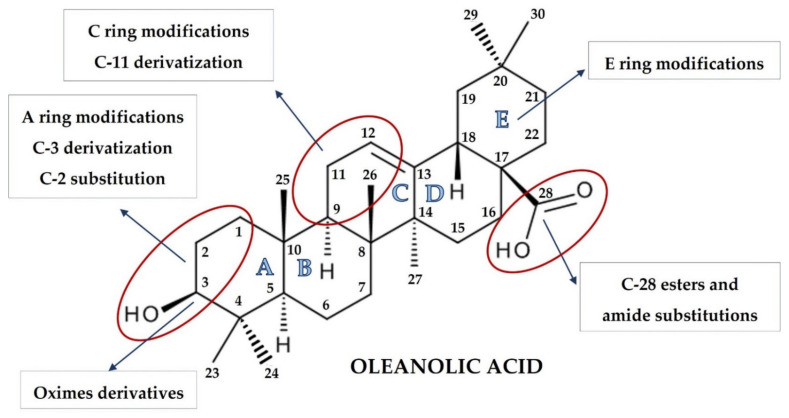
Figure 1
Figure 1
Sites of possible chemical modification of oleanolic acid structure that might lead to increased biological activity. Figure was created with BioRender.com by the authors.
Figure 2
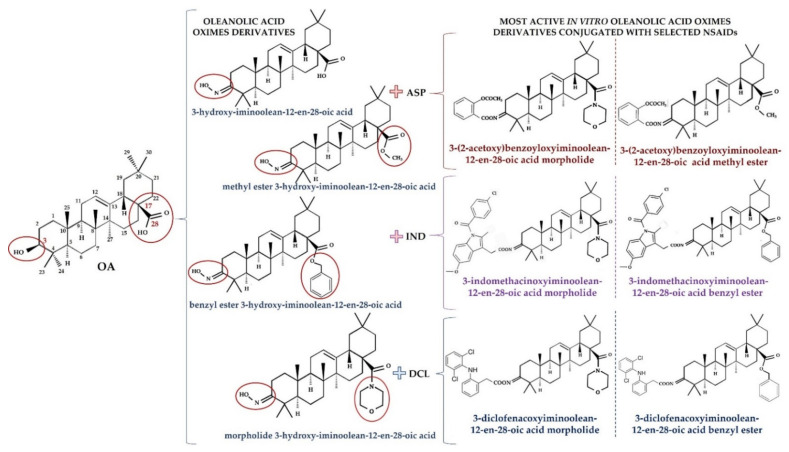
Figure 2
The structures of OAO derivatives and their conjugates with NSAIDs. Figure was created with BioRender.com by the authors.
Figure 3
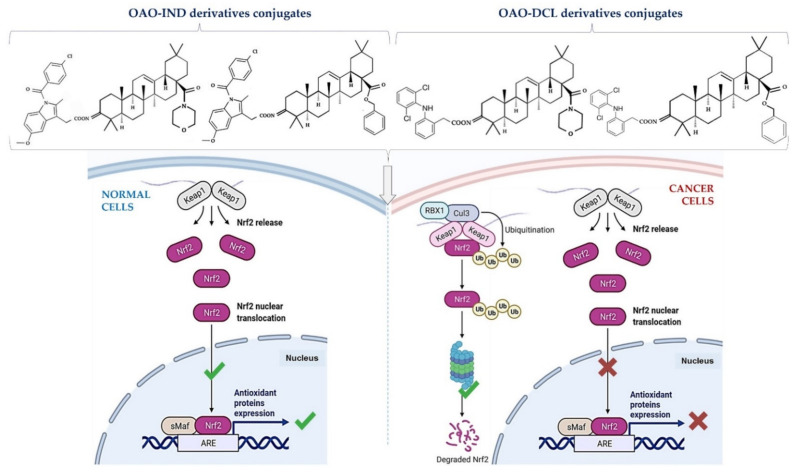
Figure 3
OAO-IND and OAO-DCL exert different effects on the Nrf2 pathway in normal hepatocytes and HCC cells. OAO–IND conjugates increase the activation of Nrf2 in normal hepatocytes by 25–55%, but inhibit its activation in HCC cells (by 30–40%) [62]. Similarly, OAO–DCL conjugates enhance the activation of Nrf2 in normal hepatocytes by 22–46% and inhibit activation of Nrf2 in HCC cells by 21–55% [39]. Figure was created with BioRender.com by the authors.
Figure 4
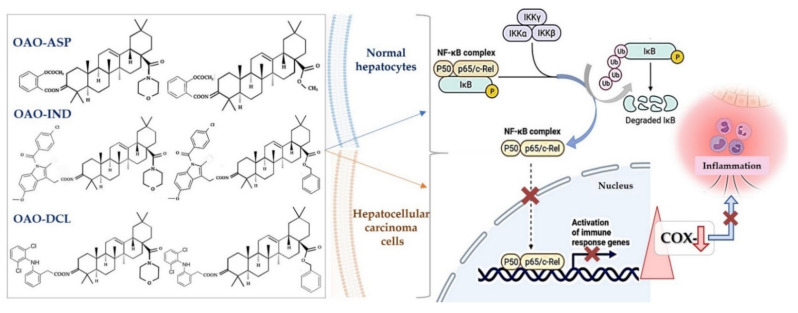
Figure 4
OAO–NSAIDs conjugates reduce NF-κB activation and expression of COX-2 in normal hepatocytes and HCC cells. OAO–NSAIDs inhibit activation of NF-κB in normal hepatocytes and in HCC cells by ~50–60% and ~40–50%, respectively [35,39,62]. Figure was created with BioRender.com by the authors.

References

    1. Guinda Á., Rada M., Delgado T., Gutiérrez-Adánez P., Castellano J.M. Pentacyclic triterpenoids from olive fruit and leaf. J. Agric. Food Chem. 2010;58:9685–9691. doi: 10.1021/jf102039t. - DOI - PubMed
    1. Jäger S., Trojan H., Kopp T., Laszczyk M.N., Scheffler A. Pentacyclic triterpene distribution in various plants-rich sources for a new group of multi-potent plant extracts. Molecules. 2009;14:2016–2031. doi: 10.3390/molecules14062016. - DOI - PMC - PubMed
    1. Pollier J., Goossens A. Oleanolic acid. Phytochemistry. 2012;77:10–15. doi: 10.1016/j.phytochem.2011.12.022. - DOI - PubMed
    1. Pawełczyk A., Olender D., Sowa-Kasprzak K., Zaprutko L. Hybrid compounds strategy in the synthesis of oleanolic acid skeleton-NSAID derivatives. Molecules. 2016;21:420. doi: 10.3390/molecules21040420. - DOI - PMC - PubMed
    1. Ahmed S.M.U., Luo L., Namani A., Wang X.J., Tang X. Nrf2 signaling pathway: Pivotal roles in inflammation. Biochim. Biophys. Acta Mol. Basis Dis. 2017;1863:585–597. doi: 10.1016/j.bbadis.2016.11.005. - DOI - PubMed

MeSH terms

Substances