


Enhancing Teaching Recovery Techniques (TRT) with Parenting Skills: RCT of TRT + Parenting with Trauma-Affected Syrian Refugees in Lebanon Utilising Remote Training with Implications for Insecure Contexts and COVID-19
- PMID: 34444403
- PMCID: PMC8394916
- DOI: 10.3390/ijerph18168652
Enhancing Teaching Recovery Techniques (TRT) with Parenting Skills: RCT of TRT + Parenting with Trauma-Affected Syrian Refugees in Lebanon Utilising Remote Training with Implications for Insecure Contexts and COVID-19
Abstract
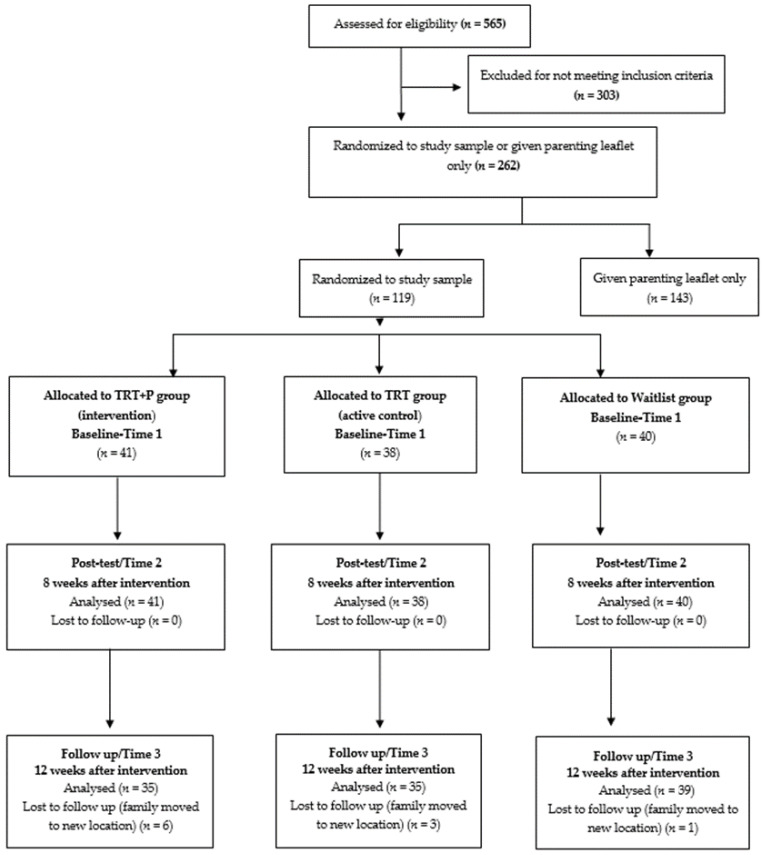
Child psychosocial recovery interventions in humanitarian contexts often overlook the significant effect that caregivers can have on improving children's future trajectory. We enhanced the well-established, evidenced-based child trauma recovery programme Teaching Recovery Techniques (TRT) intervention with parenting sessions, i.e., TRT + Parenting (TRT + P), which aims to improve parent mental health and their ability to support their children's mental health. We describe the findings of a three-arm randomised controlled trial comparing enhanced TRT + P vs. TRT and waitlist. The primary aim was to test if children in the enhanced arm of the programme show improved child and caregiver mental health. We recruited 119 Syrian refugee children and one of their caregivers in Beqaa Valley in Lebanon. They were randomised to the TRT, TRT + P, or waitlist control group. Data were collected at baseline and 2 weeks and 12 weeks post intervention. Training of facilitators was via remote training from the United Kingdom. Results showed a highly consistent pattern, with children in the enhanced TRT + P group showing the greatest levels of improvement in behavioural and emotional difficulties compared to children in the TRT or waitlist control groups. Caregivers in the TRT + P group also reported significant reductions in depression, anxiety, and stress. Findings indicate that the addition of the evidence-based parenting skills components has the potential to enhance the effects of interventions designed to improve children's mental health in contexts of trauma, conflict, and displacement. Implications for COVID-19 remote learning are also discussed.
Keywords: conflict; displaced population; family skills; parenting; refugee; war.
Conflict of interest statement
The authors declare no conflict of interest.
Figures
References
-
- UNHCR Operational Portal Refugee Situations. [(accessed on 25 June 2021)];2020 Available online: http://data2.unhcr.org/en/situations/syria.
-
- Save the Children Stop the War on Children: Protecting Children in 21st Century Conflict. [(accessed on 25 June 2021)]; Available online: https://www.savethechildren.org/content/dam/usa/reports/ed-cp/stop-the-w....
-
- Ahmad I., Smetana J., Klimstra T. Maternal Monitoring, adolescent disclosure and adolescent adjustment among Palestinian refugee youth in Jordan. J. Res. Adolescence. 2015;25:403–411. doi: 10.1111/jora.12133. - DOI
-
- Blackmore R., Gray M., Boyle J., Fazel M., Ranasinha S., Fitzgerald G., Gibson-Helm M. Systematic review and meta-analysis: The prevalence of mental illness in child and adolescent refugees and asylum seekers. J. Am. Acad. Child Adolesc. Psychiatry. 2019;59:705–714. doi: 10.1016/j.jaac.2019.11.011. - DOI - PubMed
Publication types
MeSH terms
LinkOut - more resources
Full Text Sources
Medical
