


Dose-Response Relationships between Levels of Alcohol Use and Risks of Mortality or Disease, for All People, by Age, Sex, and Specific Risk Factors
- PMID: 34444809
- PMCID: PMC8401096
- DOI: 10.3390/nu13082652
Dose-Response Relationships between Levels of Alcohol Use and Risks of Mortality or Disease, for All People, by Age, Sex, and Specific Risk Factors
Abstract
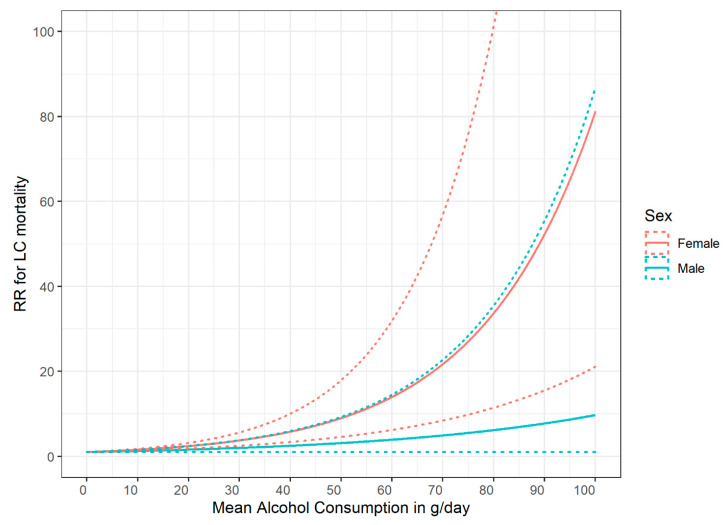
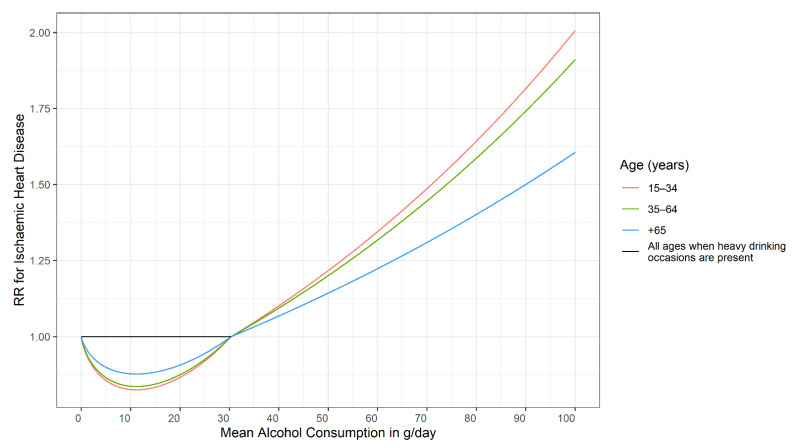
Alcohol use has been causally linked to more than 200 disease and injury conditions, as defined by three-digit ICD-10 codes. The understanding of how alcohol use is related to these conditions is essential to public health and policy research. Accordingly, this study presents a narrative review of different dose-response relationships for alcohol use. Relative-risk (RR) functions were obtained from various comparative risk assessments. Two main dimensions of alcohol consumption are used to assess disease and injury risk: (1) volume of consumption, and (2) patterns of drinking, operationalized via frequency of heavy drinking occasions. Lifetime abstention was used as the reference group. Most dose-response relationships between alcohol and outcomes are monotonic, but for diabetes type 2 and ischemic diseases, there are indications of a curvilinear relationship, where light to moderate drinking is associated with lower risk compared with not drinking (i.e., RR < 1). In general, women experience a greater increase in RR per gram of alcohol consumed than men. The RR per gram of alcohol consumed was lower for people of older ages. RRs indicated that alcohol use may interact synergistically with other risk factors, in particular with socioeconomic status and other behavioural risk factors, such as smoking, obesity, or physical inactivity. The literature on the impact of genetic constitution on dose-response curves is underdeveloped, but certain genetic variants are linked to an increased RR per gram of alcohol consumed for some diseases. When developing alcohol policy measures, including low-risk drinking guidelines, dose-response relationships must be taken into consideration.
Keywords: alcohol; alcohol control policy; curvilinear; disease; dose response; monotonous; mortality; patterns of drinking; protective effects.
Conflict of interest statement
The authors declare no conflict of interest. The funders had no role in the design of the study, in the collection, analyses, or interpretation of data, in the writing of the manuscript, or in the decision to publish the results.
Figures
References
-
- Rothman K.J., Greenland S., Lash T.L. Modern Epidemiology. 3rd ed. Lippincott Williams & Wilkins; Philadelphia, PA, USA: 2008.
Publication types
MeSH terms
Grants and funding
LinkOut - more resources
Full Text Sources
Medical
