


Timing of Creatine Supplementation around Exercise: A Real Concern?
- PMID: 34445003
- PMCID: PMC8401986
- DOI: 10.3390/nu13082844
Timing of Creatine Supplementation around Exercise: A Real Concern?
Abstract
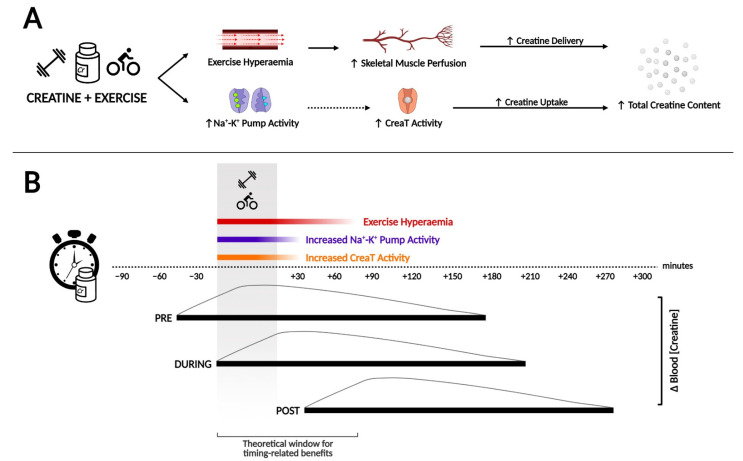
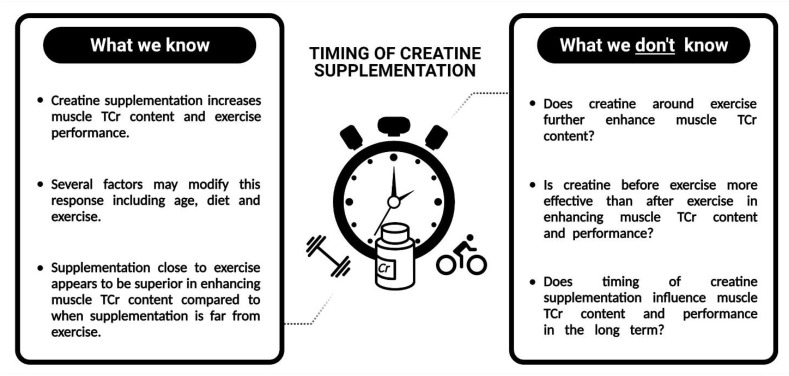
Creatine has been considered an effective ergogenic aid for several decades; it can help athletes engaged in a variety of sports and obtain performance gains. Creatine supplementation increases muscle creatine stores; several factors have been identified that may modify the intramuscular increase and subsequent performance benefits, including baseline muscle Cr content, type II muscle fibre content and size, habitual dietary intake of Cr, aging, and exercise. Timing of creatine supplementation in relation to exercise has recently been proposed as an important consideration to optimise muscle loading and performance gains, although current consensus is lacking regarding the ideal ingestion time. Research has shifted towards comparing creatine supplementation strategies pre-, during-, or post-exercise. Emerging evidence suggests greater benefits when creatine is consumed after exercise compared to pre-exercise, although methodological limitations currently preclude solid conclusions. Furthermore, physiological and mechanistic data are lacking, in regard to claims that the timing of creatine supplementation around exercise moderates gains in muscle creatine and exercise performance. This review discusses novel scientific evidence on the timing of creatine intake, the possible mechanisms that may be involved, and whether the timing of creatine supplementation around exercise is truly a real concern.
Keywords: dietary supplements; ergogenic aid; hypertrophy; resistance training; sports nutrition; strength; supplementation.
Conflict of interest statement
B.G. received research grants, creatine donation for scientific studies, travel support for participation in scientific conferences, and honorarium for speaking at lectures from AlzChem (a company that manufactures creatine). Additionally, he serves as a member of the Scientific Advisory Board for AlzChem. B.S. previously received creatine supplements free of charge from AlzChem to perform research on supplementation and exercise. AlzChem did not provide any input in regard to the intellectual content of the present review.
Figures
References
-
- Kreider R.B., Kalman D.S., Antonio J., Ziegenfuss T.N., Wildman R., Collins R., Candow D.G., Kleiner S.M., Almada A.L., Lopez H.L. International Society of Sports Nutrition position stand: Safety and efficacy of creatine supplementation in exercise, sport, and medicine. J. Int. Soc. Sports Nutr. 2017;14:18. doi: 10.1186/s12970-017-0173-z. - DOI - PMC - PubMed
-
- Maughan R.J., Burke L.M., Dvorak J., Larson-Meyer D.E., Peeling P., Phillips S.M., Rawson E.S., Walsh N.P., Garthe I., Geyer H., et al. IOC consensus statement: Dietary supplements and the high-performance athlete. Br. J. Sports Med. 2018;52:439–455. doi: 10.1136/bjsports-2018-099027. - DOI - PMC - PubMed
-
- Kreider R.B., Jung Y.P. Creatine supplementation in exercise, sport, and medicine. J. Exerc. Nutr. Biochem. 2011;15:53–69. doi: 10.5717/jenb.2011.15.2.53. - DOI
-
- Buford T.W., Kreider R.B., Stout J.R., Greenwood M., Campbell B., Spano M., Ziegenfuss T., Lopez H., Landis J., Antonio J. International Society of Sports Nutrition position stand: Creatine supplementation and exercise. J. Int. Soc. Sports Nutr. 2007;4:6. doi: 10.1186/1550-2783-4-6. - DOI - PMC - PubMed
Publication types
MeSH terms
Substances
Grants and funding
- 2018/19981-5/Fundação de Amparo à Pesquisa do Estado de São Paulo
- 2018/01594-5/Fundação de Amparo à Pesquisa do Estado de São Paulo
- 2019/06140-5/Fundação de Amparo à Pesquisa do Estado de São Paulo
- 2016/50438-0/Fundação de Amparo à Pesquisa do Estado de São Paulo
- 165737/2020-4/Conselho Nacional de Desenvolvimento Científico e Tecnológico
LinkOut - more resources
Full Text Sources
Medical
