. 2021 Aug 6;22(16):8448.
doi: 10.3390/ijms22168448.

Sustained Elevated Blood Pressure Accelerates Atherosclerosis Development in a Preclinical Model of Disease

Affiliations

Sustained Elevated Blood Pressure Accelerates Atherosclerosis Development in a Preclinical Model of Disease

Andrés Gonzalez-Guerra et al. Int J Mol Sci. .

Abstract

The continuous relationship between blood pressure (BP) and cardiovascular events makes the distinction between elevated BP and hypertension based on arbitrary cut-off values for BP. Even mild BP elevations manifesting as high-normal BP have been associated with cardiovascular risk. We hypothesize that persistent elevated BP increases atherosclerotic plaque development. To evaluate this causal link, we developed a new mouse model of elevated BP based on adeno-associated virus (AAV) gene transfer. We constructed AAV vectors to support transfer of the hRenin and hAngiotensinogen genes. A single injection of AAV-Ren/Ang (1011 total viral particles) induced sustained systolic BP increase (130 ± 20 mmHg, vs. 110 ± 15 mmHg in controls; p = 0.05). In ApoE-/- mice, AAV-induced mild BP elevation caused larger atherosclerotic lesions evaluated by histology (10-fold increase vs. normotensive controls). In this preclinical model, atheroma plaques development was attenuated by BP control with a calcium channel blocker, indicating that a small increase in BP within a physiological range has a substantial impact on plaque development in a preclinical model of atherosclerosis. These data support that non-optimal BP represents a risk for atherosclerosis development. Earlier intervention in elevated BP may prevent or delay morbidity and mortality associated with atherosclerosis.

Keywords: adeno associated virus (AAV); angiotensinogen; atherosclerosis; cardiovascular risk-factor; disease model; elevated blood-pressure; prehypertension; renin.


Conflict of interest statement

The authors declare no conflict of interest. The funders had no role in the design of the study; in the collection, analyses, or interpretation of data; in the writing of the manuscript, or in the decision to publish the results.

Figures
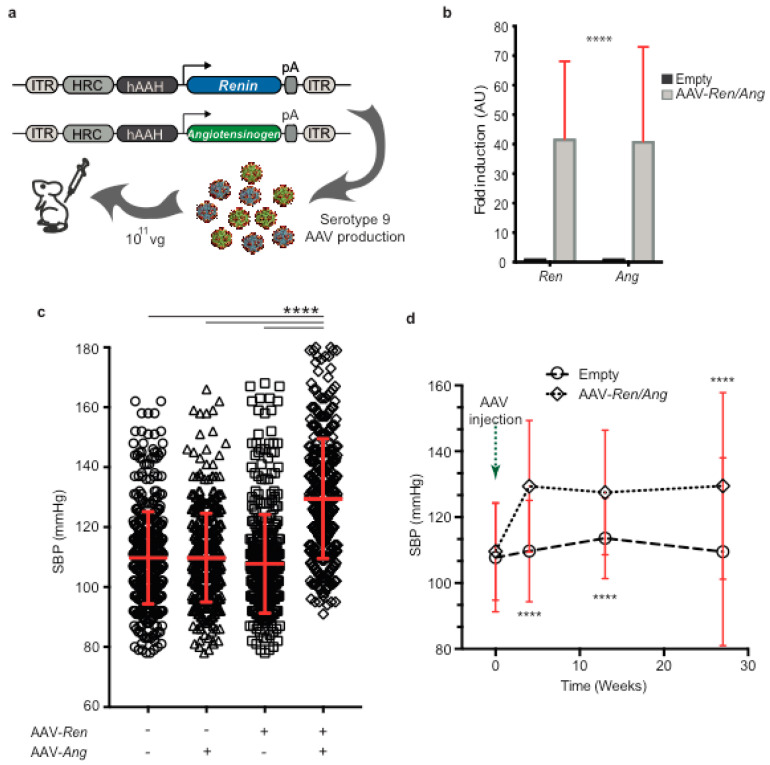
Figure 1
Figure 1
A single injection of AAV-Ren/Ang viruses increases systolic blood pressure (SBP). (a) Plasmids encoding the expression of hRenin (Ren) and hAngiotensinogen (Ang). The plasmids were introduced into serotype 9 adeno-associated viruses (AAV) and injected via the tail vein. (b) Liver mRNA expression of AAV-delivered exogenous Ren and Ang genes in C57BL6/J mice. (c) C57BL6/J mice were given either a single injection of AAV-Ren or AAV-Ang or a combined injection with both viruses (5 × 10¹⁰ vector genomes/animal, n = 10). Co-injection induced a sustained maximal mean SBP increase of ≈20 mmHg. Mean SBP was calculated from measurements from weeks 8 to 12. Data are mean ± SEM. **** p < 0.0001 versus empty vector transduced control group. (d) Evolution of tail-cuff measured SBP after AAV-Ren/Ang or AAV-empty vector injection. **** p < 0.0001, 2-way repeated-measures ANOVA (n = 10–25 per group). ITR, inverted terminal repeats; HCR-hAAH, human antitrypsin gene promoter with an ApoE gene enhancer; pA, poly-A sequence.
Figure 2
Figure 2
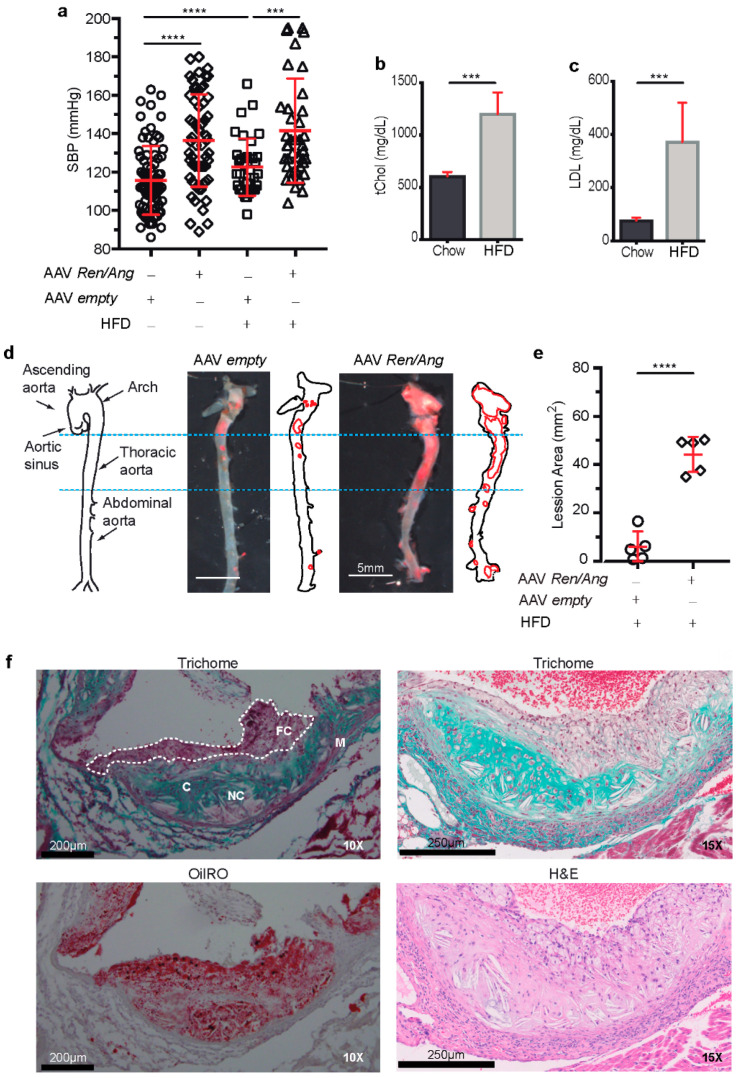
Elevated blood pressure (BP) induces atheroma plaque development in ApoE−/− mice. (a) SBP in ApoE−/− mice 6 weeks after injection with AAV-Ren/Ang or AAV-empty vector and after subsequent maintenance for a further 10 weeks on a high fat diet (HFD) (n = 15 animals per group). Data are mean ± SEM. *** p < 0.001 and **** p < 0.0001, 2-way ANOVA followed by Bonferroni post-test. (b) Serum total cholesterol and (c) serum low-density lipoprotein (LDL) cholesterol in AAV-Ren/Ang-injected ApoE−/− mice fed standard chow or the HFD for 10 weeks starting 6 weeks after AAV injection. (d) Schematic representation of the aorta. Aortic sinus, ascending aorta, arch, thoracic aorta, and abdominal aorta are indicated with black arrows. Representative complete aortas from AAV-empty control and AAV-Ren/Ang-injected ApoE−/− mice stained with Oil Red O. Aortas were extracted 10 weeks after starting the HFD. Scale bar, 5 mm. (e) Lesion area in aortas stained as in D. Data in (b,c,e) are mean ± SEM. *** p < 0.001, **** p < 0.0001, Student t-test. (f) Representative Masson’s trichrome, Oil Red O, and H&E staining of the aortic sinus in HFD-fed AAV-Ren/Ang ApoE−/− mice. FC, foam cells; NC, necrotic core; C, collagen lesions; M, tunica media. Scale bars, 200 μm (10×) and 250 μm (15×).
Figure 3
Figure 3
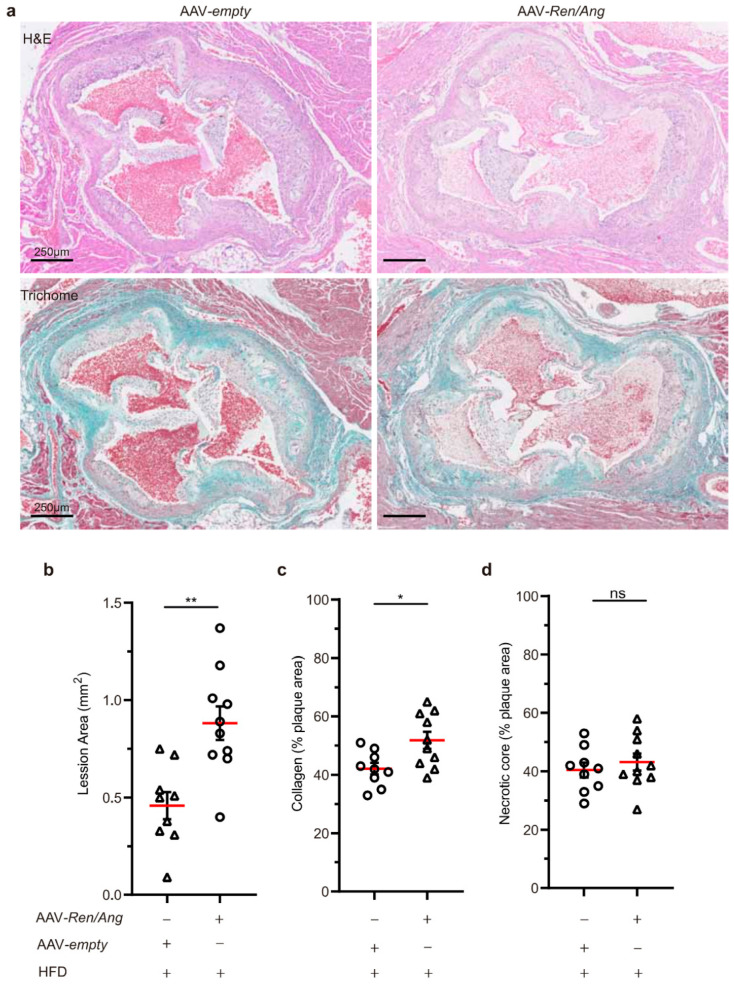
Non-optimal BP increases atherosclerosis at the aortic root. (a) Representative whole view of aortic roots from AAV-empty control and AAV-Ren/Ang-injected ApoE−/− mice stained with H&E and Masson’s trichrome. Aortas were extracted 10 weeks after starting the HFD. Scale bar, 250 μm. (b) Quantification of atherosclerotic plaque area from a (n = 9–10 AAV-empty and AAV-Ren/Ang mice) indicated as mm2. (c,d) Quantification of collagen and necrotic core area expressed as a percentage of the total plaque cross-sectional area (n = 9-10). Data in (bd) are mean ± SEM. * p < 0.05, ** p < 0.01, ns, non-significant, Student t-test.
Figure 4
Figure 4
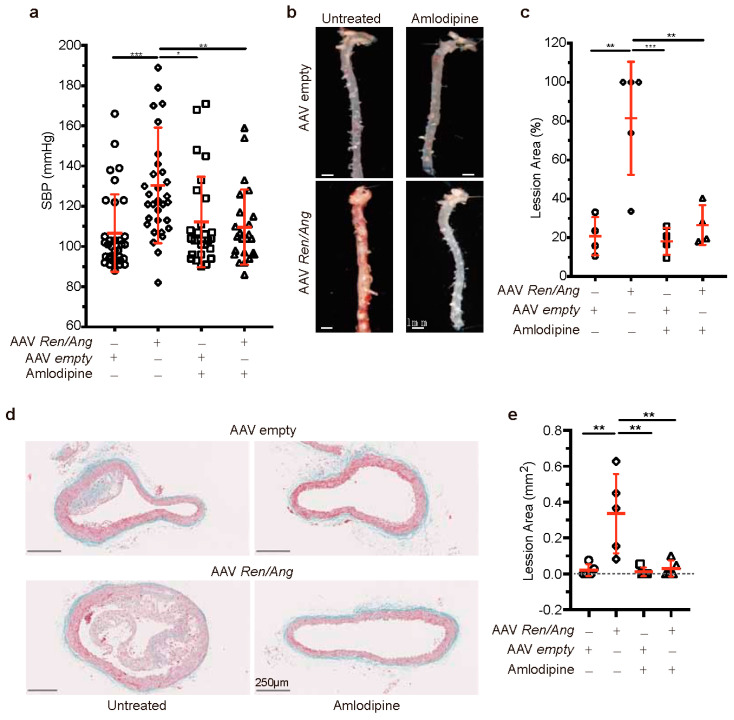
The calcium antagonist amlodipine reduces blood pressure (BP) and atherosclerosis induced by AAV-Ren/Ang transduction in mice. (a) SBP (mmHg) in ApoE−/− mice injected with AAV-empty shuttle vector or AAV-Ren/Ang. Mice were maintained for 10 weeks on the high-fat diet (HFD) starting 6 weeks after AAV injection and were untreated or treated with amlodipine (2.5 mg/kg) in the drinking water. SBP was measured at the same time of the day in all groups. Data are mean ± SEM. * p < 0.05, ** p < 0.01, *** p < 0.001, 2-way ANOVA followed by Bonferroni post-test (n = 10 per group). (b) Representative Oil Red O-stained aortas from AAV-empty shuttle vector and AAV-Ren/Ang-injected ApoE−/− mice untreated or treated with amlodipine throughout the 12-week HFD period. Scale bar, 1 mm. (c) Lesion area in aortas stained as in (b). Data are mean ± SEM. ** p < 0.01, *** p < 0.001, one-way ANOVA with Tukey’s multiple comparison test (n = 4-5 mice per group). Each data point represents an individual aorta, horizontal red bars denote mean values, and black bars denote SEM. (d) Representative Masson’s trichrome staining of descending aorta sections from ApoE−/− mice injected with empty vector or AAV-Ren/Ang and untreated or treated with amlodipine. (e) Lesion area in sections stained as in d. Data are mean ± SEM. ** p < 0.01, one-way ANOVA with Tukey’s multiple comparison test (n = 4–5 mice per group). Each data point represents an individual aorta, horizontal red bars denote mean values, and bars denote SEM.

References

    1. Kearney P.M., Whelton M., Reynolds K., Muntner P., Whelton P.K., He J. Global burden of hypertension: Analysis of worldwide data. Lancet. 2005;365:217–223. doi: 10.1016/S0140-6736(05)17741-1. - DOI - PubMed
    1. Whelton P.K., Carey R.M., Aronow W.S., Casey D.E., Jr., Collins K.J., Dennison Himmelfarb C., DePalma S.M., Gidding S., Jamerson K.A., Jones D.W., et al. 2017 ACC/AHA/AAPA/ABC/ACPM/AGS/APhA/ASH/ASPC/NMA/PCNA Guideline for the Prevention, Detection, Evaluation, and Management of High Blood Pressure in Adults: A Report of the American College of Cardiology/American Heart Association Task Force on Clinical Practice Guidelines. J. Am. Coll. Cardiol. 2018;71:e127–e248. - PubMed
    1. Williams B., Mancia G., Spiering W., Agabiti Rosei E., Azizi M., Burnier M., Clement D.L., Coca A., de Simone G., Dominiczak A., et al. 2018 ESC/ESH Guidelines for the management of arterial hypertension. Eur. Heart J. 2018;39:3021–3104. doi: 10.1093/eurheartj/ehy339. - DOI - PubMed
    1. Lewington S., Clarke R., Qizilbash N., Peto R., Collins R., Prospective Studies Collaboration Age-specific relevance of usual blood pressure to vascular mortality: A meta-analysis of individual data for one million adults in 61 prospective studies. Lancet. 2002;360:1903–1913. - PubMed
    1. Timmis A., Townsend N., Gale C.P., Torbica A., Lettino M., Petersen S.E., Mossialos E.A., Maggioni A.P., Kazakiewicz D., May H.T., et al. European Society of Cardiology: Cardiovascular Disease Statistics 2019. Eur. Heart J. 2020;41:12–85. doi: 10.1093/eurheartj/ehz859. - DOI - PubMed