


The Role of Mitochondria-Derived Peptides in Cardiovascular Diseases and Their Potential as Therapeutic Targets
- PMID: 34445477
- PMCID: PMC8396025
- DOI: 10.3390/ijms22168770
The Role of Mitochondria-Derived Peptides in Cardiovascular Diseases and Their Potential as Therapeutic Targets
Abstract
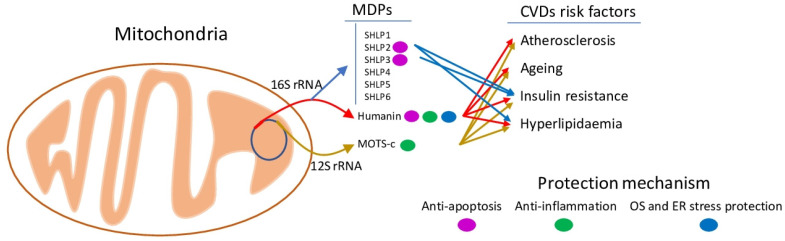
Mitochondria-derived peptides (MDPs) are small peptides hidden in the mitochondrial DNA, maintaining mitochondrial function and protecting cells under different stresses. Currently, three types of MDPs have been identified: Humanin, MOTS-c and SHLP1-6. MDPs have demonstrated anti-apoptotic and anti-inflammatory activities, reactive oxygen species and oxidative stress-protecting properties both in vitro and in vivo. Recent research suggests that MDPs have a significant cardioprotective role, affecting CVDs (cardiovascular diseases) development and progression. CVDs are the leading cause of death globally; this term combines disorders of the blood vessels and heart. In this review, we focus on the recent progress in understanding the relationships between MDPs and the main cardiovascular risk factors (atherosclerosis, insulin resistance, hyperlipidaemia and ageing). We also will discuss the therapeutic application of MDPs, modified and synthetic MDPs, and their potential as novel biomarkers and therapeutic targets.
Keywords: Humanin; MOTS-c; SHLPs; ageing; atherosclerosis; cardiovascular diseases; hyperlipidaemia; insulin resistance; mitochondria-derived peptides.
Conflict of interest statement
The authors declare no conflict of interest. The funders had no role in the design of the study; in the collection, analyses, or interpretation of data; in the writing of the manuscript, or in the decision to publish the results.
Figures
References
-
- Hashimoto Y., Niikura T., Ito Y., Sudo H., Hata M., Arakawa E., Abe Y., Kita Y., Nishimoto I. Detailed Characterization of Neuroprotection by a Rescue Factor Humanin against Various Alzheimer’s Disease-Relevant Insults. J. Neurosci. 2001;21:9235–9245. doi: 10.1523/JNEUROSCI.21-23-09235.2001. - DOI - PMC - PubMed
-
- Hashimoto Y., Niikura T., Tajima H., Yasukawa T., Sudo H., Ito Y., Kita Y., Kawasumi M., Kouyama K., Doyu M., et al. A Rescue Factor Abolishing Neuronal Cell Death by a Wide Spectrum of Familial Alzheimer’s Disease Genes and A. Proc. Natl. Acad. Sci. USA. 2001;98:6336–6341. doi: 10.1073/pnas.101133498. - DOI - PMC - PubMed
-
- Lee C., Zeng J., Drew B.G., Sallam T., Martin-Montalvo A., Wan J., Kim S.-J., Mehta H., Hevener A.L., de Cabo R., et al. The Mitochondrial-Derived Peptide MOTS-c Promotes Metabolic Homeostasis and Reduces Obesity and Insulin Resistance. Cell Metab. 2015;21:443–454. doi: 10.1016/j.cmet.2015.02.009. - DOI - PMC - PubMed
-
- Cobb L.J., Lee C., Xiao J., Yen K., Wong R.G., Nakamura H.K., Mehta H.H., Gao Q., Ashur C., Huffman D.M., et al. Naturally Occurring Mitochondrial-Derived Peptides Are Age-Dependent Regulators of Apoptosis, Insulin Sensitivity, and Inflammatory Markers. Aging. 2016;8:796–809. doi: 10.18632/aging.100943. - DOI - PMC - PubMed
Publication types
MeSH terms
Substances
Grants and funding
LinkOut - more resources
Full Text Sources
Other Literature Sources
