Review
. 2021 Aug 26;25(1):307.
doi: 10.1186/s13054-021-03736-w.

Initial antimicrobial management of sepsis

Affiliations
Review

Initial antimicrobial management of sepsis

Michael S Niederman et al. Crit Care. .

Abstract

Sepsis is a common consequence of infection, associated with a mortality rate > 25%. Although community-acquired sepsis is more common, hospital-acquired infection is more lethal. The most common site of infection is the lung, followed by abdominal infection, catheter-associated blood steam infection and urinary tract infection. Gram-negative sepsis is more common than gram-positive infection, but sepsis can also be due to fungal and viral pathogens. To reduce mortality, it is necessary to give immediate, empiric, broad-spectrum therapy to those with severe sepsis and/or shock, but this approach can drive antimicrobial overuse and resistance and should be accompanied by a commitment to de-escalation and antimicrobial stewardship. Biomarkers such a procalcitonin can provide decision support for antibiotic use, and may identify patients with a low likelihood of infection, and in some settings, can guide duration of antibiotic therapy. Sepsis can involve drug-resistant pathogens, and this often necessitates consideration of newer antimicrobial agents.

Keywords: Antibiotic therapy; Antimicrobial therapy; Bacteremia; Biomarkers; Fungal infection; Intra-abdominal infection; Pharmacokinetics; Pneumonia; Sepsis.


Conflict of interest statement

The authors declare that they have no competing interests.

Figures
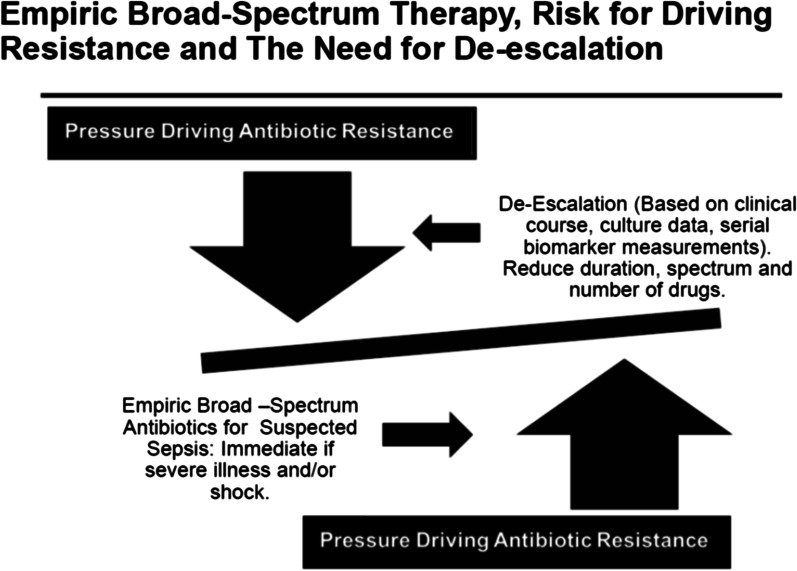
Fig. 1
Fig. 1
The need for immediate broad-spectrum empiric antimicrobial therapy for selected patients with severe sepsis may be life-saving, but may also put pressure to overuse antibiotics and drive antibiotic resistance. Thus, this approach comes with the obligation to try to control resistance by de-escalating therapy once serial clinical, microbiologic and laboratory data become available. De-escalation can be in the form of shorter duration of therapy, less broad-spectrum agents, fewer drugs, or a combination of these interventions
Fig. 2
Fig. 2
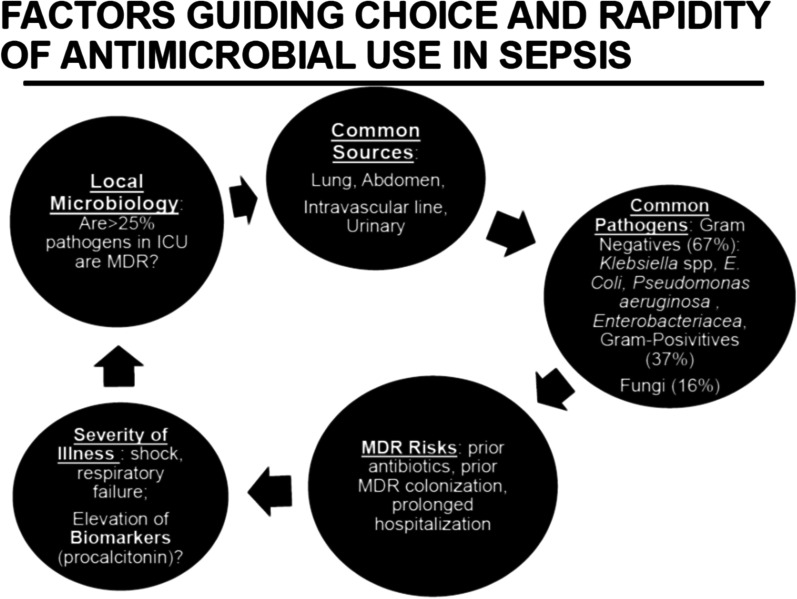
The rapidity of empiric therapy and the choice of specific agents are determined by the clinical scenario of the patient with suspected sepsis. Immediate therapy is given to those with a high likelihood of infection, and severe illness and or shock. If biomarkers like procalcitonin are not elevated, and the patient is not severely ill, immediate therapy is not necessary, and some patients may not even have infection. Specific agents are chosen with a consideration of the most common site of infection (lung > abdomen > catheter-associated infection > urinary tract infection). Each site has a group of likely pathogens, but these can vary, depending on patient-specific risk factors for resistance, and local ICU patterns of drug-resistant organisms. In sepsis, gram-negatives are more common than gram-positive, but some patients may also have fungal infection

Comment in

References

    1. Rhodes A, Evans LE, Alhazzani W, Levy MM, Antonelli M, Ferrer R, et al. Surviving sepsis campaign: international guidelines for management of sepsis and septic shock: 2016. Crit Care Med. 2017;45(3):486–552. doi: 10.1097/CCM.0000000000002255. - DOI - PubMed
    1. Seymour CW, Liu VX, Iwashyna TJ, Brunkhorst FM, Rea TD, Scherag A, et al. Assessment of clinical criteria for sepsis: for the third international consensus definitions for sepsis and septic shock (sepsis-3) JAMA. 2016;315(8):762–774. doi: 10.1001/jama.2016.0288. - DOI - PMC - PubMed
    1. Reinhart K, Daniels R, Kissoon N, Machado FR, Schachter RD, Finfer S. recognizing sepsis as a global health priority—a WHO resolution. N Engl J Med. 2017;377(5):414–417. doi: 10.1056/NEJMp1707170. - DOI - PubMed
    1. Fay K, Sapiano MRP, Gokhale R, Dantes R, Thompson N, Katz DE, et al. Assessment of health care exposures and outcomes in adult patients with sepsis and septic shock. JAMA Netw Open 2020;3(7):e206004. - PMC - PubMed
    1. Rhodes A, Evans LE, Alhazzani W, Levy MM, Antonelli M, Ferrer R, et al. Surviving sepsis campaign: international guidelines for management of sepsis and septic shock: 2016. Intensive Care Med. 2017;43(3):304–377. doi: 10.1007/s00134-017-4683-6. - DOI - PubMed

MeSH terms