


Contributions of the rodent cingulate-retrosplenial cortical axis to associative learning and memory: A proposed circuit for persistent memory maintenance
- PMID: 34450181
- PMCID: PMC8511298
- DOI: 10.1016/j.neubiorev.2021.08.023
Contributions of the rodent cingulate-retrosplenial cortical axis to associative learning and memory: A proposed circuit for persistent memory maintenance
Abstract
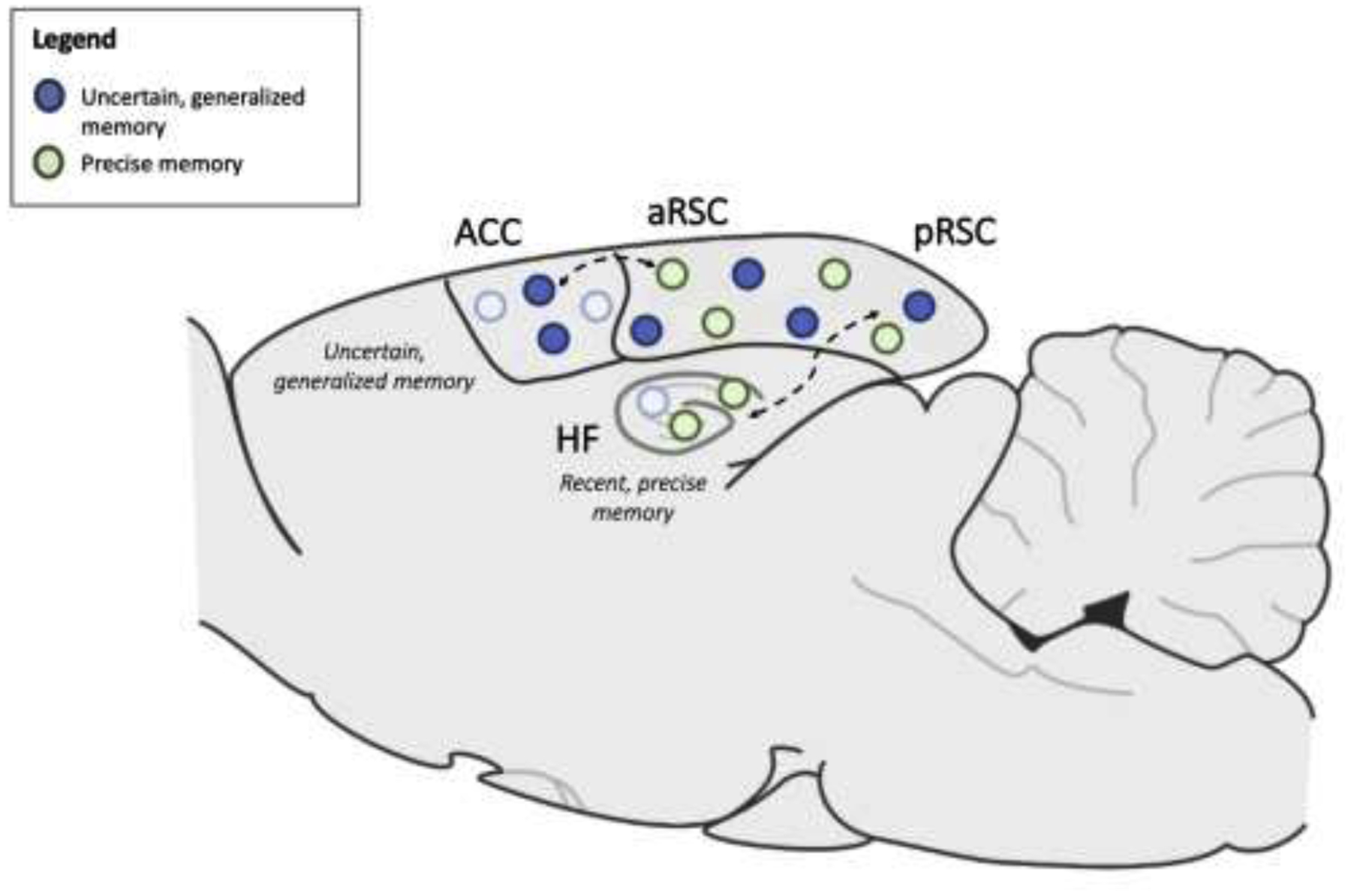
While the anterior cingulate (ACC) and retrosplenial (RSC) cortices have been extensively studied for their role in spatial navigation, less is known about how they contribute to associative learning and later memory recall. The limited work that has been conducted on this topic suggests that each of these cortical regions makes distinct, but similar contributions to associative learning and memory. Here, we review evidence from the rodent literature demonstrating that while ACC activity seems to be necessary at remote time points associated with imprecise or generalized memories, the role of the RSC seems to be uniform over time. Together, the lines of evidence reviewed here suggest that the ACC and RSC likely function together to support memory formation and maintenance following associative learning.
Keywords: Anterior cingulate; Learning; Memory; Recent; Remote; Retrosplenial.
Copyright © 2021. Published by Elsevier Ltd.
Figures
References
-
- Abel T, & Lattal KM. (2001). Molecular mechanisms of memory acquisition, consolidation and retrieval. Current Opinion in Neurobiology, 11(2): 180–187. - PubMed
-
- Baumgärte K, & Mansury IM. (2012). Neural functions of calcineurin in synaptic plasticity and memory. Learning & Memory, 19, 375–384. - PubMed
Publication types
MeSH terms
Grants and funding
LinkOut - more resources
Full Text Sources
