


Biotechnological Methods for Buckwheat Breeding
- PMID: 34451594
- PMCID: PMC8399956
- DOI: 10.3390/plants10081547
Biotechnological Methods for Buckwheat Breeding
Abstract
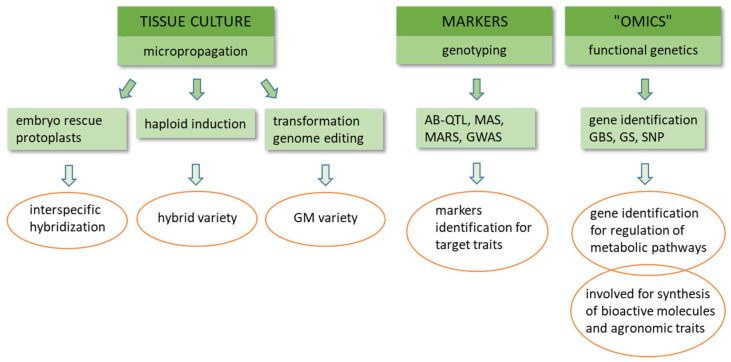
The Fagopyrum genus includes two cultivated species, namely common buckwheat (F. esculentum Moench) and Tartary buckwheat (F. tataricum Gaertn.), and more than 25 wild buckwheat species. The goal of breeders is to improve the properties of cultivated buckwheat with methods of classical breeding, with the support of biotechnological methods or a combination of both. In this paper, we reviewed the possibility to use transcriptomics, genomics, interspecific hybridization, tissue cultures and plant regeneration, molecular markers, genetic transformation, and genome editing to aid in both the breeding of buckwheat and in the identification and production of metabolites important for preserving human health. The key problems in buckwheat breeding are the unknown mode of inheritance of most traits, associated with crop yield and the synthesis of medicinal compounds, low seed yield, shedding of seeds, differential flowering and seed set on branches, and unknown action of genes responsible for the synthesis of buckwheat metabolites of pharmaceutical and medicinal interest.
Keywords: genomics; interspecific hybridization; metabolites; molecular markers; tissue cultures; transcriptomics.
Conflict of interest statement
The authors declare that they have no conflict of interest.
Figures
References
-
- Ohnishi O. Discovery of the wild ancestor of common buckwheat. Fagopyrum. 1990;11:5–10.
-
- Chrungoo N.K., Chettry U. Buckwheat: A critical approach towards assessment of its potential as a super crop. Indian J. Genet. Plant Breed. 2021;81:1–23. doi: 10.31742/IJGPB.81.1.1. - DOI
-
- Zhang K., Fan Y., Weng W., Tang Y., Zhou M. Fagopyrum longistylum (Polygonaceae), a new species from Sichuan, China. Phytotaxa. 2021;482:173–182. doi: 10.11646/phytotaxa.482.2.5. - DOI
-
- De Arcangelis E., Cuomo F., Trivisonno M.C., Marconi E., Messia M.C. Gelatinization and pasta making conditions for buckwheat gluten-free pasta. J. Cereal Sci. 2020;95:103073. doi: 10.1016/j.jcs.2020.103073. - DOI
Publication types
Grants and funding
LinkOut - more resources
Full Text Sources
