


Interspecific Differences in Physiological and Biochemical Traits Drive the Water Stress Tolerance in Young Morus alba L. and Conocarpus erectus L. Saplings
- PMID: 34451659
- PMCID: PMC8398188
- DOI: 10.3390/plants10081615
Interspecific Differences in Physiological and Biochemical Traits Drive the Water Stress Tolerance in Young Morus alba L. and Conocarpus erectus L. Saplings
Abstract
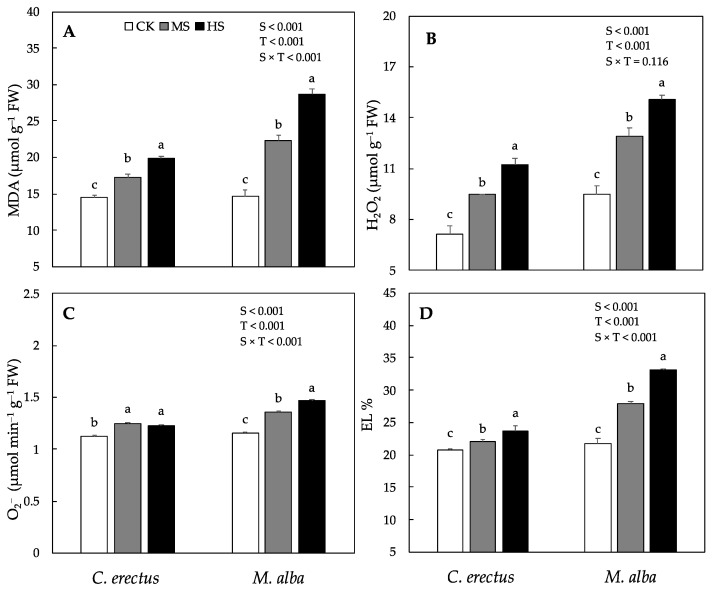
Mitigating climate change requires the identification of tree species that can tolerate water stress with fewer negative impacts on plant productivity. Therefore, the study aimed to evaluate the water stress tolerance of young saplings of C. erectus and M. alba under three soil water deficit treatments (control, CK, 90% field capacity, FC, medium stress MS, 60% FC and high stress, HS, 30% FC) under controlled conditions. Results showed that leaf and stem dry weight decreased significantly in both species under MS and HS. However, root dry weight and root/shoot ratio increased, and total dry weight remained similar to CK under MS in C. erectus saplings. Stomatal conductance, CO2 assimilation rate decreased, and intrinsic water use efficiency increased significantly in both species under MS and HS treatments. The concentration of hydrogen peroxide, superoxide radical, malondialdehyde and electrolyte leakage increased in both the species under soil water deficit but was highest in M. alba. The concentration of antioxidative enzymes like superoxide dismutase, peroxidase, catalase, and ascorbate peroxidase also increased in both species under MS and HS but was highest in C. erectus. Therefore, results suggest that C. erectus saplings depicted a better tolerance to MS due to an effective antioxidative enzyme system.
Keywords: drought stress; leaf gas exchange; mulberry; osmolytes accumulation; water use efficiency.
Conflict of interest statement
The authors declare no conflict of interest.
Figures



References
-
- Munns R. Plant adaptations to salt and water stress: Differences and commonalities. Adv. Bot. Res. 2011;57:1–32.
-
- Pakistan Economic Survey. Agricultural Statistics. [(accessed on 25 March 2021)];2020 Available online: http://www.finance.gov.pk/survey/chapters_19/2-Agriculture.pdf.
-
- Rahut D.B., Ali A., Imtiaz M., Mottaleb K.A., Erenstein O. Impact of irrigation water scarcity on rural household food security and income in Pakistan. Water Supply. 2016;16:675–683. doi: 10.2166/ws.2015.179. - DOI
-
- Qureshi A.S., McCornick P.G., Sarwar A., Sharma B.R. Challenges and prospects of sustainable groundwater management in the Indus Basin, Pakistan. Water Resour. Manag. 2010;24:1551–1569. doi: 10.1007/s11269-009-9513-3. - DOI
Grants and funding
LinkOut - more resources
Full Text Sources
Research Materials
Miscellaneous
