


New Insights on Euphorbia dendroides L. (Euphorbiaceae): Polyphenol Profile and Biological Properties of Hydroalcoholic Extracts from Aerial Parts
- PMID: 34451666
- PMCID: PMC8399491
- DOI: 10.3390/plants10081621
New Insights on Euphorbia dendroides L. (Euphorbiaceae): Polyphenol Profile and Biological Properties of Hydroalcoholic Extracts from Aerial Parts
Abstract
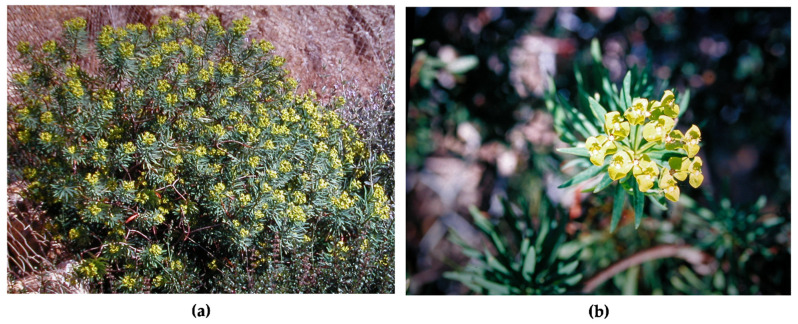
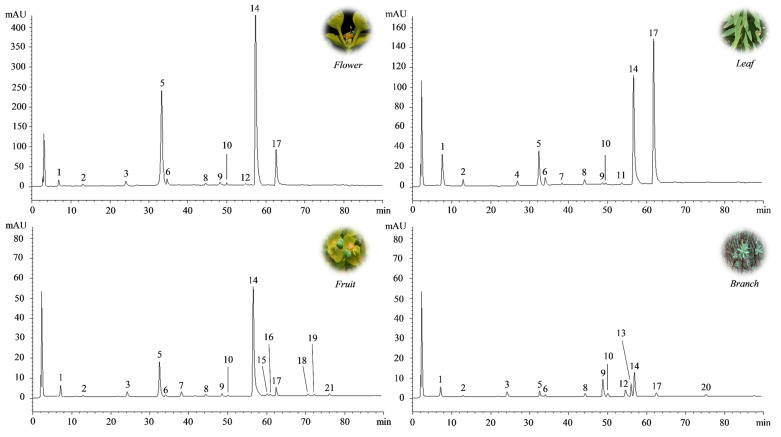
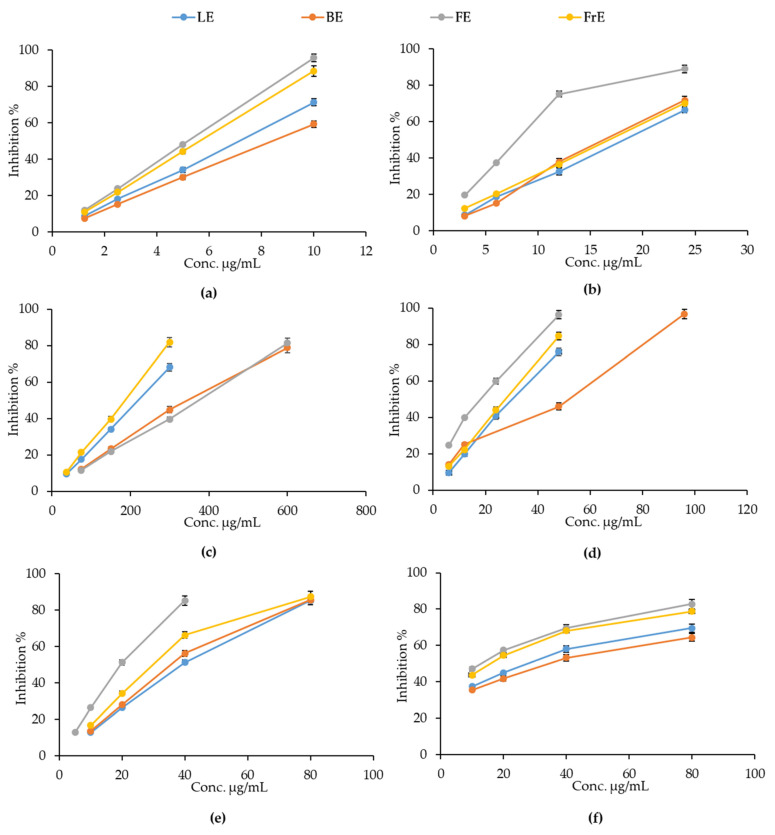
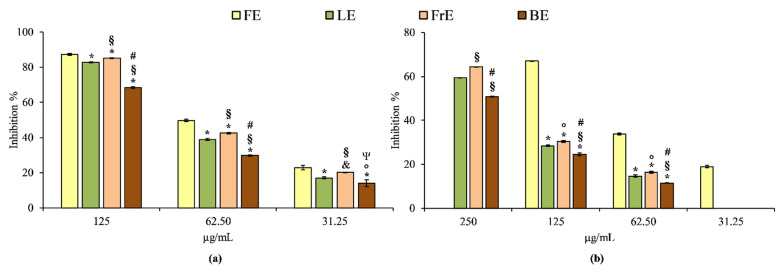
Euphorbia dendroides L. is a rounded shrub commonly found in the Mediterranean area well-known, since ancient times, for its traditional use. The aim of the present study was to investigate the phytochemical profile as well as the antioxidant and anti-inflammatory properties of flower (FE), leaf (LE), fruit (FrE), and branch (BE) hydroalcoholic extracts. For this purpose, a preliminary phytochemical screening followed by RP-LC-DAD-ESI-MS analysis, as well as several in vitro cell-free colorimetric assays, were carried out. Moreover, the toxicity of the extracts was investigated by the brine shrimp lethality assay. All extracts showed a high content of polyphenols, in particular phenolic acids (chlorogenic acid 0.74-13.80 g/100 g) and flavonoids (rutin 0.05-2.76 g/100 g and isovitexin 8.02 in BE). All the extracts showed strong and concentration-dependent antioxidant and anti-inflammatory activity with, on average, the following order of potency: FE, LE, FrE, and BE. Interestingly, all the extracts investigated did not show any toxicity on Artemia salina. Moreover, the only LD50 found (BE, 8.82 mg/mL) is well above the concentration range, which has been shown the biological properties. Considering this, this study offers the first evidence of the possible use of the polyphenol extracts from the aerial parts of E. dendroides as promising antioxidant and anti-inflammatory agents.
Keywords: Euphorbia dendroides L.; aerial parts; anti-inflammatory activity; antioxidant activity; polyphenols; toxicity.
Conflict of interest statement
The authors declare no conflict of interest.
Figures
References
-
- Horn J.W., Vane B.W., Morawetz J.J., Riina R., Steinmann V.W., Berry P.E., Wurdack K.J. Phyogenetic sand the evolution of major structural char-acters in the giant genus Euphorbia L. (Euphorbiaceae) Mol. Phylogenet. E. 2012;63:305–326. - PubMed
-
- Nambudiri N.S., Nambudiri V.E. Euphorbia peplus: 18th-centuryinsightsona 21st-century therapy. JAMA Derm. 2013;149:1081. - PubMed
-
- Gopi K., Renu K., Sannanaik Vishwanath B., Jayaraman G. Protective effect of Euphorbia hirta and its components against snake venom induced lethality. J. Ethnopharmacol. 2015;165:180–190. - PubMed
LinkOut - more resources
Full Text Sources
Research Materials
