


Thermodynamic Stability Is a Strong Predictor for the Delivery of DARPins to the Cytosol via Anthrax Toxin
- PMID: 34452246
- PMCID: PMC8401532
- DOI: 10.3390/pharmaceutics13081285
Thermodynamic Stability Is a Strong Predictor for the Delivery of DARPins to the Cytosol via Anthrax Toxin
Abstract
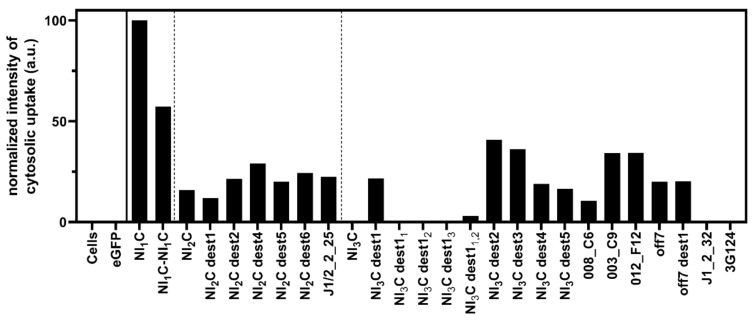
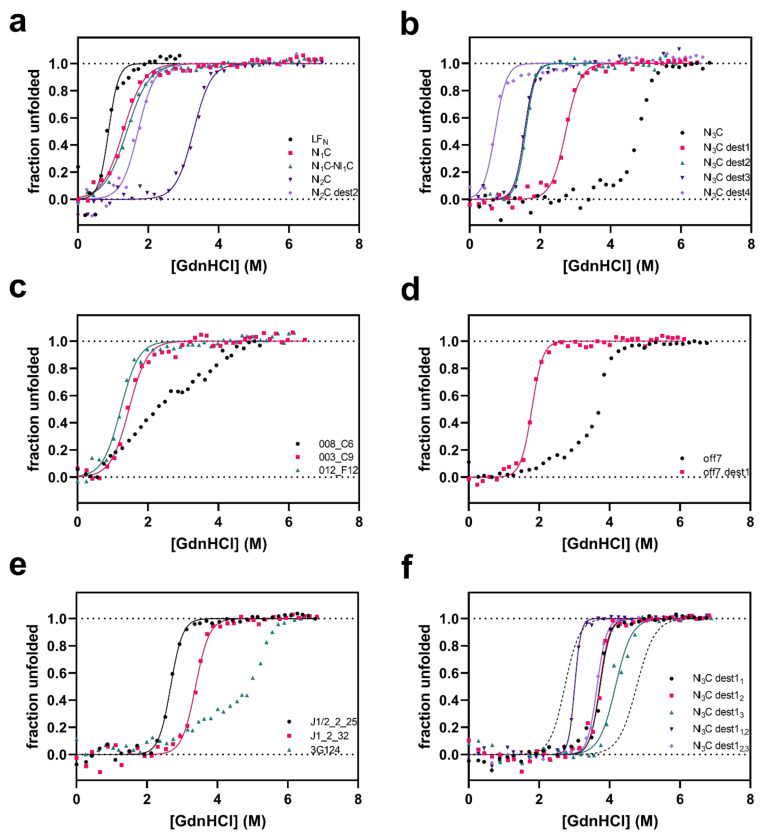
Anthrax toxin has evolved to translocate its toxic cargo proteins to the cytosol of cells carrying its cognate receptor. Cargo molecules need to unfold to penetrate the narrow pore formed by its membrane-spanning subunit, protective antigen (PA). Various alternative cargo molecules have previously been tested, with some showing only limited translocation efficiency, and it may be assumed that these were too stable to be unfolded before passing through the anthrax pore. In this study, we systematically and quantitatively analyzed the correlation between the translocation of various designed ankyrin repeat proteins (DARPins) and their different sizes and thermodynamic stabilities. To measure cytosolic uptake, we used biotinylation of the cargo by cytosolic BirA, and we measured cargo equilibrium stability via denaturant-induced unfolding, monitored by circular dichroism (CD). Most of the tested DARPin cargoes, including target-binding ones, were translocated to the cytosol. Those DARPins, which remained trapped in the endosome, were confirmed by CD to show a high equilibrium stability. We could pinpoint a stability threshold up to which cargo DARPins still get translocated to the cytosol. These experiments have outlined the requirements for translocatable binding proteins, relevant stability measurements to assess translocatable candidates, and guidelines to further engineer this property if needed.
Keywords: DARPin; anthrax toxin; circular dichroism; cytosolic protein delivery; protein stability.
Conflict of interest statement
The authors declare no conflict of interest. The funders had no role in the design of the study; in the collection, analyses, or interpretation of data; in the writing of the manuscript, or in the decision to publish the results.
Figures
Similar articles
-
DARPins bind their cytosolic targets after having been translocated through the protective antigen pore of anthrax toxin.Sci Rep. 2023 May 17;13(1):8048. doi: 10.1038/s41598-023-34647-1. Sci Rep. 2023. PMID: 37198284 Free PMC article.
-
Reengineering anthrax toxin protective antigen for improved receptor-specific protein delivery.BMC Biol. 2020 Aug 13;18(1):100. doi: 10.1186/s12915-020-00827-y. BMC Biol. 2020. PMID: 32792013 Free PMC article.
-
Efficient cell-specific uptake of binding proteins into the cytoplasm through engineered modular transport systems.J Control Release. 2015 Feb 28;200:13-22. doi: 10.1016/j.jconrel.2014.12.019. Epub 2014 Dec 17. J Control Release. 2015. PMID: 25526701
-
[Molecular model of anthrax toxin translocation into target-cells].Bioorg Khim. 2014 Jul-Aug;40(4):399-404. doi: 10.1134/s1068162014040098. Bioorg Khim. 2014. PMID: 25898749 Review. Russian.
-
Delivery of Non-Native Cargo into Mammalian Cells Using Anthrax Lethal Toxin.ACS Chem Biol. 2016 Jun 17;11(6):1490-501. doi: 10.1021/acschembio.6b00169. Epub 2016 May 2. ACS Chem Biol. 2016. PMID: 27055654 Review.
Cited by
-
Intracellular Protein Delivery: Approaches, Challenges, and Clinical Applications.BME Front. 2024 Jan 25;5:0035. doi: 10.34133/bmef.0035. eCollection 2024. BME Front. 2024. PMID: 38282957 Free PMC article. Review.
-
Antibodies as Biosensors' Key Components: State-of-the-Art in Russia 2020-2021.Sensors (Basel). 2021 Nov 16;21(22):7614. doi: 10.3390/s21227614. Sensors (Basel). 2021. PMID: 34833687 Free PMC article. Review.
-
HOPS-Dependent Endosomal Escape Demands Protein Unfolding.ACS Cent Sci. 2024 Mar 26;10(4):860-870. doi: 10.1021/acscentsci.4c00016. eCollection 2024 Apr 24. ACS Cent Sci. 2024. PMID: 38680556 Free PMC article.
-
DARPins bind their cytosolic targets after having been translocated through the protective antigen pore of anthrax toxin.Sci Rep. 2023 May 17;13(1):8048. doi: 10.1038/s41598-023-34647-1. Sci Rep. 2023. PMID: 37198284 Free PMC article.
-
Targeting the Inside of Cells with Biologicals: Toxin Routes in a Therapeutic Context.BioDrugs. 2023 Mar;37(2):181-203. doi: 10.1007/s40259-023-00580-y. Epub 2023 Feb 2. BioDrugs. 2023. PMID: 36729328 Free PMC article. Review.
References
-
- Zielinski R., Lyakhov I., Jacobs A., Chertov O., Kramer-Marek G., Francella N., Stephen A., Fisher R., Blumenthal R., Capala J. Affitoxin—A novel recombinant, HER2-specific, anticancer agent for targeted therapy of HER2-positive tumors. J. Immunother. 2009;32:817–825. doi: 10.1097/CJI.0b013e3181ad4d5d. - DOI - PMC - PubMed
Grants and funding
LinkOut - more resources
Full Text Sources
