Review
. 2021 Aug 23;13(8):1314.
doi: 10.3390/pharmaceutics13081314.

Ectopic Odorant Receptor Responding to Flavor Compounds: Versatile Roles in Health and Disease

Affiliations
Review

Ectopic Odorant Receptor Responding to Flavor Compounds: Versatile Roles in Health and Disease

Tao Tong et al. Pharmaceutics. .

Abstract

Prompted by the ground-breaking discovery of the rodent odorant receptor (OR) gene family within the olfactory epithelium nearly 30 years ago, followed by that of OR genes in cells of the mammalian germ line, and potentiated by the identification of ORs throughout the body, our appreciation for ORs as general chemoreceptors responding to odorant compounds in the regulation of physiological or pathophysiological processes continues to expand. Ectopic ORs are now activated by a diversity of flavor compounds and are involved in diverse physiological phenomena varying from adipogenesis to myogenesis to hepatic lipid accumulation to serotonin secretion. In this review, we outline the key biological functions of the ectopic ORs responding to flavor compounds and the underlying molecular mechanisms. We also discuss research opportunities for utilizing ectopic ORs as therapeutic strategies in the treatment of human disease as well as challenges to be overcome in the future. The recognition of the potent function, signaling pathway, and pharmacology of ectopic ORs in diverse tissues and cell types, coupled with the fact that they belong to G protein-coupled receptors, a highly druggable protein family, unequivocally highlight the potential of ectopic ORs responding to flavor compounds, especially food-derived odorant compounds, as a promising therapeutic strategy for various diseases.

Keywords: G protein-coupled receptor; cyclic adenosine monophosphate; ectopic function; ectopic odorant receptor; odorant compounds.


Conflict of interest statement

The authors declare no conflict of interests.

Figures
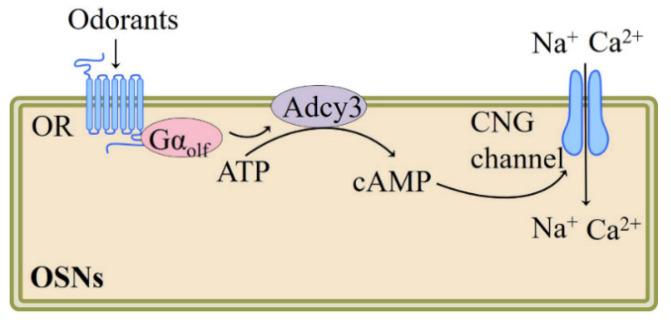
Figure 1
Figure 1
Schematic model of the olfactory signaling transduction pathways in OSNs, adapted from [3,23], published by Cell Press, 1991 and Annual Reviews, 2002. Adcy, adenylyl cyclase; cAMP, cyclic adenosine monophosphate; CNG, cyclic nucleotide gated channel; Gαolf, olfactory G protein alpha subunit.
Figure 2
Figure 2
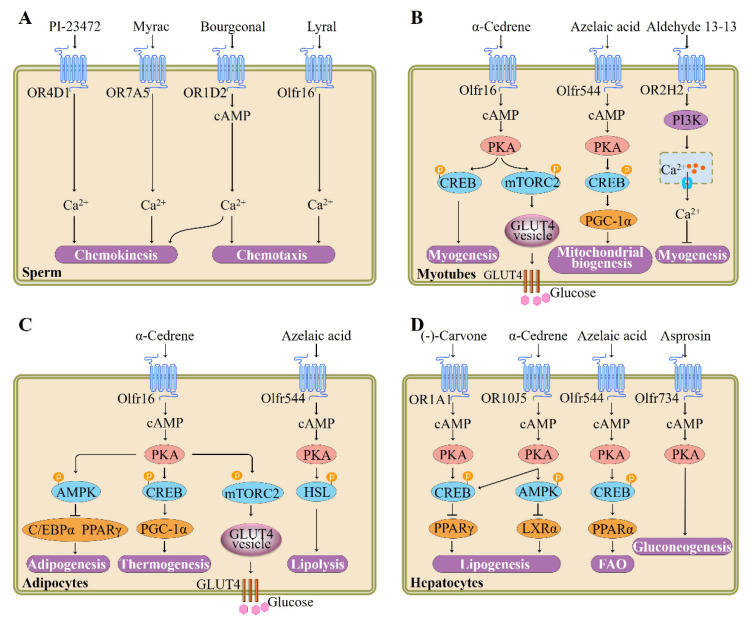
Summary of signaling pathways and functions regulated by ectopic ORs in sperm, myotubes, adipocytes, and hepatocytes. (A) Activation of OR4D1, OR7A5, OR1D2, or olfr16 modulates sperm chemotaxis or chemokinesis, adapted from [5,42,43], published by AAAS, 2003; American Society for Biochemistry and Molecular Biology, 2011; The Company of Biologists, 2004. (B) Stimulation of olfr16 by α-cedrene in myotubes promotes myogenesis and increases GLUT4-mediated glucose uptake. In addition, olfr544 and OR2H2 activation induces mitochondrial biogenesis and inhibits myogenesis, respectively, adapted from [36,44,45], published by Wiley, 2018; MDPI, 2014 and Elsevier, 2018. (C) Regulation of adipogenesis, thermogenesis, GLUT4-mediated glucose uptake, or lipolysis by olfr16 or olfr544, adapted from [18,35], published by MDPI, 2018 and MDPI, 2017. (D) ORs (OR1A1, OR10J5, olfr544, or olfr734) can modulate hepatic lipogenesis, fatty acid oxidation (FAO), or gluconeogenesis, adapted from [12,46,47], published by Elsevier, 2015; Nature Portfolio, 2017 and Cell Press, 2019. AMPK, adenosine monophosphate (AMP)-activated protein kinase; cAMP, cyclic adenosine monophosphate; CREB, cAMP-responsive element-binding protein; C/EBPα, CCAAT/enhancer-binding proteins α; HSL, hormone-sensitive lipase; GLUT4, glucose transporter type 4; mTORC2, mammalian target of rapamycin complex 2; PKA, protein kinase A; PPAR, peroxisome proliferator-activated receptor; PI3K, phosphoinositide 3-kinase; PGC-1α, peroxisome proliferator-activated receptor γ coactivator 1-alpha.
Figure 3
Figure 3
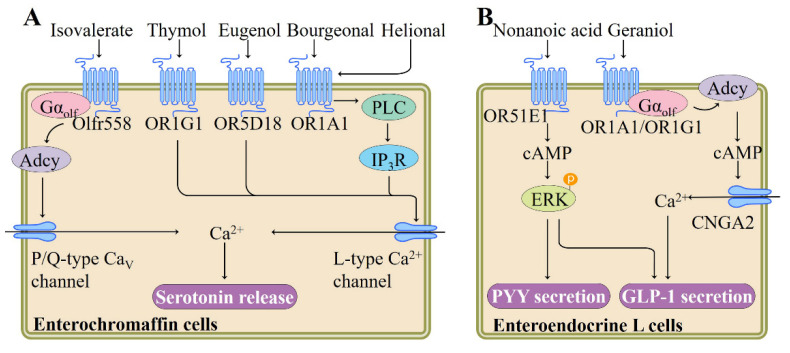
Summary of signaling pathways and functions regulated by ectopic ORs in enteroendocrine cells. (A) Activation of olfr558, OR1G1, OR5D18, or OR1A1 enhances the release of serotonin from enterochromaffin cells, adapted from [62,63], published by LIPPINCOTT WILLIAMS & WILKINS, 2013 and Cell Press, 2007. (B) Regulation of GLP-1 and PYY secretion from enteroendocrine L cells through OR51E1, OR1A1, or OR1G1, adapted from [64], published by Philadelphia, PA: W.B. Saunders, 2017. Adcy, adenylyl cyclase; CNGA2, cyclic nucleotide gated channel subunit alpha 2; cAMP, cyclic adenosine monophosphate; ERK, extracellular signal-regulated kinase; IP3R, inositol-1,4,5-trisphosphate (IP3) receptor; Gαolf, olfactory G protein alpha subunit; GLP-1, glucagon-like peptide 1; PLC, Gq-phospholipase C; PYY, peptide YY.
Figure 4
Figure 4
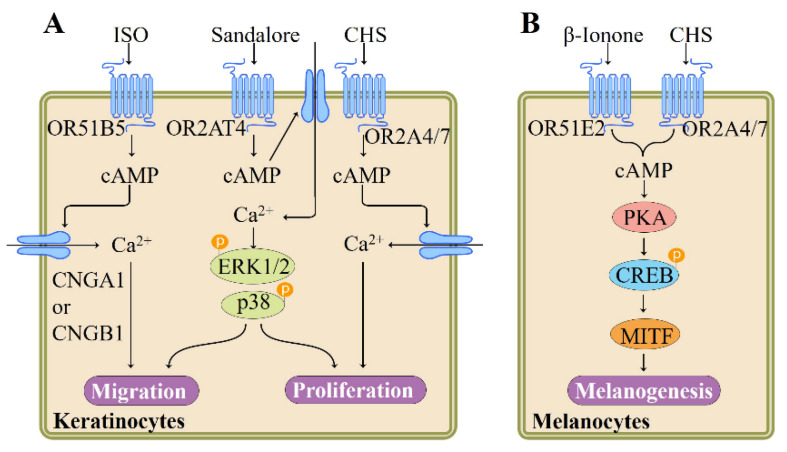
Summary of signaling pathways and functions regulated by ectopic ORs in skin cells, adapted from [74], published by Elsevier, 2018. (A) Activation of OR51B5, OR2AT4, or OR2A4/7 increases the migration and proliferation of keratinocytes, adapted from [75,76], published by NATURE PUBLISHING CO., 2019 and Wiley, 2017. (B) Both OR51E2 and OR2A4/7 activation enhances melanogenesis, adapted from [77,78], published by Nature, 2018 and American Society for Biochemistry and Molecular Biology, 2016. cAMP, cyclic adenosine monophosphate; CREB, cAMP-responsive element-binding protein; CNGB1, cyclic nucleotide gated channel subunit beta 1; CNGA1, cyclic nucleotide gated channel subunit alpha 1; ERK1/2, extracellular signal-regulated kinase-1/2; MITF, microphthalmia-associated transcription factor; PKA, protein kinase A; p38, p38 mitogen–activated protein kinases.
Figure 5
Figure 5
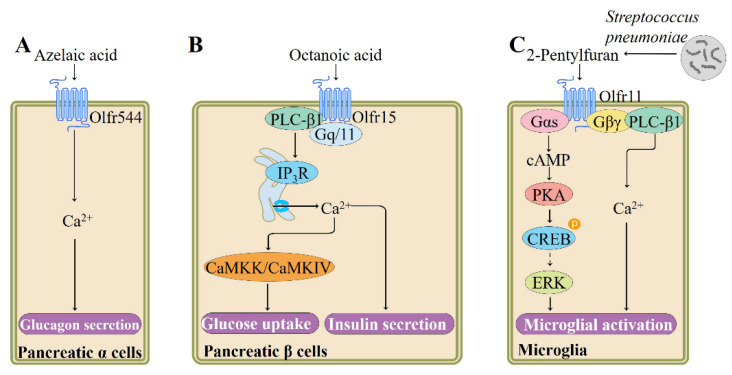
Summary of signaling pathways and functions regulated by ectopic ORs in pancreatic α and β cells and microglia. (A) Activation of olfr544 increases the secretion of glucagon from α cells, adapted from [10], published by Elsevier, 2015. (B) Stimulation of olfr15 enhances insulin secretion from β cells and glucose uptake, adapted from [99], published by Bentham Science Publishers, 2020. (C) Regulation of microglial activation by Streptococcus pneumoniae-secreted metabolite acting through olfr110, adapted from [100], published by Elsevier, 2020. cAMP, cyclic adenosine monophosphate; CaMKIV, Ca2+/calmodulin-dependent protein kinase IV; CaMKK, Ca2+/calmodulin-dependent protein kinase kinase; CREB, cAMP-responsive element-binding protein; ERK, extracellular signal-regulated kinase; IP3R, inositol-1,4,5-trisphosphate (IP3) receptor; PLC, Gq-phospholipase C.
Figure 6
Figure 6
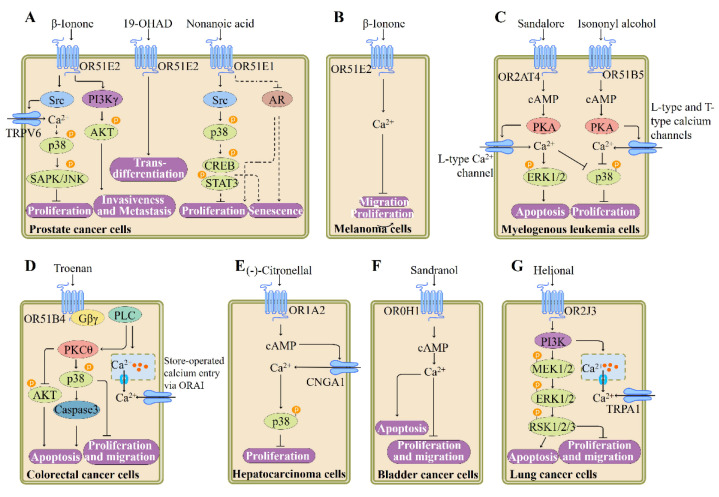
Summary of ectopic OR-induced signaling pathways involved in the regulation of cancer cell function. (A) Upon ligand (β-ionone) binding, OR51E2 reduces the proliferation of prostate cancer cells and promotes invasiveness of prostate cancer cells. In addition, activation of OR51E2 enhances cellular transformation, leading to neuroendocrine trans-differentiation. The OR51E1 activation promotes cellular senescence and inhibits the proliferation of prostate cancer cells, adapted from [110,113], published by Elsevier, 2019 and Elsevier, 2018. (B) Stimulation of OR51E2 suppresses the migration and proliferation of human melanoma cells [114], published by American Society for Biochemistry and Molecular Biology, 2011. (C) Stimulation of OR2AT4 or OR51B5 affects the main physiological processes in human myelogenous leukemia cells, such as proliferation, apoptosis, and differentiation, adapted from [115], published by Wiley, 2017. (D) Activation of OR51B4 results in inhibition of proliferation and migration of colorectal cancer cells and induces apoptosis [116], published by Nature, 2016. (E) OR1A2 stimulation reduces proliferation of hepatocarcinoma cells, adapted from [117], published by Public Library of Science, 2017. (F) OR10H1 is capable of inhibiting bladder cancer cell proliferation and migration and inducing apoptosis when stimulated by its agonist [118], published by Elsevier, 2015. (G) Activation of OR2J3 inhibits cell migration and proliferation and induces apoptosis in lung cancer cells [119], published by Frontiers Media S.A., 2018. AKT, protein kinase B; AR, androgen receptor; cAMP, cyclic adenosine monophosphate; CNGA1, cyclic nucleotide gated channel subunit alpha 1; CREB, cAMP-responsive element-binding protein; ERK1/2, extracellular signal-regulated kinase-1/2; MEK, mitogen-activated protein kinase kinase; ORAI, Orai calcium release-activated calcium modulator 1; PKA, protein kinase A; p38, p38 mitogen–activated protein kinases; PI3K, phosphoinositide 3-kinase; RSK, ribosomal S6 kinase; SAPK/JNK, stress-activated protein kinase/c-Jun NH2-terminal kinase; STAT3, signal transducer and activator of transcription 3; Src, sarcoma tyrosine kinase; TRPV6, transient receptor potential vanilloid type 6; TRPA1, transient receptor potential ion channel subfamily A, member 1.

References

    1. Zozulya S., Echeverri F., Nguyen T. The human olfactory receptor repertoire. Genome Biol. 2001;2:research0018.1. doi: 10.1186/gb-2001-2-6-research0018. - DOI - PMC - PubMed
    1. Zhang X., Firestein S. The olfactory receptor gene superfamily of the mouse. Nat. Neurosci. 2002;5:124–133. doi: 10.1038/nn800. - DOI - PubMed
    1. Buck L., Axel R. A novel multigene family may encode odorant receptors: A molecular basis for odor recognition. Cell. 1991;65:175–187. doi: 10.1016/0092-8674(91)90418-X. - DOI - PubMed
    1. Kaupp U.B. Olfactory signalling in vertebrates and insects: Differences and commonalities. Nat. Rev. Neurosci. 2010;11:188–200. doi: 10.1038/nrn2789. - DOI - PubMed
    1. Spehr M., Gisselmann G., Poplawski A., Riffell J.A., Wetzel C.H., Zimmer R.K., Hatt H. Identification of a testicular odorant receptor mediating human sperm chemotaxis. Science. 2003;299:2054–2058. doi: 10.1126/science.1080376. - DOI - PubMed

LinkOut - more resources