


Virucidal Efficacy of Blue LED and Far-UVC Light Disinfection against Feline Infectious Peritonitis Virus as a Model for SARS-CoV-2
- PMID: 34452302
- PMCID: PMC8402852
- DOI: 10.3390/v13081436
Virucidal Efficacy of Blue LED and Far-UVC Light Disinfection against Feline Infectious Peritonitis Virus as a Model for SARS-CoV-2
Abstract
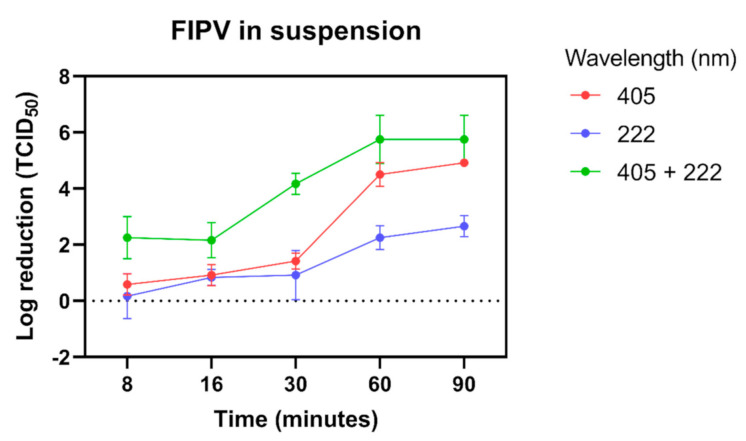
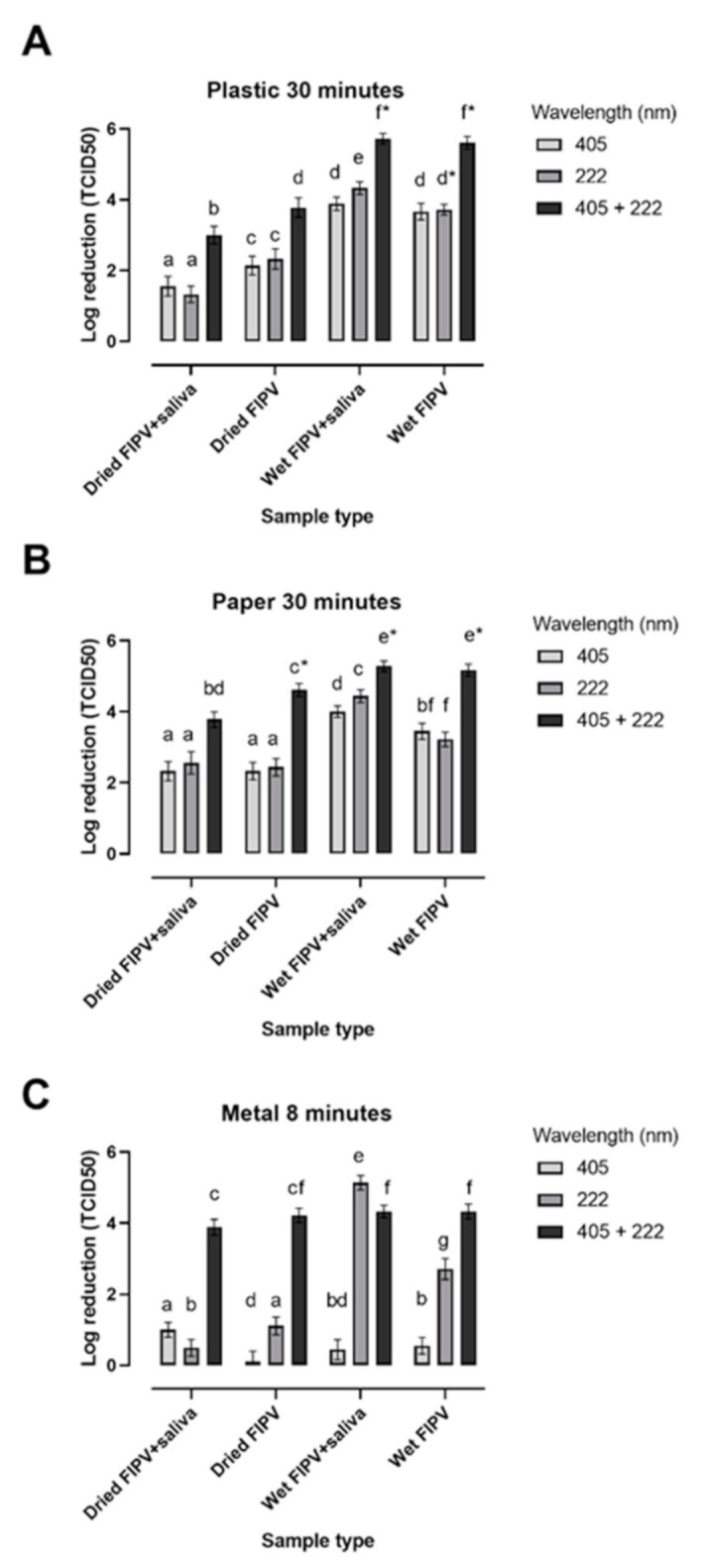
Transmission of the severe acute respiratory syndrome coronavirus 2 (SARS-CoV-2) occurs through respiratory droplets passed directly from person to person or indirectly through fomites, such as common use surfaces or objects. The aim of this study was to determine the virucidal efficacy of blue LED (405 nm) and far-UVC (222 nm) light in comparison to standard UVC (254 nm) irradiation for the inactivation of feline infectious peritonitis virus (FIPV) on different matrices as a model for SARS-CoV-2. Wet or dried FIPV on stainless steel, plastic, or paper discs, in the presence or absence of artificial saliva, were exposed to various wavelengths of light for different time periods (1-90 min). Dual activity of blue LED and far-UVC lights were virucidal for most wet and dried FIPV within 4 to 16 min on all matrices. Individual action of blue LED and far-UVC lights were virucidal for wet FIPV but required longer irradiation times (8-90 min) to reach a 4-log reduction. In comparison, LED (265 nm) and germicidal UVC (254 nm) were virucidal on almost all matrices for both wet and dried FIPV within 1 min exposure. UVC was more effective for the disinfection of surfaces as compared to blue LED and far-UVC individually or together. However, dual action of blue LED and far-UVC was virucidal. This combination of lights could be used as a safer alternative to traditional UVC.
Keywords: 405 nm blue light; coronavirus; far-UVC; feline infectious peritonitis virus; light disinfection; pandemic; ultraviolet light; viral inactivation.
Conflict of interest statement
The authors declare no conflict of interest. The funders had no role in the design of the study; in the collection, analyses, or interpretation of data; in the writing of the manuscript; or in the decision to publish the results.
Figures
References
-
- World Health Organization Origins of SARS-CoV-2. [(accessed on 16 June 2021)]; Available online: https://apps.who.int/iris/bitstream/handle/10665/332197/WHO-2019-nCoV-FA....
-
- World Health Organization Worldometer COVID-19 Coronavirus Pandemic. [(accessed on 28 May 2021)]; Available online: https://www.worldometers.info/coronavirus/
-
- Gorbalenya A.E., Baker S.C., Baric R.S., de Groot R.J., Drosten C., Gulyaeva A.A., Haagmans B.L., Lauber C., Leontovich A.M., Neuman B.W., et al. The species Severe acute respiratory syndrome-related coronavirus: Classifying 2019-nCoV and naming it SARS-CoV-2. Nat. Microbiol. 2020;5:536–544. - PMC - PubMed
Publication types
MeSH terms
Grants and funding
LinkOut - more resources
Full Text Sources
Medical
Miscellaneous
