. 2021 Aug 4;13(8):1542.
doi: 10.3390/v13081542.

Proposed Update to the Taxonomy of Pestiviruses: Eight Additional Species within the Genus Pestivirus, Family Flaviviridae

Affiliations

Proposed Update to the Taxonomy of Pestiviruses: Eight Additional Species within the Genus Pestivirus, Family Flaviviridae

Alexander Postel et al. Viruses. .

Abstract

Pestiviruses are plus-stranded RNA viruses belonging to the family Flaviviridae. They comprise several important pathogens like classical swine fever virus and bovine viral diarrhea virus that induce economically important animal diseases. In 2017, the last update of pestivirus taxonomy resulted in demarcation of 11 species designated Pestivirus A through Pestivirus K. Since then, multiple new pestiviruses have been reported including pathogens associated with disease in pigs or small ruminants. In addition, pestivirus sequences have been found during metagenomics analysis of different non-ungulate hosts (bats, rodents, whale, and pangolin), but the consequences of this pestivirus diversity for animal health still need to be established. To provide a systematic classification of the newly discovered viruses, we analyzed the genetic relationship based on complete coding sequences (cds) and deduced polyprotein sequences and calculated pairwise distances that allow species demarcation. In addition, phylogenetic analysis was performed based on a highly conserved region within the non-structural protein NS5B. Taking into account the genetic relationships observed together with available information about antigenic properties, host origin, and characteristics of disease, we propose to expand the number of pestivirus species to 19 by adding eight additional species designated Pestivirus L through Pestivirus S.

Keywords: Flaviviridae; genetic distances; pestivirus; phylogenetic analysis; species; taxonomy.


Conflict of interest statement

The authors declare no conflict of interest.

Figures
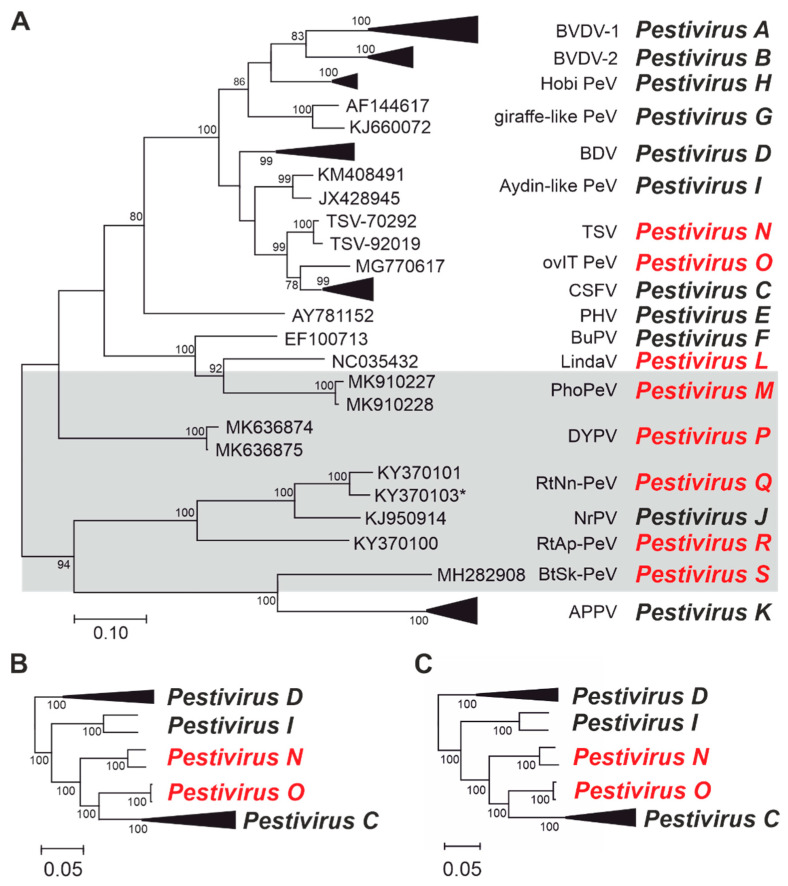
Figure 1
Figure 1
Phylogenetic characterization of known pestiviruses. (A) Construction of the Maximum likelihood tree was based on the conserved partial NS5B peptide sequences corresponding to positions 3312–3837 in the polyprotein of BVDV-1 (Pestivirus A) reference strain SD-1. With one exception (KY370103, indicated by asterisk), the sequences were derived from complete coding sequences. Core data set was used as established earlier and modified as described in Materials and methods [26]. Given are GenBank accession numbers and abbreviations of virus names as listed in Table 1 and Table 3. The established (Pestivirus A through Pestivirus K; black) and newly proposed (Pestivirus L through Pestivirus S; red) pestivirus species are indicated next to the tree. Pestivirus sequences identified in non-ungulate hosts are highlighted (grey shaded box). For clarity, the clades for viruses in the species Pestivirus A, Pestivirus B, Pestivirus C, Pestivirus D, Pestivirus H, and Pestivirus K are collapsed. For statistical analysis, 1000 bootstrap repetitions were performed. Only bootstrap values >70% are shown. A subset of pestivirus species closely related to TSV (Pestivirus N) and ovIT PeV (Pestivirus O) was analyzed separately by Maximum likelihood analyses for complete coding sequences (B) and polyprotein sequences (C) to compare the topologies of the trees.

References

    1. Simmonds P., Becher P., Bukh J., Gould E.A., Meyers G., Monath T., Muerhoff S., Pletnev A., Rico-Hesse R., Smith D.B., et al. ICTV Virus Taxonomy Profile: Flaviviridae. J. Gen. Virol. 2017;98:2–3. doi: 10.1099/jgv.0.000672. - DOI - PMC - PubMed
    1. Houe H. Economic impact of BVDV infection in dairies. Biologicals. 2003;31:137–143. doi: 10.1016/S1045-1056(03)00030-7. - DOI - PubMed
    1. Moennig V., Becher P. Pestivirus control programs: How far have we come and where are we going? Anim. Health Res. Rev. 2015;16:83–87. doi: 10.1017/S1466252315000092. - DOI - PubMed
    1. Becher P., König M., Paton D.J., Thiel H.J. Further characterization of Border disease virus isolates: Evidence for the presence of more than three species within the genus Pestivirus. Virology. 1995;209:200–206. doi: 10.1006/viro.1995.1243. - DOI - PubMed
    1. Becher P., Orlich M., Shannon A.D., Horner G., Konig M., Thiel H.J. Phylogenetic analysis of pestiviruses from domestic and wild ruminants. J. Gen. Virol. 1997;78:1357–1366. doi: 10.1099/0022-1317-78-6-1357. - DOI - PubMed

Publication types

LinkOut - more resources
