


Hepatitis C Virus Vaccine Research: Time to Put Up or Shut Up
- PMID: 34452460
- PMCID: PMC8402855
- DOI: 10.3390/v13081596
Hepatitis C Virus Vaccine Research: Time to Put Up or Shut Up
Abstract
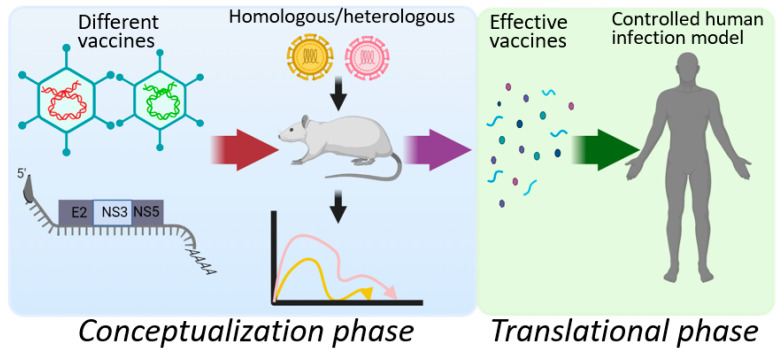
Unless urgently needed to prevent a pandemic, the development of a viral vaccine should follow a rigorous scientific approach. Each vaccine candidate should be designed considering the in-depth knowledge of protective immunity, followed by preclinical studies to assess immunogenicity and safety, and lastly, the evaluation of selected vaccines in human clinical trials. The recently concluded first phase II clinical trial of a human hepatitis C virus (HCV) vaccine followed this approach. Still, despite promising preclinical results, it failed to protect against chronic infection, raising grave concerns about our understanding of protective immunity. This setback, combined with the lack of HCV animal models and availability of new highly effective antivirals, has fueled ongoing discussions of using a controlled human infection model (CHIM) to test new HCV vaccine candidates. Before taking on such an approach, however, we must carefully weigh all the ethical and health consequences of human infection in the absence of a complete understanding of HCV immunity and pathogenesis. We know that there are significant gaps in our knowledge of adaptive immunity necessary to prevent chronic HCV infection. This review discusses our current understanding of HCV immunity and the critical gaps that should be filled before embarking upon new HCV vaccine trials. We discuss the importance of T cells, neutralizing antibodies, and HCV genetic diversity. We address if and how the animal HCV-like viruses can be used for conceptualizing effective HCV vaccines and what we have learned so far from these HCV surrogates. Finally, we propose a logical but narrow path forward for HCV vaccine development.
Keywords: Hepacivirus; animal model; controlled human infection model; hepatitis C virus; vaccine.
Conflict of interest statement
The authors declare no conflict of interest.
Figures
References
-
- WHO . Global Hepatitis Report 2017. World Health Organization; Geneva, Switzerland: 2017.
-
- Zibbell J.E., Asher A.K., Patel R.C., Kupronis B., Iqbal K., Ward J.W., Holtzman D. Increases in Acute Hepatitis C Virus Infection Related to a Growing Opioid Epidemic and Associated Injection Drug Use, United States, 2004 to 2014. Am. J. Public Health. 2018;108:175–181. doi: 10.2105/AJPH.2017.304132. - DOI - PMC - PubMed
Publication types
MeSH terms
Substances
Grants and funding
LinkOut - more resources
Full Text Sources
Medical
