


International initiative for a curated SDHB variant database improving the diagnosis of hereditary paraganglioma and pheochromocytoma
- PMID: 34452955
- PMCID: PMC8882202
- DOI: 10.1136/jmedgenet-2020-107652
International initiative for a curated SDHB variant database improving the diagnosis of hereditary paraganglioma and pheochromocytoma
Abstract
Background: SDHB is one of the major genes predisposing to paraganglioma/pheochromocytoma (PPGL). Identifying pathogenic SDHB variants in patients with PPGL is essential to the management of patients and relatives due to the increased risk of recurrences, metastases and the emergence of non-PPGL tumours. In this context, the 'NGS and PPGL (NGSnPPGL) Study Group' initiated an international effort to collect, annotate and classify SDHB variants and to provide an accurate, expert-curated and freely available SDHB variant database.
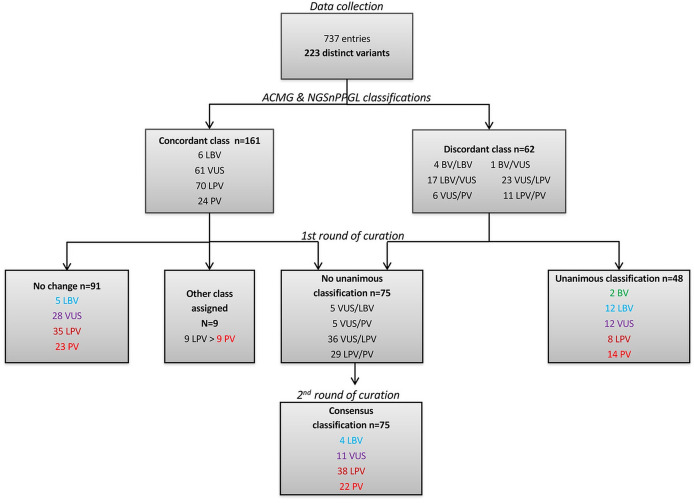
Methods: A total of 223 distinct SDHB variants from 737 patients were collected worldwide. Using multiple criteria, each variant was first classified according to a 5-tier grouping based on American College of Medical Genetics and NGSnPPGL standardised recommendations and was then manually reviewed by a panel of experts in the field.
Results: This multistep process resulted in 23 benign/likely benign, 149 pathogenic/likely pathogenic variants and 51 variants of unknown significance (VUS). Expert curation reduced by half the number of variants initially classified as VUS. Variant classifications are publicly accessible via the Leiden Open Variation Database system (https://databases.lovd.nl/shared/genes/SDHB).
Conclusion: This international initiative by a panel of experts allowed us to establish a consensus classification for 223 SDHB variants that should be used as a routine tool by geneticists in charge of PPGL laboratory diagnosis. This accurate classification of SDHB genetic variants will help to clarify the diagnosis of hereditary PPGL and to improve the clinical care of patients and relatives with PPGL.
Keywords: adrenal gland diseases; databases; genetic; genetic testing; genetic variation; human genetics.
© Author(s) (or their employer(s)) 2022. Re-use permitted under CC BY. Published by BMJ.
Conflict of interest statement
Competing interests: None declared.
Figures
References
-
- Astuti D, Latif F, Dallol A, Dahia PL, Douglas F, George E, Sköldberg F, Husebye ES, Eng C, Maher ER. Gene mutations in the succinate dehydrogenase subunit SDHB cause susceptibility to familial pheochromocytoma and to familial paraganglioma. Am J Hum Genet 2001;69:49–54. 10.1086/321282 - DOI - PMC - PubMed
-
- NGS in PPGL (NGSnPPGL) Study Group, Toledo RA, Burnichon N, Cascon A, Benn DE, Bayley J-P, Welander J, Tops CM, Firth H, Dwight T, Ercolino T, Mannelli M, Opocher G, Clifton-Bligh R, Gimm O, Maher ER, Robledo M, Gimenez-Roqueplo A-P, Dahia PLM. Consensus statement on next-generation-sequencing-based diagnostic testing of hereditary phaeochromocytomas and paragangliomas. Nat Rev Endocrinol 2017;13:233–47. 10.1038/nrendo.2016.185 - DOI - PubMed
-
- Lenders JWM, Kerstens MN, Amar L, Prejbisz A, Robledo M, Taieb D, Pacak K, Crona J, Zelinka T, Mannelli M, Deutschbein T, Timmers HJLM, Castinetti F, Dralle H, Widimský J, Gimenez-Roqueplo A-P, Eisenhofer G. Genetics, diagnosis, management and future directions of research of phaeochromocytoma and paraganglioma: a position statement and consensus of the Working group on endocrine hypertension of the European Society of hypertension. J Hypertens 2020;38:1443–56. 10.1097/HJH.0000000000002438 - DOI - PMC - PubMed
-
- Ben Aim L, Pigny P, Castro-Vega LJ, Buffet A, Amar L, Bertherat J, Drui D, Guilhem I, Baudin E, Lussey-Lepoutre C, Corsini C, Chabrier G, Briet C, Faivre L, Cardot-Bauters C, Favier J, Gimenez-Roqueplo A-P, Burnichon N. Targeted next-generation sequencing detects rare genetic events in pheochromocytoma and paraganglioma. J Med Genet 2019;56:513–20. 10.1136/jmedgenet-2018-105714 - DOI - PubMed
Publication types
MeSH terms
Substances
Grants and funding
LinkOut - more resources
Full Text Sources
Medical
