


Analysis of Acanthamoeba genotypes from public freshwater sources in Thailand reveals a new genotype, T23 Acanthamoeba bangkokensis sp. nov
- PMID: 34453084
- PMCID: PMC8397737
- DOI: 10.1038/s41598-021-96690-0
Analysis of Acanthamoeba genotypes from public freshwater sources in Thailand reveals a new genotype, T23 Acanthamoeba bangkokensis sp. nov
Abstract
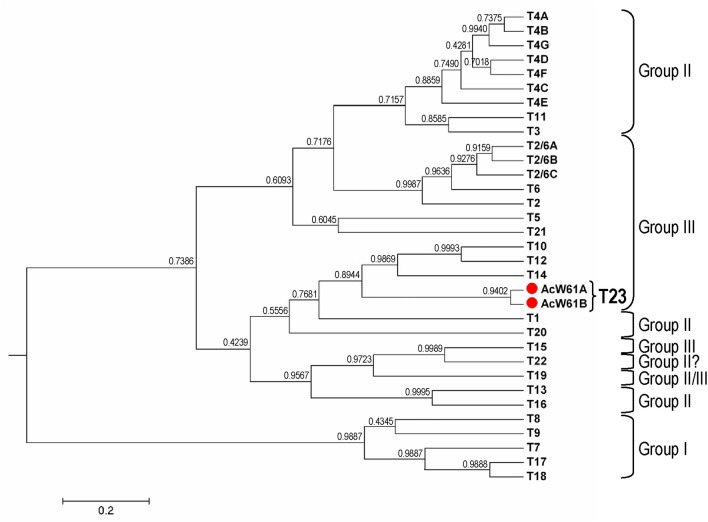
A survey of Acanthamoeba in 100 public freshwater sources in 28 provinces across Thailand has identified 9 genotypes comprising T2/6, T3-T5, T9, T11, T12, T18 and a novel 'T23' among 131 isolates. Sequencing of the near complete 18S rRNA gene of Acanthamoeba of all isolates has shown that the most predominant genotype T4 found in 87 isolates (66.4%) contained 4 subtypes, i.e. T4A, T4B, T4C and T4F, while all isolates assigned to genotype T2/6 belonged to subtype B. Among intron-bearing genotypes, most isolates harbouring genotype T3 contained S516 introns, characterised by 3 distinct variants whilst all genotypes T4A and T5 were intronless. Identical 18S rRNA sequences of Acanthamoeba were identified across regions of the country and four isolates in this study shared the same sequences with those from remote nations, suggesting that some strains have reproductive success in diverse ecological niche. Nucleotide diversity of genotypes T2/6B, T3, T4, T9 and T11 in this study was significantly less than that among global isolates outside Thailand, implying that limited sequence diversity occurred within local populations. A remarkably higher level of nucleotide diversity in genotype T11 than those of other genotypes (0.041 vs. 0.012-0.024) could be due to cryptic subtypes. Recombination breakpoints have been detected within genotypes and subtypes as well as within isolates despite no evidence for sexual and parasexual cycles in the genus Acanthamoeba. Tajima's D, Fu & Li's D* and F* statistics revealed significantly negative deviation from neutrality across genotypes and subtypes, implying purifying selection in this locus. The 18S rRNA gene of the novel genotype 'T23' displayed 7.82% to 28.44% sequence differences in comparison with all known genotypes. Both Bayesian and maximum likelihood phylogenetic trees have placed genotype T23 as sister to the clade comprising genotypes T10, T12 and T14, all of these possess cyst structure belonging to morphological group III. Hence, Acanthamoeba bangkokensis sp. nov. is proposed for this novel genotype. It is likely that more genotypes of Acanthamoeba remain to be discovered while the evolution of the 18S rRNA gene of this pathogenic-free living amoeba seems to be ongoing.
© 2021. The Author(s).
Conflict of interest statement
The authors declare no competing interests.
Figures



References
-
- Castellani A. An amoeba found in cultures of a yeast: preliminary note. J. Trop. Med. Hyg. 1930;33:160.
-
- Volkonsky M. Hartmanella castellanii Douglas, et classification des hartmannelles. Arch. Zool. Exp. Gen. 1931;72:317–339.
Publication types
MeSH terms
Substances
LinkOut - more resources
Full Text Sources
Research Materials
